Natural Light, Sleep, and Your Child’s Brain: What Modern Chronobiology Reveals
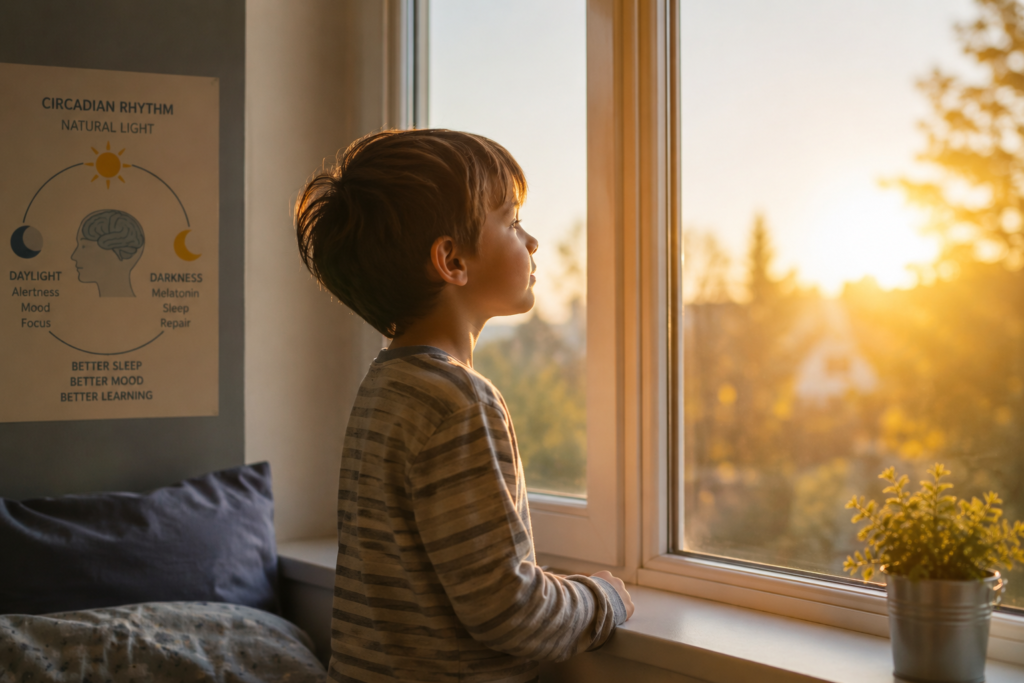
We have known for decades that sleep matters for children. What we have understood far less well — until recently — is the profound role that light plays in regulating sleep, and through sleep, nearly every other aspect of a child’s physical and neurological development.
The science of chronobiology — the study of biological time and circadian rhythms — has produced some of the most important and least communicated findings in modern health research. Understanding even the basics of how light shapes your child’s biological clock may be one of the most valuable things you can do for their long-term wellbeing.
The Circadian System: A Brief Orientation
Every cell in the human body contains a biological clock — a molecular mechanism that runs on an approximately 24-hour cycle and coordinates the timing of thousands of physiological processes: hormone release, cell repair, immune function, digestion, body temperature regulation, and the sleep-wake cycle itself.
These cellular clocks are organized and synchronized by a master clock in the brain — the suprachiasmatic nucleus (SCN), a tiny cluster of about 20,000 neurons in the hypothalamus. The SCN receives direct input from a special class of photoreceptors in the eye called intrinsically photosensitive retinal ganglion cells (ipRGCs).
These cells respond primarily to short-wavelength blue light — the kind that dominates natural daylight — and use it to synchronize the entire circadian system with the external light-dark cycle.
In practical terms, modern children are living in a light environment radically different from the one human biology evolved under — and the consequences are increasingly visible in sleep quality, mood regulation, attention, and learning.
Morning Light: The Anchor of the Circadian System
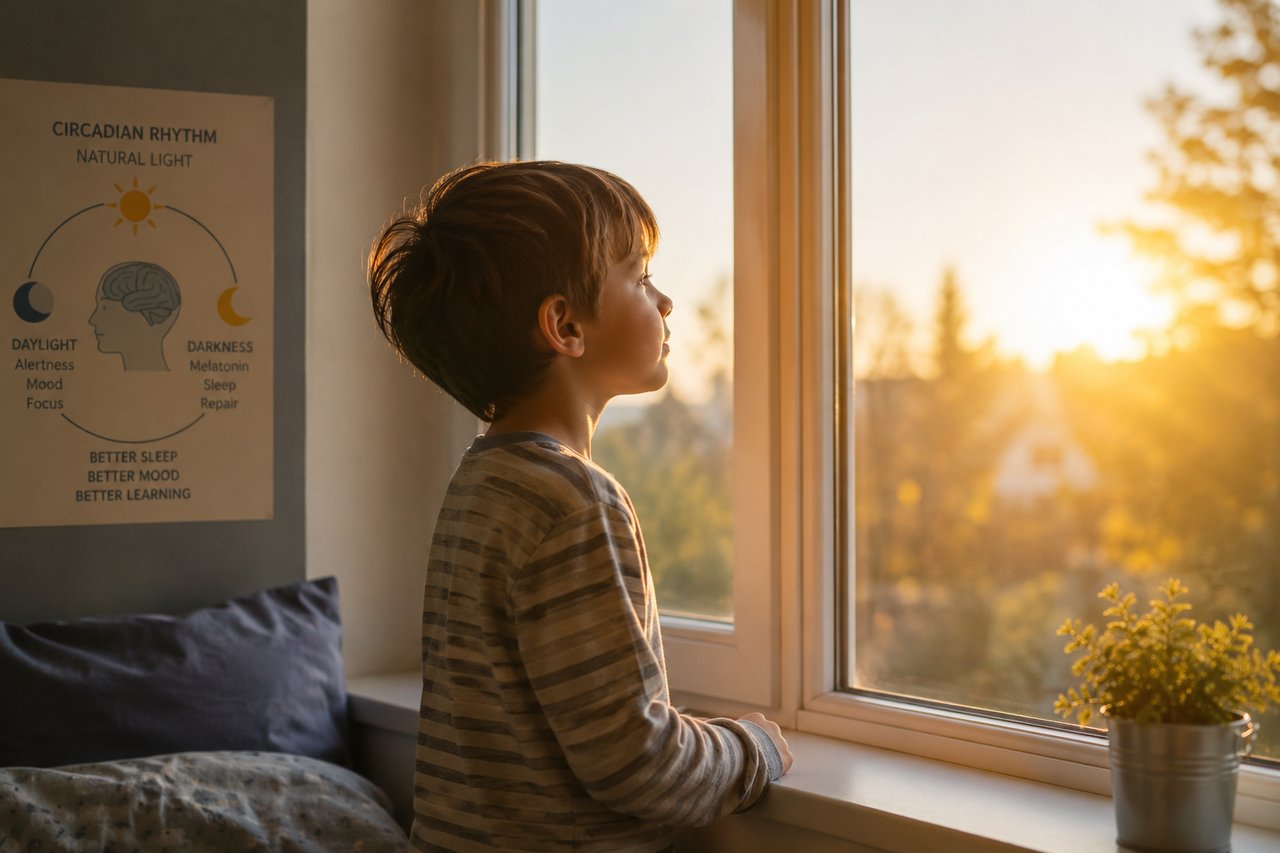
The most critical light signal for circadian regulation is bright light in the first two hours after waking. Morning light exposure — particularly the high-intensity, broad-spectrum light of natural daylight — serves as the primary anchor signal that sets the biological clock for the entire day.
When this morning light signal is strong and consistent, cortisol rises appropriately — not as a stress response, but as a healthy signal that promotes alertness and metabolic activation. Melatonin suppression occurs on schedule, helping the child feel fully awake. And crucially, this suppression sets the timing of melatonin’s rise in the evening — typically 14-16 hours later — which determines when the child will begin to feel genuinely sleepy.
Research by circadian neuroscientist Andrew Huberman at Stanford has helped bring this concept into mainstream awareness — and the underlying science is substantially robust.
For children, the implications are significant. A child who spends their first hour after waking under indoor artificial light (typically 100-500 lux) receives a vastly weaker circadian signal than a child who spends even 5-10 minutes outdoors. Natural daylight, even on an overcast day, typically provides 10,000-100,000 lux — a difference of one to two orders of magnitude.
Evening Light: Where Modern Families Go Wrong
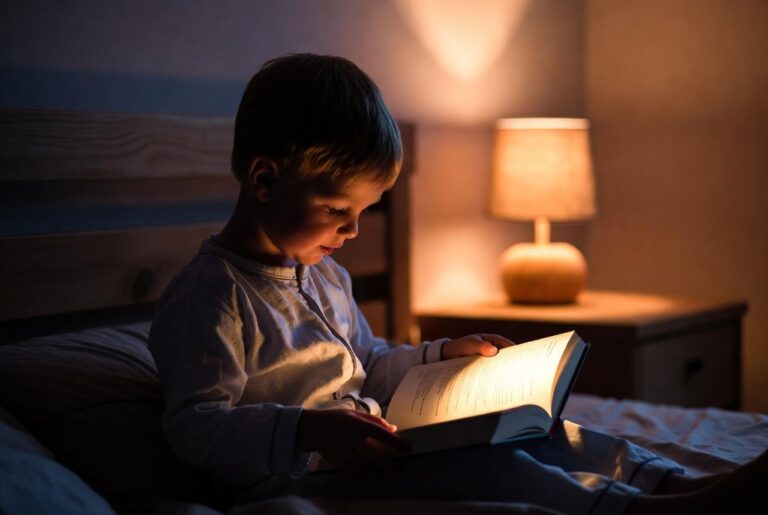
If morning light anchors the circadian clock, evening light dysregulates it. And this is where the modern indoor lifestyle creates some of the most significant and least-discussed problems for children’s sleep and brain development.
The circadian system interprets any bright or blue-enriched light in the evening as a signal that it is still daytime. This delays melatonin secretion and shifts the entire sleep cycle later — a phenomenon known as circadian phase delay. The devices that dominate modern family evenings — smartphones, tablets, laptops, and LED televisions — emit precisely the kind of blue light that the brain’s circadian system is most sensitive to.
Research published in JAMA Pediatrics found that increased evening screen exposure in children is associated with shorter sleep duration, delayed bedtimes, poorer sleep quality, and greater daytime fatigue. But the mechanism is not simply behavioral — it is biological. Evening blue light directly suppresses melatonin production through the retina-SCN pathway. The child’s brain is receiving a clear neurological message: it is still daytime. Stay awake.
The downstream consequences extend far beyond tiredness.
Growth Hormone and Physical Development
Much of children’s growth hormone release occurs during the first phases of deep sleep. When sleep timing is delayed or fragmented, this hormonal rhythm becomes disrupted — with potential consequences for physical growth and tissue repair.
Learning and Memory Consolidation
During sleep — particularly slow-wave sleep — the hippocampus consolidates memories and transfers learning into long-term storage. Chronic sleep disruption impairs this process measurably, affecting concentration, academic performance, and emotional regulation.
Emotional Resilience
Sleep-deprived children show increased amygdala reactivity — meaning the brain becomes more emotionally sensitive and less capable of impulse control. A tired child is not simply sleepy. They are neurologically less resilient.
The Indoor Light Problem
Modern children spend much of their time indoors — in schools, homes, cars, and screen environments. Indoor lighting is typically far dimmer than natural daylight and often biologically insufficient for healthy circadian signaling.
Even without excessive screen use, many children experience what some researchers describe as “circadian poverty”: too little bright natural light during the day, and too much artificial light at night. This combination weakens the biological clock and contributes to sleep dysregulation, mood instability, impaired focus, and potentially long-term metabolic consequences.
Research on children in East Asia, where indoor academic schedules are particularly intensive, has documented unusually high rates of myopia — a finding now linked in part to insufficient outdoor light exposure. It is a reminder that light deprivation has measurable physical consequences that extend well beyond sleep.
Practical Applications for Families
The research is clear. The applications are relatively simple — though not always easy to implement in the context of modern family schedules.
Get outside within the first hour of waking. Even 5-10 minutes of outdoor light exposure provides a powerful circadian anchor signal. Cloudy days still provide 10-50 times more light than indoor environments.
Dim indoor lights 2-3 hours before bed. Use warm-spectrum bulbs in the evening to reduce both intensity and blue-light content as bedtime approaches.
Remove devices from bedrooms. Not only because of behavioral distraction — but because even ambient light from charging screens can affect melatonin production through closed eyelids.
Protect outdoor time during the day. Natural daylight is not simply “healthy.” It is a biological signal that the brain requires to organize sleep, mood, and nearly every major physiological system.
Understand the limits of weekend catch-up. Social jetlag — the mismatch between the circadian clock’s preferred timing and the socially imposed schedule — perpetuates the cycle of circadian dysregulation when sleep timing shifts significantly on weekends.
The Bigger Picture
Light is not just something we see with. It is information the brain uses to organize nearly every major biological system in the body.
Children’s brains evolved under conditions of bright natural mornings, outdoor movement, and dark evenings. Modern indoor life has radically altered that environment in only a few generations. Understanding this gives families something genuinely powerful: the ability to make small, precise, science-based changes that can meaningfully improve sleep, mood, learning, and long-term wellbeing.
The most powerful thing you can do for your child’s sleep tonight may have nothing to do with bedtime routines or melatonin supplements. It may simply be taking them outside — into the morning light — tomorrow.
Enjoying this content? Family Healthy Guide translates modern science into practical insights for families. Download your free 7-Day Family Reset guide →