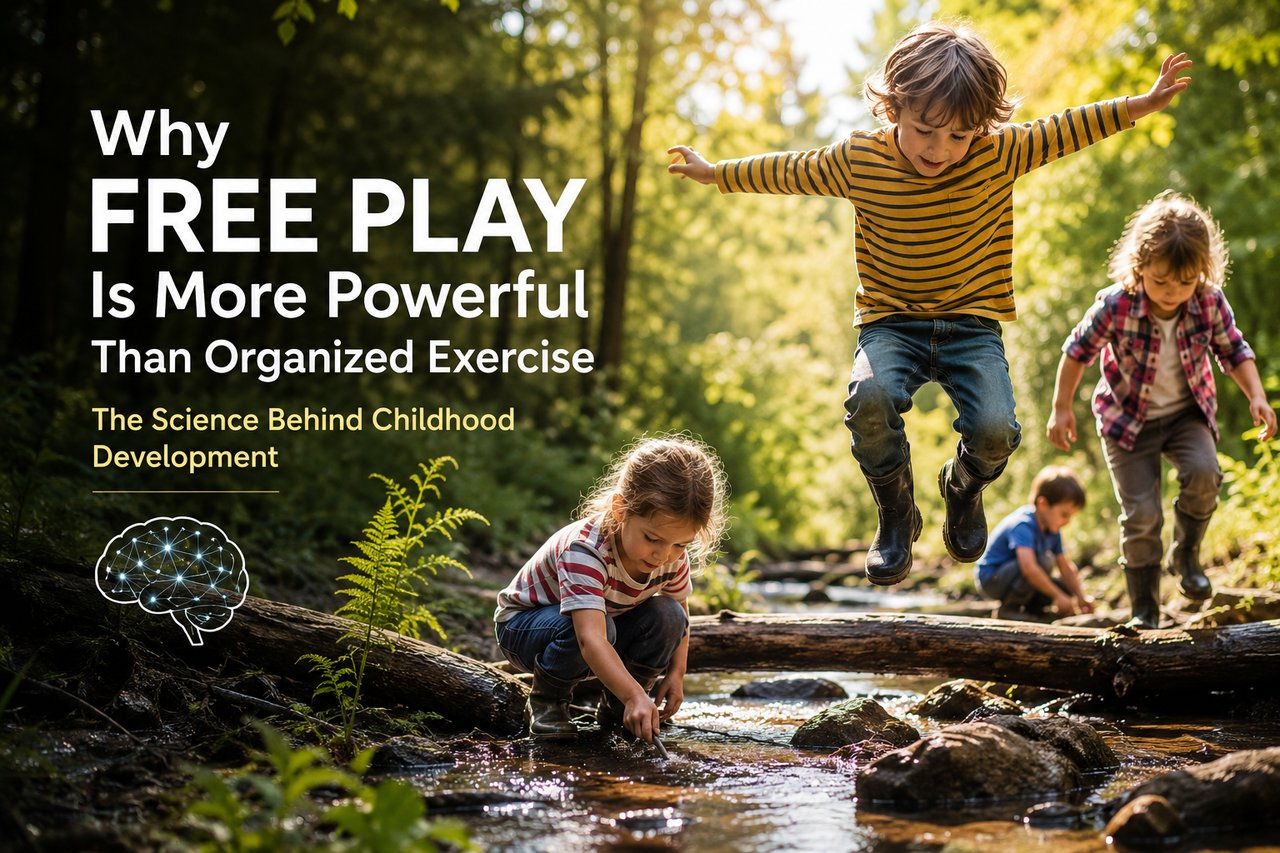
Why Free Play Is More Powerful Than Organized Exercise for Children’s Development
Walk into any pediatrician’s office today and you’ll likely see a poster recommending “60 minutes of physical activity” for children each day. It sounds reasonable. It’s been repeated so many times that most parents accept it without question.But here’s what that recommendation doesn’t tell you: the type of movement matters enormously — and growing evidence suggests that unstructured, child-led free play may be one of the most undervalued drivers of children’s physical, neurological, and emotional development we have.
What Is Free Play — and What It Isn’tFree play is not a sport.
It’s not a dance class, a swim lesson, or a structured gym session. Free play is movement and activity that is self-directed, intrinsically motivated, open-ended, and imaginative.Think of children climbing trees, building forts, chasing each other through a field, inventing games with rocks and sticks, or simply wandering through a forest with no particular destination.This is what children did for most of human history. And this is what modern developmental science is rediscovering as essential.
The Neuroscience of Play
Dr. Stuart Brown, founder of the National Institute for Play, argues that play is not a luxury — it is a biological necessity. His research reveals that play is wired into the mammalian brain as a fundamental developmental mechanism.During free play, the brain activates multiple systems simultaneously. The prefrontal cortex — responsible for decision-making, impulse control, and social judgment — is constantly engaged as children navigate the social dynamics of play. The cerebellum, now understood to be deeply involved in cognitive function and emotional processing, is activated by the complex, unpredictable movements of free play in ways that structured exercise cannot replicate. The default mode network — associated with imagination, creativity, and self-understanding — becomes highly active during open-ended play.In simple terms: during free play, a child’s brain is doing far more complex work than during a soccer practice or a gym class.
What Happens to Children Who Don’t Get Enough Free Play
Peter Gray, a research professor at Boston College and author of Free to Learn, has tracked the dramatic decline in children’s free play since the 1950s alongside equally dramatic rises in childhood anxiety, depression, and a sense of helplessness.Children who lack sufficient free play show reduced ability to self-regulate emotions, lower frustration tolerance, weaker executive function, and higher rates of anxiety. These matter because executive function and emotional self-regulation are among the strongest predictors of academic success, healthy relationships, and lifelong mental health.
The Physical Development Argument
Unstructured outdoor play exposes children to irregular, unpredictable movement patterns: climbing, jumping, balancing, rolling, crawling, hanging, spinning. These varied movement inputs are essential for vestibular system development, proprioception, bone density and joint health, and emerging research suggests they may more effectively stimulate mitochondrial biogenesis than sustained moderate exercise.
The Risk Paradox
Norwegian researcher Ellen Beate Hansen Sandseter has identified six categories of risky play that children are naturally drawn to: heights, speed, tools, near dangerous elements, rough-and-tumble, and playing away from adult supervision.Her research suggests that children who engage in appropriate risky play develop better risk assessment abilities, greater physical confidence, lower rates of phobias and anxiety, and more sophisticated social negotiation skills. The absence of risky play, paradoxically, may make children more vulnerable — not less.
What This Means for Families
This research doesn’t suggest that organized sports or structured activities have no value. They do. But the evidence is clear that they cannot substitute for unstructured free play.Protect unscheduled time. Resist the urge to direct. Embrace boredom. Allow age-appropriate risk. Prioritize outdoor over indoor play.
The Bigger Picture
The shift from free play to organized activity is a relatively recent historical development. But the biological reality is that children’s brains and bodies evolved over hundreds of thousands of years in an environment of rich, varied, child-led play.We cannot replace that with a soccer schedule — no matter how well-designed.
Enjoying this content?
Family Healthy Guide translates modern science into practical insights for families. Download your free 7-Day Family Reset guide →https://familyhealthyguide.com/free-family-guide