Ultra-Processed Foods and Children’s Mental Health: What Parents Should Know
Quick Answer
Research in children and adolescents suggests that higher consumption of ultra-processed foods is associated with several mental health and wellbeing outcomes, including anxiety, depressive symptoms, sleep problems and psychological distress. Almost all of this evidence is observational, so it cannot establish that ultra-processed foods directly cause these problems. The useful takeaway for families is about the overall dietary pattern rather than any single food or meal.
The conversation about children’s nutrition usually focuses on vitamins, calories, and vegetables. A growing body of research is asking a different question: how does a diet built largely on industrial food formulations relate to how children feel, sleep, and concentrate?
What Are Ultra-Processed Foods, Exactly?
The term “junk food” is imprecise. The scientific community has converged on a more useful classification system — the NOVA classification — which defines ultra-processed foods not by their nutritional content alone, but by the degree of industrial processing they undergo.
Ultra-processed foods are formulations made mostly or entirely from substances extracted from foods — oils, fats, sugars, starch, proteins — combined with additives designed to enhance taste, texture, appearance, and shelf life. They are designed to be highly palatable, often combining ingredients and textures in ways that can encourage continued eating.
Common examples include packaged snacks, breakfast cereals with added sugar, chicken nuggets, flavored yogurts, instant noodles, soft drinks, and most fast food items.
What distinguishes them is not simply that they are unhealthy in the traditional sense. It is that researchers study them as a distinct category, defined by processing rather than by nutrient content alone.
The Gut-Brain Axis: A System Most Parents Have Never Heard Of
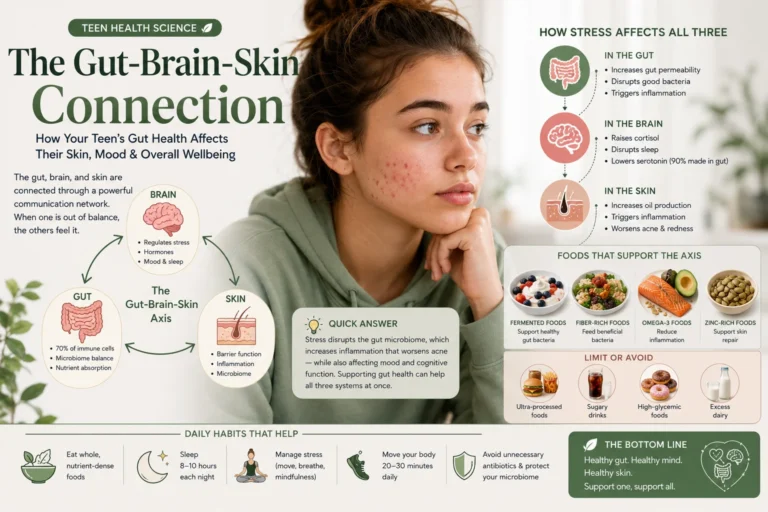
To understand why diet and mental health might be connected at all, it helps to understand a biological system that has only become well-understood in the last decade: the gut-brain axis — the same interconnected network we explored in our guide to the gut-brain-skin connection.
The gut and the brain are in constant, bidirectional communication through the vagus nerve, the enteric nervous system, and a network of hormonal and immune signals. The gut has its own dense network of neurons, and it produces most of the body’s serotonin. It is worth being precise about what that does and does not mean: serotonin produced in the gut does not cross into the brain, so the familiar shorthand that gut serotonin controls mood is not accurate. Gut-brain signalling is real, but it runs through nerve, immune and metabolic routes that researchers are still mapping.
The composition of the gut microbiome — the trillions of bacteria that live in the digestive system — may contribute to this communication, alongside neural, immune and metabolic signals. The microbiome is itself shaped by diet.
Ultra-processed foods are typically low in fiber and high in emulsifiers, preservatives, and other additives. Dietary patterns of this kind may influence the composition of the gut microbiome, and lower microbial diversity has been discussed in connection with inflammation. The evidence here is uneven, though: much of the work on emulsifiers specifically comes from animal models and small human trials, and it does not yet support firm conclusions about children.
In simple terms: diet can influence the gut microbiome and other gut-brain signalling pathways, and those pathways are thought to be involved in processes related to mood, attention and behaviour. That is a plausible route, not a demonstrated chain of cause and effect in children.
What the Research Shows in Children
A 2026 systematic review in Nutrients identified 20 observational studies examining ultra-processed food intake and mental health in children and adolescents aged 3 to 19. Most reported a positive association between higher UPF consumption and mental health problems — including anxiety, depressive symptoms, irritability, sleep disturbances and, in adolescent samples, suicidal ideation. The pattern held across a wide range of countries, though the strength of the association varied by country, by sex, and by the assessment tools used.
An earlier meta-analysis in Nutritional Neuroscience (Malmir and colleagues, 2023) pooled 17 observational studies focused specifically on children and adolescents. It reported significant associations between junk food consumption and psychological distress, including anxiety, sleep disturbance and reduced psychological well-being.
Two things are worth holding onto here. The findings recur across many different countries and populations, which is meaningful. But almost all of this research is cross-sectional — it photographs diet and mental health at the same moment, so it cannot establish which came first. The two longitudinal studies in the 2026 review point in different directions: one found a negative association between junk food intake and wellbeing over two years, while in the other, early associations with later behavioural difficulties faded once family income, child IQ and maternal mental health were accounted for.
Reward, Palatability and Food Preference
Highly palatable foods can activate reward-related brain pathways, including dopamine signalling involved in motivation and food preference.
This is by design. Food scientists use precise combinations of sugar, fat, salt, and texture to maximize what the industry calls “palatability” — the quality that makes a product easy to keep eating.
Children and adolescents are still developing the prefrontal cortex, the brain region involved in impulse control and decision-making, which makes food preferences, habits, and the wider eating environment an important area of research. That same region depends heavily on stable glucose supply, as we discussed in our article on breakfast and children’s brain performance. Research on how repeated exposure to hyper-palatable foods affects reward signalling comes largely from animal models, and it has not been established that the same changes occur in children’s brains. What parents describe — a child who wants the packaged snack and turns down the fruit — is real, but the neuroscience behind it is still being worked out.
A child’s preference for highly palatable packaged foods is not simply a matter of willpower. Reward, habit, availability, and repeated exposure can all shape food preferences.
Inflammation as a Possible Pathway
A second possible pathway deserves attention: inflammation. Diets high in added sugars and certain fats have been linked to raised inflammatory markers, and elevated markers such as C-reactive protein and IL-6 have repeatedly been associated with depressive and anxiety symptoms. Much of that work is in adults, and it describes a hypothesis about how diet might reach the brain rather than a confirmed mechanism in developing children.
This is a reasonable line of investigation rather than a settled finding, and it is one of the main reasons researchers are interested in childhood diet specifically. It is not a basis for concluding that any individual child’s diet has already caused lasting harm.
Key Facts
- A 2026 systematic review in Nutrients identified 20 observational studies examining ultra-processed food intake and mental health in children and adolescents aged 3 to 19.
- Most reported associations between higher intake and poorer mental health outcomes, most consistently anxiety symptoms, depressive symptoms and sleep disturbance.
- Almost all of this evidence is cross-sectional, which means it cannot establish cause and effect. The two longitudinal studies in that review did not agree.
- Ultra-processed foods supply roughly two-thirds of total energy intake among US children and adolescents (Khandpur et al., 2020).
What This Means for Families — Practically
This research is not an argument for perfection. Children will eat ultra-processed foods. So will adults. The goal is not elimination — it is context and proportion.
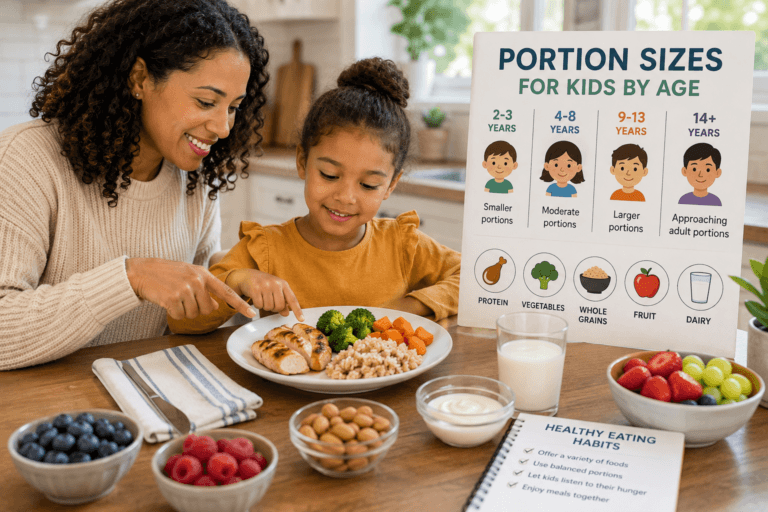
Whole foods as the default, not the exception. Overall dietary patterns are generally more informative than any single meal or food. A child who regularly eats whole foods — vegetables, fruits, whole grains, proteins, healthy fats — with occasional ultra-processed foods represents a different overall dietary pattern from one in which ultra-processed foods are the daily norm.
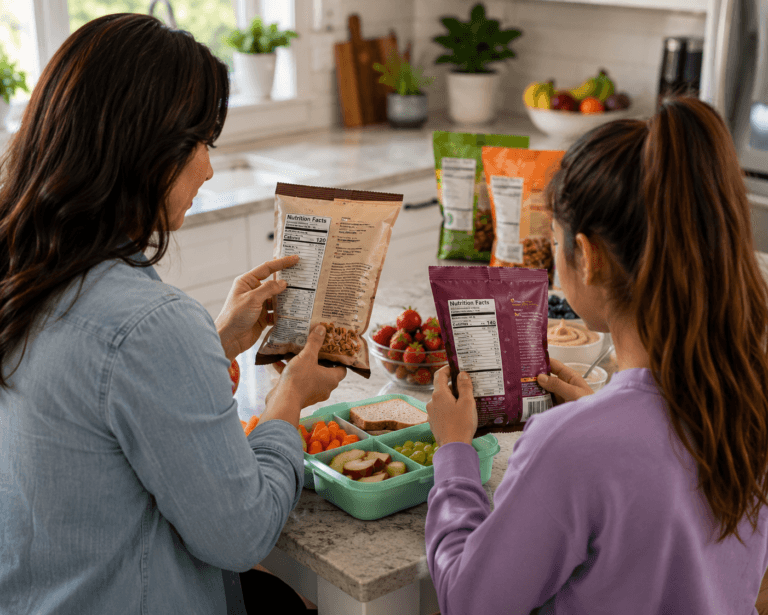
Read ingredient lists, not just nutrition labels. A product can appear nutritionally reasonable on its label while containing multiple emulsifiers, artificial flavors, and preservatives whose effects on the microbiome are still being studied. The ingredient list tells you which NOVA category you are actually buying — a long run of additives, flavourings and emulsifiers alongside few recognisable whole ingredients is the defining feature, and the calorie count will not show it.
Fiber matters. Dietary fiber feeds beneficial gut bacteria and supports microbiome diversity. Fruits, vegetables, legumes, and whole grains are its primary sources. Increasing fiber intake can support digestive health and provide substrates for beneficial gut microbes.
Cooking together matters. Including children in food preparation may help them become more comfortable with a wider variety of foods, and builds a relationship with whole ingredients rather than packaged products.
The Bigger Picture
The rise of ultra-processed foods in children’s diets is one of the most significant nutritional shifts in human history — occurring over just two or three generations.
Modern food environments differ substantially from those in which earlier generations lived, with much greater availability of inexpensive, highly palatable packaged foods.
Understanding this does not require fear or guilt. It requires information — and the recognition that food is not simply fuel. For a developing child, food is one part of a broader environment that supports growth, health, learning, and wellbeing. The goal is not dietary perfection, but making minimally processed foods the everyday default.
Frequently Asked Questions
Do ultra-processed foods cause mental health problems in children?
Not necessarily. Research in children and adolescents has found associations between higher ultra-processed food consumption and several mental-health and wellbeing outcomes. However, most of the available evidence is observational, so it cannot establish that ultra-processed foods directly cause these problems.
What counts as an ultra-processed food?
Ultra-processed foods are industrial formulations made mostly or entirely from substances extracted from foods and combined with additives that enhance taste, texture, appearance, or shelf life. Common examples include packaged snacks, some breakfast cereals, chicken nuggets, flavored yogurts, instant noodles, soft drinks, and many fast-food products.
Does gut health really affect my child’s mood?
The gut and brain communicate through neural, immune, and metabolic pathways, but the relationship is more complex than saying that gut serotonin directly controls mood. Current research does not establish a simple cause-and-effect chain from diet to the microbiome to mood in children.
Do I need to eliminate ultra-processed foods completely?
No. The goal does not need to be complete elimination. A more practical approach is to make minimally processed foods the everyday default while allowing room for occasional ultra-processed foods without fear or guilt about individual meals.
What does the research say about ultra-processed foods and children’s brain health?
Research in children and adolescents suggests associations between higher ultra-processed food consumption and some mental-health and wellbeing outcomes. However, evidence for direct neurological effects in children remains limited, and most studies cannot establish causality. For families, the evidence supports focusing on overall dietary patterns rather than worrying about any single food.
Key Research Referenced
Georgiou, A., Chrysostomou, S., and Kantilafti, M. (2026). Ultra-Processed Foods and Mental Health in Children and Adolescents: Evidence from a Systematic Review. Nutrients, 18(6), 899. doi:10.3390/nu18060899
Malmir, H. et al. (2023). Junk food consumption and psychological distress in children and adolescents: a systematic review and meta-analysis. Nutritional Neuroscience, 26, 807–827. doi:10.1080/1028415X.2022.2094856
Khandpur, N. et al. (2020). Ultra-Processed Food Consumption among the Paediatric Population: An Overview and Call to Action from the European Childhood Obesity Group. Annals of Nutrition and Metabolism, 76, 109–113. doi:10.1159/000507840
This article is educational content summarising published research on diet and children’s mental health. Most of that research is observational and cannot establish cause and effect. It does not replace individual medical advice. If you have concerns about your child’s mood, sleep, behaviour, eating, or growth, speak to your child’s pediatrician.
Want more science-backed family health insights? Family Healthy Guide translates modern neuroscience into practical tools for modern families.