The Best Bedtime Routine for Children — What Neuroscience Actually Recommends
Most bedtime advice focuses on what to do. This article focuses on why — and the neuroscience behind it changes how you think about the entire evening.
The Problem With Most Bedtime Routines
Search “bedtime routine for kids” and you will find thousands of articles recommending variations of the same formula: bath, book, bed. The advice is not wrong. But it is incomplete. What most bedtime guides miss is the biological mechanism behind why routines work — and without understanding that mechanism, parents are left guessing which elements actually matter and which are simply habits passed down without scrutiny. The neuroscience of sleep onset is now well understood. And it points to something more precise than a warm bath and a story.
What the Brain Needs to Fall Asleep
Sleep is not something the brain does when it runs out of energy. It is an active, precisely timed biological process — regulated by two interdependent systems. The first is the circadian system — the internal biological clock that determines when the brain expects sleep to begin, based primarily on light signals received throughout the day. The second is sleep pressure — the homeostatic drive that builds the longer a child stays awake. Adenosine, a molecule that accumulates in the brain during extended wakefulness, is one of the key chemical signals involved in this process, though the precise mechanisms are still being worked out. The longer a child has been awake, the higher the sleep pressure, and the stronger the drive to sleep. For a child to fall asleep easily, both systems need to be aligned: the circadian clock must be signaling that it is nighttime, and sleep pressure must be sufficiently high. A good bedtime routine works — when it works — because it supports both of these systems simultaneously.
Light: The Most Powerful Signal
The single most important variable in evening sleep preparation is light.
The circadian system is exquisitely sensitive to light in the blue-wavelength spectrum — the kind emitted by screens, LED lighting, and most modern indoor lighting. Exposure to this light in the two to three hours before bed directly suppresses melatonin secretion and signals to the brain that it is still daytime.
This is not a metaphor. It is a measurable neurological event.
A child who spends the evening hour before bed on a tablet or in a brightly lit room is receiving a clear biological message: stay awake. No amount of warm milk or lavender oil will fully counteract that signal.
What this means practically: dimming lights and removing screens at least 60 to 90 minutes before bed is not optional — it is the foundation on which everything else rests.
Temperature: The Underestimated Factor
Core body temperature drops naturally in the hours before sleep — a process that is both a signal and a facilitator of sleep onset. A warm bath before bed appears to support this process. Warm water widens the blood vessels near the skin, increasing heat loss through the hands and feet, so core temperature falls more readily afterward. In a systematic review and meta-analysis, Haghayegh and colleagues (2019, Sleep Medicine Reviews) found that bathing in water of roughly 40–42.5 °C, one to two hours before bed, was associated with a shorter time to fall asleep and better self-rated sleep quality. Two limits are worth stating plainly: the authors describe this mechanism as consistent with their findings rather than confirmed, and the trials were conducted in adults — comparable studies in children have not been published. A warm bath is therefore a sensible, low-risk part of an evening routine, though the size of the effect in children is not established. A cool bedroom supports this same mechanism throughout the night.
Consistency: The Signal the Brain Learns
The circadian system is not simply a clock — it is a prediction machine. When a child goes to bed at the same time each night, performs the same sequence of activities, and wakes at the same time each morning, the brain learns to anticipate sleep. Melatonin begins rising earlier. The transition to sleep becomes progressively smoother. Inconsistency — late nights on weekends, irregular schedules, variable wake times — disrupts this prediction. The brain cannot prepare for sleep it does not expect. This is the scientific basis for routine. Not habit for its own sake, but because the brain responds to repeated patterns by optimizing its biological preparation for what comes next.
“A bedtime routine is not just comforting. It is a biological signal the brain learns to trust.”
Does Age Change Anything?
The biological principles are the same at every age. But the application shifts. Toddlers (1–4): Need the longest wind-down — up to 90 minutes. Predictability and physical closeness are neurologically important. Separation anxiety is a stress response, not a behavior problem. School-age children (5–12): Sleep pressure builds more slowly. Consistent wake times matter more than exact bedtimes. Reading independently begins to replace read-alouds — but the calm environment remains essential. Teenagers: The circadian clock shifts biologically later during puberty — this is not laziness, it is chronobiology. Later school start times are associated with better academic performance, mood, and physical health in this age group.
The Role of Reading
Reading aloud to children before bed is one of the most well-supported bedtime practices — and not primarily for the reasons usually given.
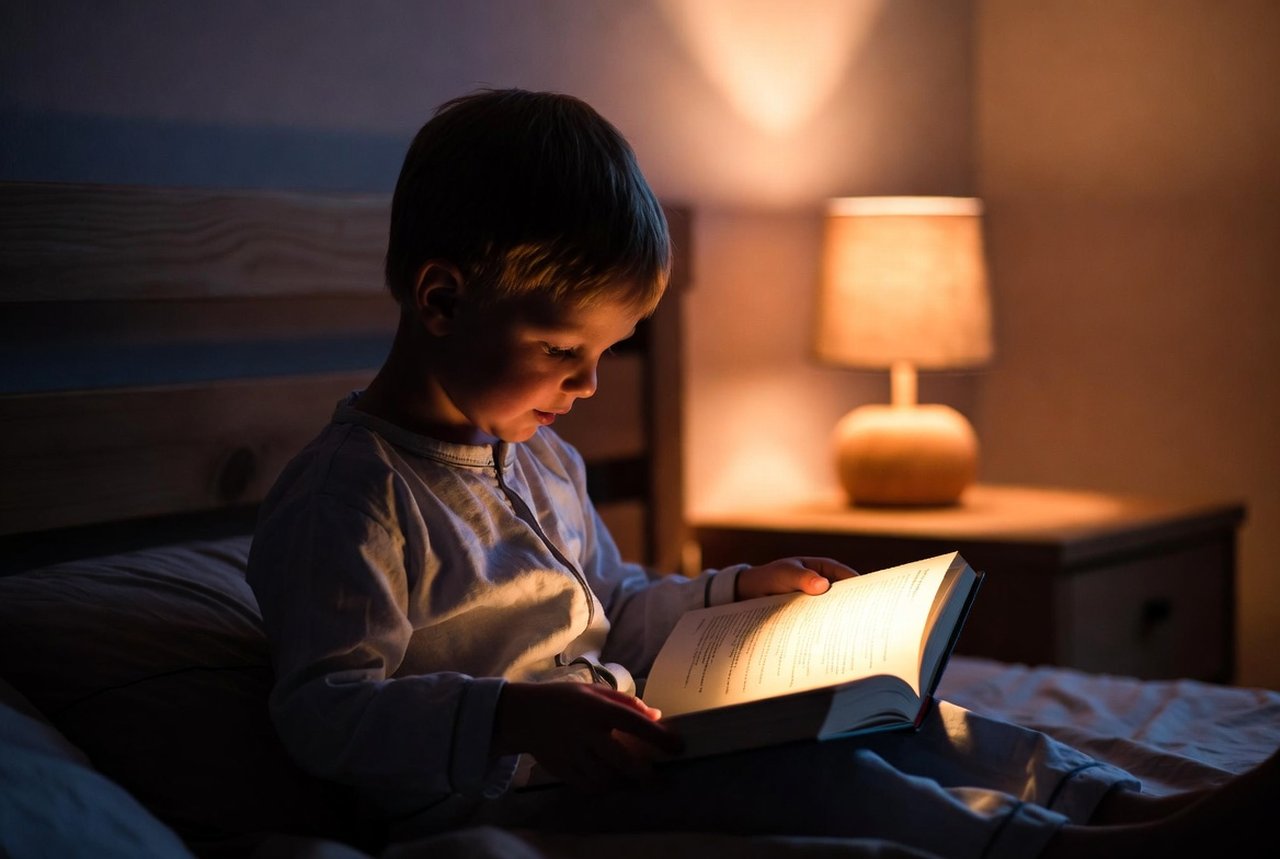
Yes, shared reading builds vocabulary and literacy. But its role in sleep preparation is more immediate: it is a low-stimulation, socially warm activity that occupies the mind without activating the arousal systems that screens trigger.
Reading does not deliver the rapid rewards and novelty of interactive media. It does not generate the emotional urgency of social comparison. It creates a calm, predictable mental state that allows the nervous system to decelerate.
It also strengthens the emotional bond between parent and child — and felt security supports settling in young children, whose stress-response systems are still developing.
What a Neuroscience-Based Bedtime Routine Actually Looks Like
The sequence matters as much as the elements.
90 minutes before bed:
Dim the lights in the home. Switch off screens. Move to warm-spectrum lighting if possible.
60 minutes before bed:
Warm bath or shower. Keep the bedroom cool.
At bedtime:
Calm, low-stimulation activity — reading aloud, quiet conversation, gentle stretching. No screens, no exciting play, no emotionally activating content.
Morning:
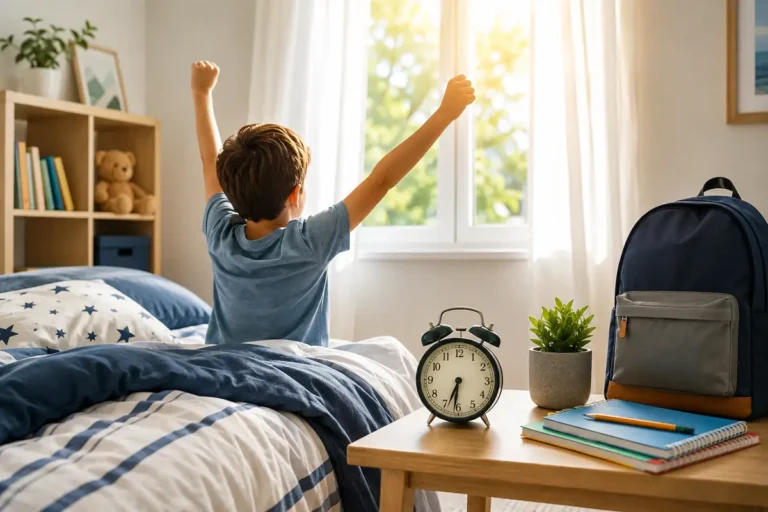
Consistent wake time. Outdoor light soon after waking supports alertness and a steady schedule.
What Parents Often Get Wrong
Starting the routine too late. The biological preparation for sleep begins 90 minutes before the child actually needs to be asleep — not at bedtime itself. Screens as a wind-down tool. A calm show or audiobook played on a bright screen still delivers blue light. The content matters less than the light source. Inconsistency on weekends. Irregular sleep schedules can shift the body’s internal clock and contribute to social jetlag, making Monday mornings genuinely difficult for the child’s biology, not just their mood. Overlooking the morning. The quality of the following night’s sleep is significantly influenced by what happens the morning before. Consistent wake times matter, and morning daylight is a reasonable habit. At the same time, studies in young children show substantial sensitivity to evening light, making the light environment before bed an important part of the sleep routine.
The Bigger Picture
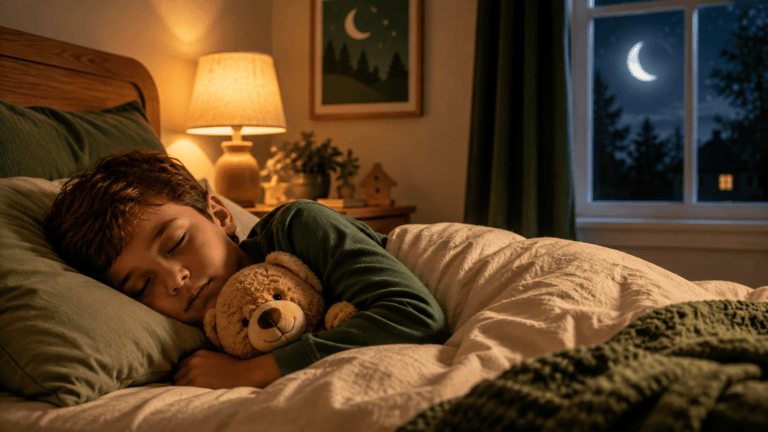
Sleep is not a passive state that children fall into when they are tired enough. It is a biological process that the brain prepares for, anticipates, and executes according to signals it has received throughout the entire day — from the morning light to the evening screen, from the consistency of the schedule to the temperature of the room. A good bedtime routine is not a collection of soothing rituals. It is a set of precise environmental signals that tell the brain: it is safe, it is dark, it is time. When those signals are consistent and well-timed, sleep follows naturally. When they are absent or contradictory, the child is not being difficult. Their biology is simply responding to the information it has been given.
Key Research Referenced
Haghayegh, S., Khoshnevis, S., Smolensky, M.H., Diller, K.R., & Castriotta, R.J. (2019). Before-bedtime passive body heating by warm shower or bath to improve sleep: a systematic review and meta-analysis. Sleep Medicine Reviews, 46, 124–135. doi:10.1016/j.smrv.2019.04.008
Hale, L., Kirschen, G.W., LeBourgeois, M.K., et al. (2018). Youth screen media habits and sleep: sleep-friendly screen behavior recommendations for clinicians, educators, and parents. Child and Adolescent Psychiatric Clinics of North America, 27(2), 229–245. doi:10.1016/j.chc.2017.11.014
Huang, L., Zhu, W., Li, N., Zhang, B., Dai, W., Li, S., & Xu, H. (2024). Functions and mechanisms of adenosine and its receptors in sleep regulation. Sleep Medicine, 115, 210–217. doi:10.1016/j.sleep.2024.02.012
Mindell, J.A., Li, A.M., Sadeh, A., Kwon, R., & Goh, D.Y. (2015). Bedtime routines for young children: a dose-dependent association with sleep outcomes. Sleep, 38(5), 717–722. doi:10.5665/sleep.4662
Owens, J., Adolescent Sleep Working Group, & Committee on Adolescence (2014). School start times for adolescents. Pediatrics, 134(3), 642–649. doi:10.1542/peds.2014-1697
This article is part of our complete Ultimate Guide to Healthy Sleep for Kids, which covers sleep needs by age, sleep hygiene, common sleep problems, and more.
Want more science-backed family health insights?
Family Healthy Guide translates modern neuroscience into practical tools for modern families.