10 Simple Healthy Habits for Kids That Science Actually Supports
We live in an era of complicated parenting advice. Optimize sleep. Limit sugar. Reduce screens. Build emotional resilience. Eat the rainbow. It can feel like a full-time job just keeping up.
But the science of child development points in a simpler direction: a handful of consistent daily habits, practiced without pressure, produce more lasting health outcomes than any single intervention.
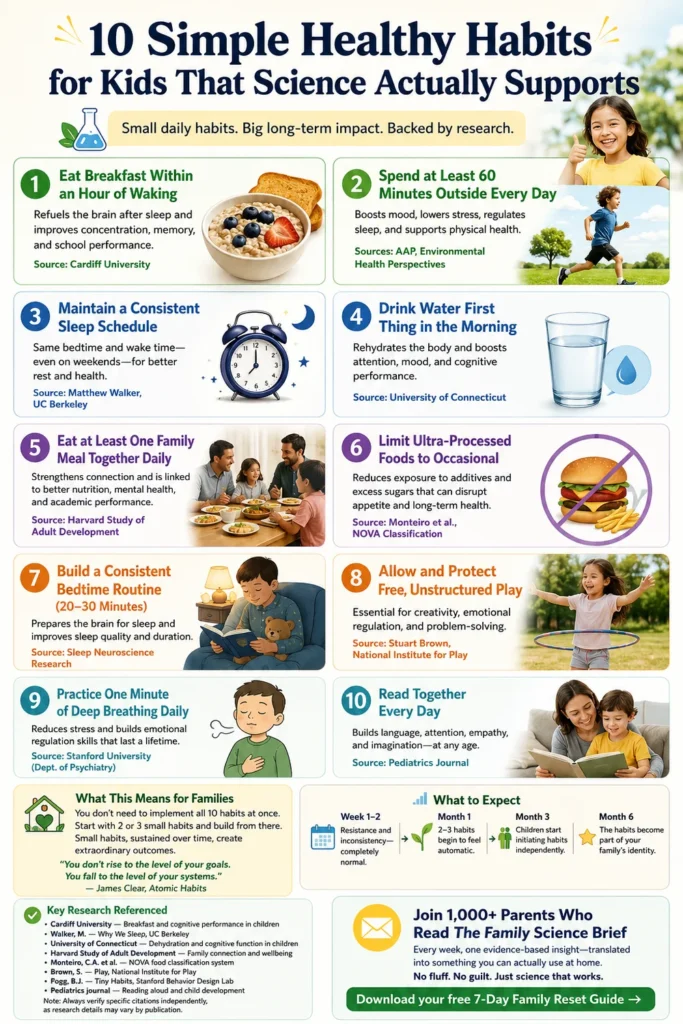
Here are 10 habits — small, practical, and backed by research.
1. Eat a Real Breakfast
The habit:
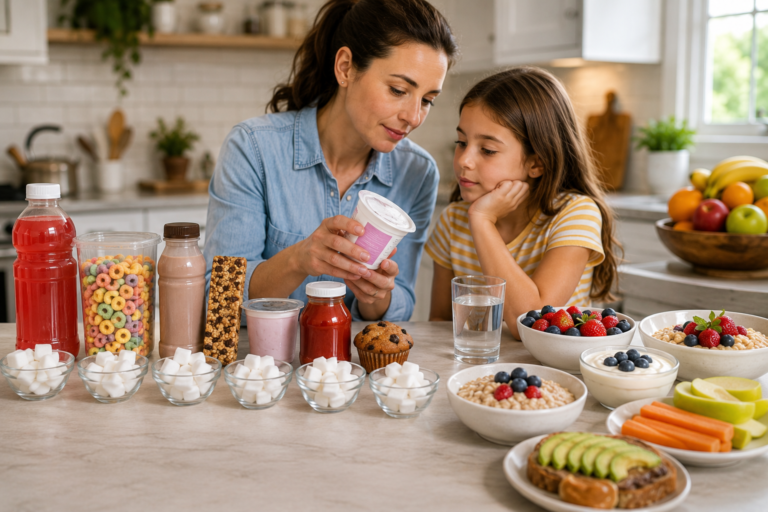
A real breakfast — protein, complex carbs, minimal sugar.Systematic reviews of studies in children and adolescents find that eating breakfast can improve attention and memory compared with going without breakfast, with the clearest effects seen in children who are undernourished. Evidence linking breakfast with school performance is weaker and largely observational. Glucose is the brain’s main fuel, and blood sugar is at its lowest of the day on waking.It doesn’t need to be elaborate: eggs, whole grain toast, yogurt with fruit, or oatmeal all work. The consistency matters more than the perfection.(See our full article on what science says about breakfast and children’s brains.)
2.Spend at Least 60 Minutes Outside Every Day
The habit:
Unstructured outdoor time — not organized sport, just outside.The American Academy of Pediatrics recommends 60 minutes of physical activity daily for children. But beyond movement, outdoor light is far brighter than indoor lighting, and daylight is the main signal the body clock uses to keep time.Spending time in green space can lower cortisol levels, a stress hormone, though this finding has been studied mainly in adults rather than children.(Read more about natural light, sleep, and your child’s brain.)
3. Maintain a Consistent Sleep Schedule — Even on Weekends
The habit:
Same bedtime, same wake time, 7 days a week.
Large differences between weekday and weekend sleep timing have been linked to poorer sleep quality and wellbeing, particularly in teenagers and young adults.
The American Academy of Sleep Medicine recommends 9 to 12 hours per 24 hours for children aged 6 to 12, and 8 to 10 hours for teenagers aged 13 to 18 — on a regular basis, which makes a consistent schedule part of the recommendation rather than an alternative to it.
4.Drink Water First Thing in the Morning
The habit:
One glass of water before anything else.Studies in young adults found that mild dehydration — around 1–2% of body weight — can worsen mood and make attention harder to sustain. These studies induced dehydration through exercise, with or without a diuretic, and did not study children.Make it a ritual: water glass on the nightstand, or first stop in the kitchen before screens or breakfast.
5.Eat at Least One Family Meal Together Daily
The habit:
Sit down together — phones away, conversation on.
Reviews of the research consistently link more frequent family meals with healthier eating and better diet quality. Associations with wellbeing and school outcomes appear too, though less consistently, and trials that tried to increase family meals have had mixed results. One finding is unusually consistent: the benefit for diet tends to fade when the television is on during the meal.
6.Limit Ultra-Processed Foods to Occasional, Not Daily
The habit:
Cook real food most of the time — not all the time.
Ultra-processed foods make up over 60% of the calories US children eat, measured using the NOVA classification. Compared with less processed foods they carry more added sugar and sodium, and less fibre and protein, making their overall nutritional profile different from less processed foods.
The goal isn’t elimination. It’s reduction. Replacing one ultra-processed snack per day with a whole food alternative compounds significantly over months and years.
(Read our full article on how ultra-processed foods affect children’s brains.)
7. Build a Consistent Bedtime Routine
The habit:
The same sequence of calm activities before sleep, every night.
The brain doesn’t switch off on command. It needs a transition — a consistent signal that sleep is coming. In a study of more than 10,000 children aged five and under, families who kept a bedtime routine on more nights of the week reported better sleep: earlier bedtimes, less time to fall asleep, fewer night wakings, and more sleep overall.
A simple routine: dim lights → warm bath or shower → reading → sleep. The specific activities matter less than their consistency and calm tone.
(See our neuroscience-based bedtime routine guide.)
8. Allow — and Protect — Free, Unstructured Play
The habit:
At least 30 minutes of play with no agenda, no screens, no adult direction.Unstructured play supports creativity, emotional regulation, and problem-solving. Free play is not wasted time. It is the work of childhood.(Read why free play is more powerful than organized exercise.)
9. Practice a Few Minutes of Deep Breathing Daily
The habit:
A few minutes of slow, intentional breathing — morning or before bed.This may sound too simple to matter. But in a randomised trial in adults, five minutes of daily breathing exercises over a month improved mood and lowered resting respiratory rate more than an equivalent period of mindfulness meditation. The trial did not measure cortisol, and it did not include children. Start with box breathing: inhale 4 counts, hold 4, exhale 4, hold 4.
10. Read Together Every Day — Even Briefly
The habit:
10–15 minutes of shared reading, any age.
Reading together is not just about literacy. It’s about attention, imagination, and connection — three things screens cannot replicate.
What This Means for Families
You don’t need to implement all 10 habits at once. Starting with two or three small habits and building from there is more manageable than overhauling everything at once.
Pick the two habits that feel most achievable this week. Build from there. Small habits, sustained over time, create extraordinary outcomes.
“You don’t rise to the level of your goals. You fall to the level of your systems.”
— James Clear, Atomic Habits
What to Expect
Week 1–2:
Resistance and inconsistency — completely normal.
Month 1:
2–3 habits begin to feel automatic.
Month 3:
Children start initiating habits independently.
Month 6:
The habits become part of your family’s identity.
Key Research Referenced
Ganio MS, Armstrong LE, Casa DJ, et al. Mild dehydration impairs cognitive performance and mood of men. British Journal of Nutrition. 2011;106:1535–1543.
Armstrong LE, Ganio MS, Casa DJ, et al. Mild dehydration affects mood in healthy young women. Journal of Nutrition. 2012;142:382–388.
Wang L, Martínez Steele E, Du M, et al. Trends in consumption of ultraprocessed foods among US youths aged 2-19 years, 1999-2018. JAMA. 2021;326(6):519–530. doi:10.1001/jama.2021.10238
Balban MY, Neri E, Kogon MM, et al. Brief structured respiration practices enhance mood and reduce physiological arousal. Cell Reports Medicine. 2023;4(1):100895. doi:10.1016/j.xcrm.2022.100895
Paruthi S, Brooks LJ, D’Ambrosio C, et al. Recommended amount of sleep for pediatric populations: a consensus statement of the American Academy of Sleep Medicine. Journal of Clinical Sleep Medicine. 2016;12(6):785–786. doi:10.5664/jcsm.5866
Mindell JA, Li AM, Sadeh A, Kwon R, Goh DYT. Bedtime routines for young children: a dose-dependent association with sleep outcomes. Sleep. 2015;38(5):717–722. doi:10.5665/sleep.4662