Ear Pain in Children: Causes and When to Call
Quick Answer
Ear pain has more than one possible cause, and pulling at the ear does not prove an infection. Middle-ear infections can bring ear pain, fever and temporary trouble hearing, and fluid or pus coming from the ear can be a sign of infection. A pediatrician may need to examine the ear to tell what is going on.
Ear pain can be sharp, or a dull throbbing ache. It may come and go or stay constant, and it is commonly worse at night — which is why an uncomfortable child can seem hardest to settle after bedtime.
An ear infection is one possible cause, but not every child with ear pain has the same problem. Knowing what ear infections are, what tends to come with them, and when a pediatrician should take a closer look will tell you more than the pain by itself.
What Causes Ear Pain in Children?
An ear infection happens when bacteria or viruses infect the middle ear, the small space behind the eardrum. This is known as otitis media.
The middle ear connects to the back of the nose and throat through the eustachian tube. When that tube becomes blocked, usually because of a cold or allergies, fluid can build up in the middle ear — and that fluid creates an environment where bacteria or viruses can grow.
Children are more susceptible than adults for two reasons. Their immune systems are still developing, and the eustachian tube is shorter, narrower and more horizontal than an adult’s, which makes it harder for fluid to drain out of the ear.
What Does an Ear Infection Feel Like?
An ear infection can cause fever and difficulty hearing alongside the pain.
If your child is not hearing well right now, that generally clears up when the infection does, and lasting damage to hearing is generally not expected. But that reassurance is not a reason to put off calling the pediatrician.
Common Myth
“My child is pulling at their ear, so it must be an ear infection.”
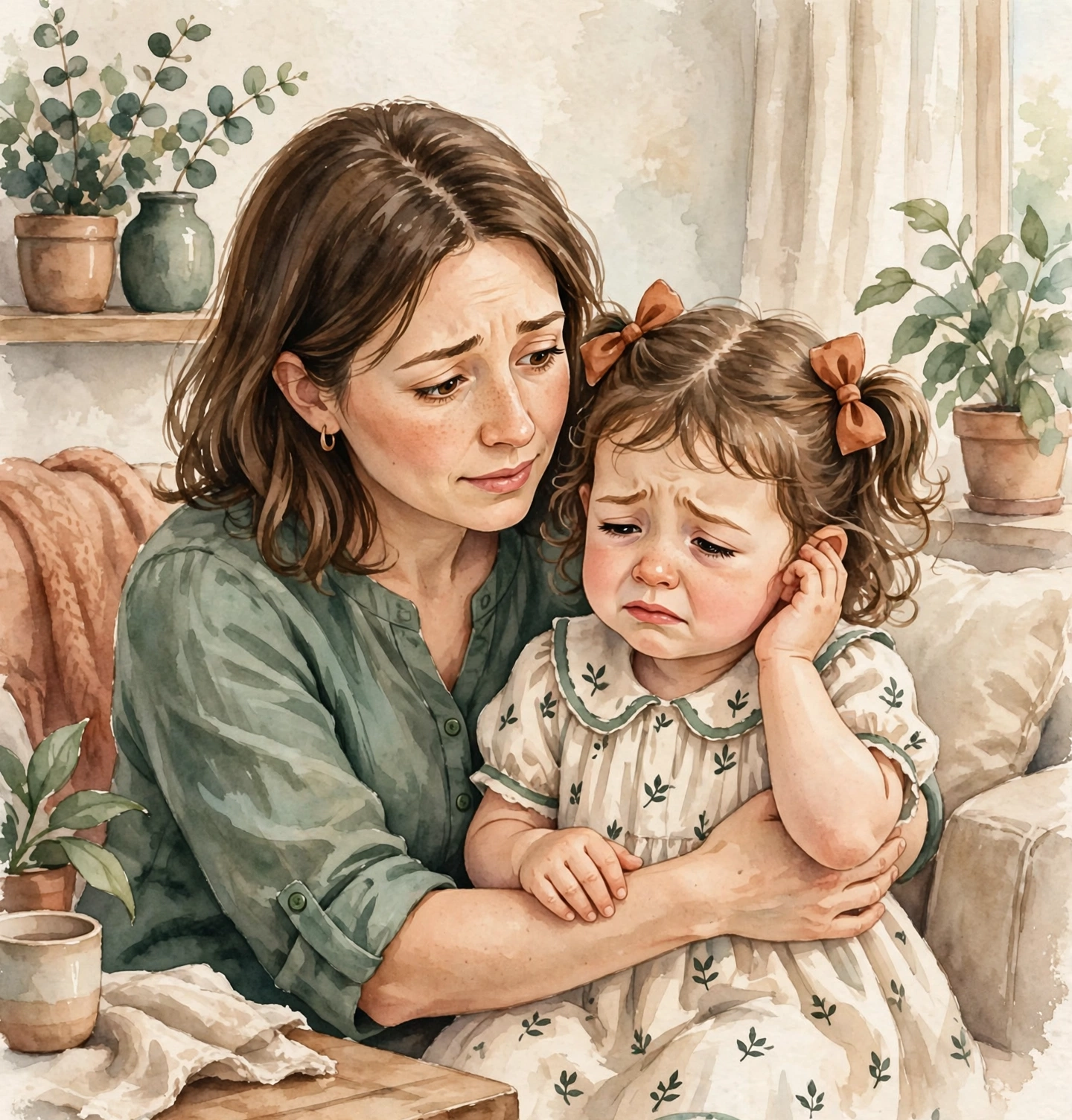
Many babies and small children tug or pull at their ears to self-soothe, or simply to play with them. Ear pulling on its own is not enough to tell you an infection is present. What is worth noticing is the wider picture: is there ear pain, are there other symptoms, and is any fluid or pus coming from the ear?
What About Fluid Coming From the Ear?
Pus or fluid coming out of your child’s ear can be a sign of an infection, and it can happen when an infection has ruptured the eardrum.
If you see it, contact your child’s pediatrician for guidance.
Middle-Ear Infection or Swimmer’s Ear?
Not every ear infection involves the same part of the ear.
A middle-ear infection — otitis media — affects the space behind the eardrum. An infection of the ear canal, often called swimmer’s ear or otitis externa, is a different thing. If the outer ear canal is inflamed while the eardrum looks normal, swimmer’s ear may be the cause.
This is one of the reasons ear pain by itself does not tell you which part of the ear is affected.
Can a Cold Be Followed by an Ear Infection?
Yes — a cold can block the eustachian tube and let fluid build up in the middle ear. AAP symptom-checker information notes that ear infections often begin around the third day of a cold.
If a cough or other respiratory symptoms are part of the picture, see our guide to cough in children. This guide stays with the ear rather than the cold behind it.
How Common Are Ear Infections in Children?
They are particularly common in early childhood. AAP symptom-checker information describes ear infections as peaking between 6 months and 2 years of age, and notes that about half of children with an ear infection have a fever.
A fever does not by itself tell you what is causing the illness. If your child has a fever alongside ear pain, use our guide to fever in children rather than reading a temperature number on its own.
When Should You Call the Pediatrician?
Ear infections can cause serious discomfort and sleep loss, so it is important to have your child checked rather than waiting to see what happens.
Call your child’s pediatrician if your child has ear pain that concerns you, or if you see fluid or pus coming from the ear. The pediatrician can examine the ear and work out what is causing the pain.
Very young babies need particular care. The AAP clinical practice guideline for acute otitis media addresses otherwise healthy children from 6 months through 12 years with uncomplicated acute otitis media. Its recommendations should not simply be stretched to cover babies younger than 6 months.
If your baby is younger than 6 months and you are worried about ear pain or a possible infection, contact the pediatrician rather than applying the guideline’s observation recommendations yourself.
Why Does the Doctor Sometimes Wait Before Prescribing Antibiotics?
Many childhood ear infections clear up without medication. AAP parent guidance notes that around 80% resolve on their own, and that frequent antibiotic use can contribute to antibiotic resistance.
So for some children, a pediatrician may choose to wait 48 to 72 hours before prescribing antibiotics. The doctor uses that observation period when the clinical situation allows it, with follow-up in place and a plan to start treatment if the child worsens or does not improve.
This is a management decision a doctor makes after examining a child. It is not an instruction for a parent to wait at home for 48 to 72 hours whenever a child complains of ear pain.
When Might a Doctor Recommend Antibiotics?
AAP parent guidance notes that a doctor may decide antibiotics are the better option when a child is under 2, when the infection is severe or there is serious pain or fever, when symptoms have lasted several days and appear to be getting worse, or when a child has a weakened immune system or another condition that raises the risk of complications.
These are factors for the doctor to weigh after evaluating your child. They are not a checklist for deciding at home whether your child needs antibiotics.
What Can You Do About Ear Pain?
Pain relief can be part of caring for a child with an ear infection. Acetaminophen and ibuprofen are options to discuss with your child’s clinician, or to use according to the product label and your child’s own circumstances.
This article does not provide medication doses.
Can a Child With an Ear Infection Go to School?
An ear infection itself is not contagious, and a child can go back to childcare or school once they feel well enough. For the wider question of when an illness means keeping a child home, see our guide to when to keep your child home from school.
FHG Science Note
There is a real difference between what a parent can observe and what requires an examination. A child can have ear pain without having a middle-ear infection, and diagnosing acute otitis media depends on what a clinician sees when examining the eardrum. That is why the useful question at home is not “is this an infection?” but “does this need to be looked at?”
The AAP clinical guideline also has a defined scope: otherwise healthy children from 6 months through 12 years with uncomplicated acute otitis media. Keeping that scope visible is what stops a clinical recommendation from turning into a one-size-fits-all home rule.
What Parents Should Remember
- Ear pain has more than one cause, and ear pulling alone does not prove an infection.
- Middle-ear infections can bring ear pain, fever and temporary trouble hearing.
- Fluid or pus coming from the ear can be a sign of infection and is a reason to call.
- Ear infections are common in young children and often follow a cold.
- Many clear up without medication — but the decision to observe belongs to the doctor, after an examination.
- The AAP guideline’s observation recommendations do not extend to babies younger than 6 months.
- For fever questions, use our fever guide rather than applying a temperature cutoff from elsewhere.
Sources
- American Academy of Pediatrics — Clinical Practice Guideline: The Diagnosis and Management of Acute Otitis Media. Pediatrics. 2013;131(3):e964–e999. DOI: 10.1542/peds.2012-3488 (correction published 2014).
- American Academy of Pediatrics / HealthyChildren.org — Ear Infections in Children: Information for Parents. Last updated October 13, 2023.
- American Academy of Pediatrics / HealthyChildren.org KidsDoc Symptom Checker — Earache / Ear Infection Questions.
This article provides general parent education based on the cited AAP sources. It does not diagnose an individual child and does not provide medication dosing. It is not a substitute for advice from your child’s healthcare provider. If your child has severe, unusual or worsening symptoms, contact a healthcare professional.