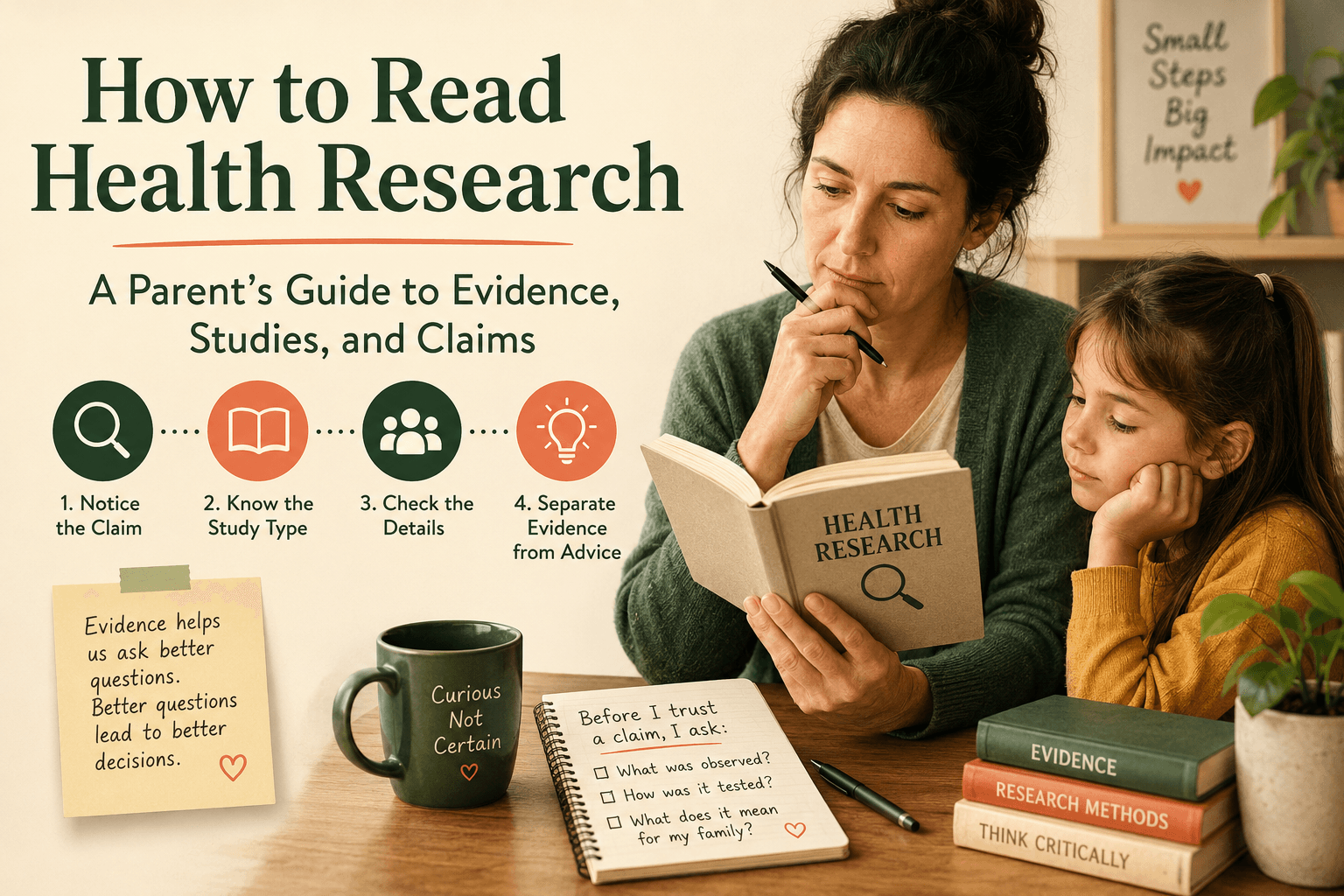
How to Read Health Research: A Parent’s Guide to Evidence, Studies, and Claims
Part 1 — When “I Saw It” Is Not the Same as “It Caused It”
You know your child better than anyone.
So when you notice that your child seems more restless after a certain food, sleeps worse after a late evening, or behaves differently after a particular routine, it is natural to connect the two.
And sometimes that observation is real.
The harder question is what caused it.
That distinction — between association and causation — is one of the most important ideas in health research.
A simple example: sugar and behaviour
For years, many parents have believed that sugar makes children hyperactive.
The observation can feel convincing: a child eats something sweet, becomes more energetic, and the two events happen close together.
But timing alone cannot tell us whether one event caused the other.
A 1995 JAMA meta-analysis of double-blind, placebo-controlled trials found no measurable effect of sugar on children’s behaviour or cognitive performance — though the authors were careful to say that a small effect, or an effect in some children, could not be ruled out.
Source: Wolraich, Wilson & White, 1995. doi.org/10.1001/jama.1995.03530200053037
That result creates an interesting question:
If the trials did not find the expected effect, why can a parent genuinely notice a difference?
One 1994 experiment offers a particularly useful illustration.
Researchers studied boys whose mothers already described them as being sensitive to sugar. The mothers were told that their sons had either received a large dose of sugar or a placebo.
But every child actually received the placebo.
The mothers who believed their sons had received sugar nevertheless rated them as more hyperactive. Their interactions with their sons also changed: those mothers exercised more control by staying physically closer.
The study involved 35 boys ages 5–7 whose mothers had already described them as “sugar sensitive,” so this was a small, selected sample — not a snapshot of children in general.
The important lesson is not that the mothers were foolish or that they imagined what they saw.
Something observable happened.
What was mistaken was the explanation for why it happened.
Source: Hoover & Milich, 1994. doi.org/10.1007/BF02168088
Observation gives you a question — not necessarily an answer
This is where everyday experience and scientific research serve different purposes.
Your observation is valuable because it tells you: something seems to be happening here, and I should pay attention to it.
Research asks a different question: what else could explain this pattern, and what happens when we test those explanations?
Maybe the food itself matters. Maybe the situation around the food matters. Maybe expectations influence what adults notice. Maybe several things changed at the same time. Or maybe the apparent pattern does not hold when researchers test it under controlled conditions.
Good research does not require parents to distrust their observations. It gives us better tools for interpreting them.
The question to ask
The next time you hear — or make — a health claim, try adding three words: compared with what?
Instead of “sugar makes my child hyperactive,” ask: compared with what happens when my child eats the same kind of food without sugar, or when the surrounding circumstances are similar?
That small change in wording moves you from a conclusion to a testable question.
And that is exactly where evidence-based thinking begins.
Quick check
- What was actually observed?
- What other explanations could fit the same observation?
- Was the proposed cause actually tested?
Once you start asking how was this tested?, the next question follows naturally — because researchers test different questions in very different ways, and the method shapes what the answer can mean.
Part 2 — Know What Kind of Study You’re Reading
Some weeks it can feel as though health research contradicts itself on a schedule.
One headline says a food protects your child. A few months later, another says it does the opposite. It is tempting to conclude that nobody really knows anything.
Usually something less dramatic is going on: the two studies were not asking the same question, and were not built to answer it the same way.
The kind of study helps tell you what kind of claim it can support. This is the single most useful thing a non-specialist can learn to notice.
Randomised trials
In a randomised trial, researchers assign participants to different conditions by chance — one group gets the thing being tested, another does not.
That random assignment allows researchers to compare groups under a controlled condition, rather than simply comparing people who happened to choose different exposures.
The sugar trials in Part 1 were built on the same principle — participants, parents, and researchers were all kept unaware of who received sugar — which is why they could answer a question that observation alone could not.
Trials also have limits. They may study a specific population for a specific period and under controlled conditions that do not reproduce every detail of family life. And many important questions cannot be randomised at all — you cannot assign children to years of poor sleep, or to a difficult childhood, to see what happens.
Observational studies
Observational studies follow people living their ordinary lives and look for patterns.
This is how researchers study questions that trials cannot ethically assign: long stretches of time, real-world conditions, and exposures that people experience in ordinary life.
The trade-off is the one Part 1 was about. People who differ in one habit usually differ in others too, and those other differences travel with them into the results. Researchers can measure and adjust for some of those differences, but the results still depend on which differences were measured and how well they were handled.
Reviews and meta-analyses
A systematic review brings together studies addressing a question; a meta-analysis can statistically combine results from those studies into a pooled estimate.
Source: Murad et al., 2016. doi.org/10.1136/ebmed-2016-110401
These are often described as the top of the evidence hierarchy. That description deserves more care than it usually gets.
Combining many studies does not automatically produce strong evidence. If the studies being combined are small, poorly run, or measuring different things, the average of them is not more trustworthy — just more confident-looking.
Sources: Ioannidis, 2016. doi.org/10.1111/1468-0009.12210 · Page & Moher, 2016. doi.org/10.1111/1468-0009.12211
Ioannidis argued strongly that systematic reviews and meta-analyses can be redundant or misleading when produced without sufficient care. A published rebuttal in the same issue disputed that framing. The useful lesson here is not that meta-analyses are unreliable. It is that their authority still depends on the evidence they contain and how that evidence was handled.
Researchers who study how evidence is ranked have argued the familiar pyramid is too simple — a review isn’t automatically better than a trial, and a trial isn’t automatically better than a well-run observational study. What matters is the question being asked and how well the study was run.
Source: Murad et al., 2016. doi.org/10.1136/ebmed-2016-110401
There is also a limit that cannot be engineered away. The studies pooled together are never identical — different participants, different methods, different measurements. Researchers can measure and describe that variation, and sometimes explain it. They cannot make it disappear.
Why single studies disagree
This is where the contradictory headlines come from.
When two researchers looked up 50 ordinary cookbook ingredients, they found published studies linking most of them to cancer risk — some raising it, some lowering it, sometimes for the same food.
Source: Schoenfeld & Ioannidis, 2013. doi.org/10.3945/ajcn.112.047142
The useful conclusion is not that nutrition research is worthless. It is that any single study on a common food is one result among many, so the wider picture needs to be assessed across studies — with attention to how each one was done.
What replication adds
One more thing separates a finding that holds from a finding that happened to appear once: someone else runs the study again.
Replication gives researchers another chance to see whether a finding appears again. Sometimes the pattern is reproduced fully; sometimes only part of it is. Both outcomes are information. A result that partly replicates should not be described as though the original finding were either completely confirmed or completely rejected.
Quick check
- Were people assigned to a condition, or observed as they were?
- If this is a review, what kind of studies went into it?
- Has anyone tried to repeat it?
Knowing the study type narrows what a finding can mean. The next question is narrower still — because two studies of the same type can differ enormously in who they studied, for how long, and what they actually measured.
Part 3 — Look Past “Researchers Found…”
Most health claims reach us pre-digested.
A headline, a caption, a line in a newsletter: researchers found that… By the time it arrives, the study has been compressed into a sentence, and everything that would let you judge it has been left behind.
You do not need to read the full paper to do better than that. Most research papers provide a short summary — an abstract — that can help you answer some of those questions before you read further. Learning to look for a few specific things is a useful place to start.
How many people were studied?
A study of thousands and a study of thirty are both real research, but they support different weights.
Small studies are not worthless. Some of the most useful work is done in small, tightly controlled groups, because that level of control is impossible at scale. But sample size is part of the context you need to see before interpreting a result. A small study tells you about the people who took part in it; it does not, by itself, tell you how broadly the finding applies.
Ask the number first. It is usually in the first two lines.
Who were they?
This is the question most often skipped, and it changes the meaning of a finding more than almost anything else.
The 1994 sugar experiment from Part 1 is a good illustration: 35 boys, ages 5 to 7, whose mothers had already described them as sugar sensitive. Every one of those details narrows what the result describes. Boys, not children generally. A narrow age band. And mothers pre-selected for a belief the study was designed to examine.
None of that is a flaw — it was the right design for that question. But it means the result speaks about that group, and extending it beyond them is a step the study itself did not take.
So: who was actually in the room? Adults or children? Which ages? Healthy volunteers, or people already dealing with a condition? And were they selected for something in particular?
What did the researchers actually measure?
Headlines deal in outcomes people care about. Studies deal in outcomes that can be measured.
Those are often not the same thing, and the gap between them is where a lot of overstatement lives. A study might measure a hormone level, a test score, a questionnaire response, or a number of minutes — and the summary you read may translate that into something much broader, like better sleep, improved learning, or healthier children.
The translation might be reasonable. It might not. You can only tell by looking at what was measured.
How long did it last?
A study that observes something once, a study that runs for six weeks, and a study that follows families for a decade are answering different questions, even if they share a topic.
Ask how long the measurement ran, and how long afterwards anyone checked. Then notice whether the claim being made stays inside that window.
What did the researchers say the limits were?
This is the most useful habit in this entire article, and the easiest.
Researchers routinely state the limits of their own work. Those statements are usually accurate, usually specific, and almost never make it into the coverage.
The sugar meta-analysis in Part 1 is a clear case. Its authors did not claim to have closed the question — they said a small effect, or an effect in some children, could not be ruled out. That qualification came from the researchers themselves. It simply did not survive the retelling.
When a summary sounds more certain than the study it describes, the missing caution is often sitting in the paper’s own final paragraphs.
Quick check
- How many, and who?
- What was measured, and for how long?
- What did the authors say their study could not settle?
These questions tell you what a study found. A separate question is what anyone should do about it — and that is not the same thing, even when the advice comes from an organisation you trust.
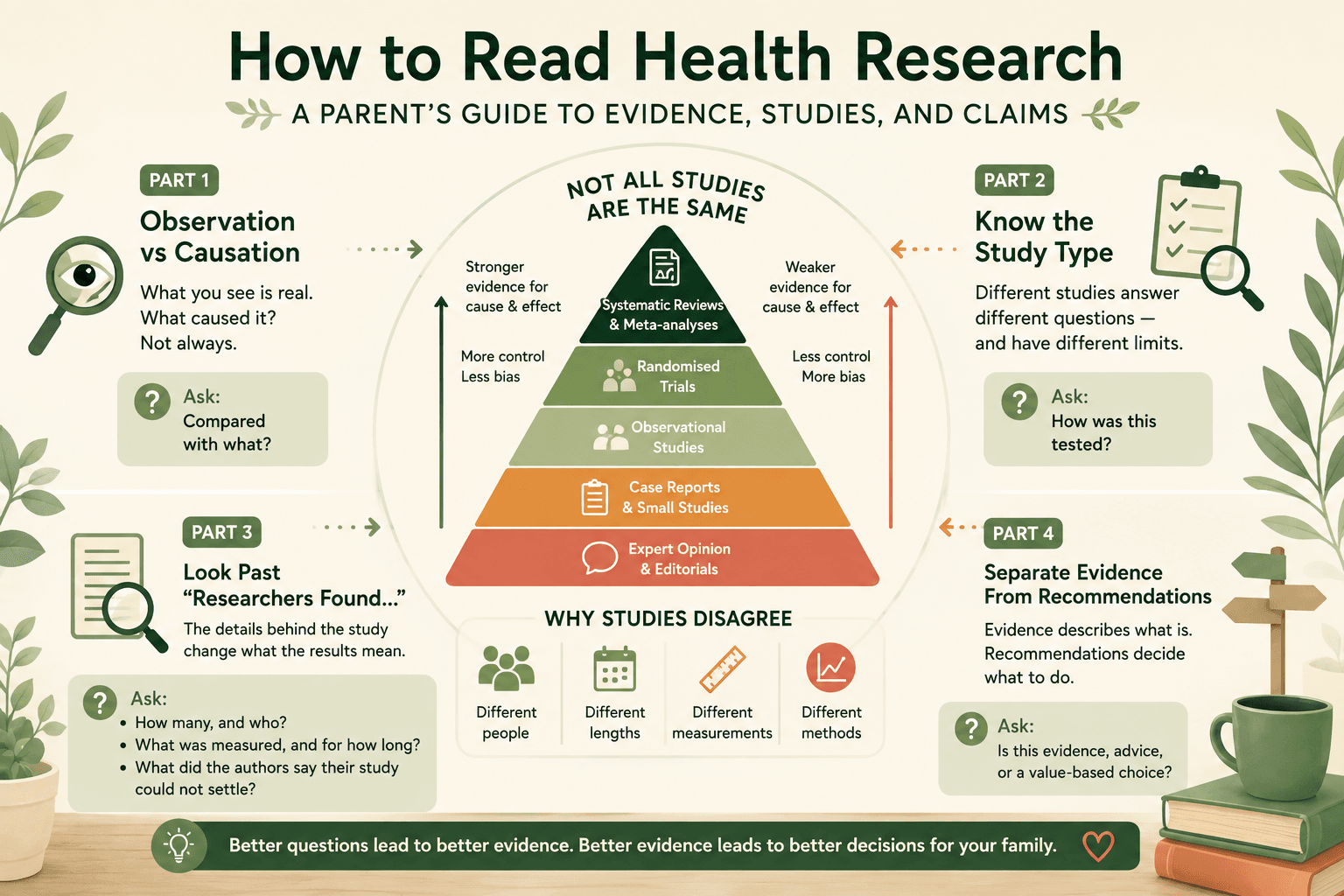
Part 4 — Separate Evidence From Recommendations
There is a moment in most health conversations when someone reaches for an institution.
The AAP says. The CDC recommends. The WHO advises. And the conversation stops there, because what else is there to say?
That instinct is reasonable. Major health organisations review far more evidence than any parent could, and their guidance is usually the most sensible starting point available.
But a recommendation and a research finding are two different objects, and treating them as the same one causes predictable confusion.
What a recommendation adds
A study reports what happened under particular conditions.
A recommendation takes findings like that and turns them into advice for a whole population — which means weighing things a study does not measure: how strong the underlying evidence is, what happens if the advice is wrong in either direction, what is realistic for families, and what to say about questions the research has not settled.
That last one matters. Guidance cannot wait for certainty. It has to say something useful now, using the evidence that exists, which means every recommendation carries a judgement inside it about how to act under uncertainty.
None of that makes guidance untrustworthy. It makes it a different kind of statement — one that can change when the evidence, the technology, or the circumstances change, without anything having gone wrong.
Guidance that changed, in public
Advice about young children and screens is a useful example, because the whole sequence is documented.
In 2011, the American Academy of Pediatrics reaffirmed its earlier position that pediatricians should urge parents to avoid television viewing for children under two.
Source: AAP Council on Communications and Media, 2011. doi.org/10.1542/peds.2011-1753
In 2016, the position shifted. Media use was discouraged under 18 months with an explicit exception for video chatting, and for children aged 18 to 24 months, high-quality programming watched together with a parent.
Source: AAP Council on Communications and Media, 2016. doi.org/10.1542/peds.2016-2591
In 2026, that statement was replaced by one that reframes the question entirely, placing children’s media use inside a wider system — the child, the caregiver, the design of the digital environment, and the commercial and policy forces shaping it — and stating that media and children cannot be viewed solely through the lens of individual child behaviours or screen limits alone.
Source: Munzer et al., 2026. doi.org/10.1542/peds.2025-075320
Guidance on young children and screens has moved from avoiding TV under two, to allowing video chat and co-watching, to a 2026 statement that no longer treats individual screen limits as the organising idea. Guidance changed alongside changes in the evidence, the technology, and the ways children use media.
That is what working guidance looks like: advice that can be revised rather than fixed in place.
The recommendation you heard may not be the one that was issued
There is a second problem, and it sits between the organisation and you.
The AAP’s own 2011 statement records that its earlier wording had been frequently misquoted in media coverage. The policy had discouraged television viewing for children under two. It was widely reported as a rule of no media exposure at all.
That is an organisation documenting, in its own publication, that its recommendation was altered in transmission.
It is worth sitting with, because it means the familiar shortcut — the experts say X — can fail even when the experts are entirely trustworthy and you have simply received X second-hand.
So when a recommendation matters to your family, it is worth looking for the original statement rather than relying on a summary. These statements are often available directly from the organisation, and they are more specific and more qualified than the versions that reach you.
Quick check
- Is this a finding, or advice built on findings?
- Is this the current version of the guidance?
- Have I read what the organisation actually said, or a description of it?
Recommendations get distorted on the way to you. So do findings — and there are a few specific moves that show up again and again in how a modest result becomes a confident claim.
Part 5 — Watch for the Leap
By now you have a way to look at a study itself.
But health claims rarely stay inside the study.
They travel — from paper to press release, from press release to headline, from headline to social post, and finally into the advice a parent hears. At each step there is an opportunity for a specific finding to become a broader statement.
When the wording goes further than the study
A study can report an association, while the headline says one thing causes another.
It can find a result in animals, while the story talks about what it means for people.
Or it can report a finding that may have practical implications, while the headline turns it into direct advice.
These are not necessarily fabrications. Often the underlying finding is real. The problem is that the wording has moved beyond what the study actually tested.
One BMJ analysis examined university press releases and the news coverage that followed them. It found that when press releases contained exaggeration, the resulting news coverage was more likely to contain it too. The study could not establish that the press release caused the exaggeration.
Source: Sumner et al., 2014. doi.org/10.1136/bmj.g7015
That last sentence matters.
The study itself was observational. So even when the subject of the research is exaggerated health reporting, we still have to avoid turning an association into a causal story.
A later replication reproduced part of that pattern but not all of it.
Source: Bratton et al., 2019. doi.org/10.12688/wellcomeopenres.15486.2
That is what replication looks like in practice: not a simple verdict of true or false, but another piece of evidence that changes how confidently the original finding should be described.
When a finding crosses a population boundary
There is another leap, and it is much harder to notice.
A result can be real for the people who were studied and still not tell you what happens in a different group.
Adults are not preschoolers. Preschoolers are not teenagers. A result in healthy volunteers does not automatically describe children with a medical condition. A finding under tightly controlled laboratory conditions does not automatically describe an ordinary home.
Advice about evening light is a useful illustration.
In adults, evening light suppresses melatonin in an intensity-dependent way.
But controlled studies in preschool-aged children found strong suppression across a wide range of evening light levels, without a clean relationship between brightness and the size of the suppression. In a related study, one hour of evening light produced an average circadian phase delay of about 56 minutes, with substantial variation between individual children.
Sources: Hartstein et al., 2022. doi.org/10.1111/jpi.12780 · Hartstein et al., 2023. doi.org/10.1177/07487304221134330
The point is not that adult research is useless for children.
It is that an adult finding can carry assumptions about dose, sensitivity, or response that do not transfer neatly to a young child — which means advice built on adult studies can quietly under-protect a small child.
Those preschool studies were small, conducted under controlled laboratory conditions, and their participants were a narrow age group. Their results should not simply be extended to school-age children or teenagers.
That is why how old were the participants? belongs beside what did the study find?
The three leaps to watch for
When you read a health claim, pause when you see one of these moves:
- Association → causation. People with X had more of Y becomes X causes Y.
- Studied group → everyone. This happened in these participants becomes this is what happens to people generally.
- Measured outcome → bigger outcome. A study measured one specific change becomes this improves health, learning, sleep, or behaviour.
The words may sound only slightly different. The claim they create can be very different.
Quick check
- Did the study actually test the cause the headline is describing?
- Were the people studied similar to the people the claim is about?
- Is the conclusion describing what was measured — or something broader?
You now have five ways to slow a health claim down. The last step is turning them into something you can actually use the next time a headline reaches you.
Part 6 — A Simple Way to Read the Next Health Claim
You do not need to become a researcher to become harder to mislead.
You need a repeatable way to slow a claim down before you accept it, share it, or act on it.
FHG Science Note
Research does not become trustworthy because a study sounds impressive. It becomes useful when the claim stays the same size as what was actually tested.
A strong reading habit is therefore not which side is right? but what does this evidence actually allow us to say?
That distinction sits at the heart of evidence-based family health.
A study can be sound and still be limited. A result can be interesting without being universal. A recommendation can be reasonable without being permanent. And revised guidance does not mean the earlier guidance was foolish — advice is sometimes revised alongside changes in the question, the evidence, the technology, or the context.
The five questions
1. What is the claim?
Write it in plain language. Separate what was observed from what someone says caused it.
2. What kind of evidence is behind it?
A randomised trial, an observational study, a review, a meta-analysis, or a recommendation built from several sources?
3. Who was studied?
Age, population, health status, selection criteria, setting. Do those people resemble the people the claim is about?
4. What was actually measured?
Find the specific outcome. Be careful when a measured change becomes a broad statement about health, behaviour, learning, or sleep.
5. What are the limits — and what happened as the claim travelled?
Read the researchers’ own qualifications. Then compare the original finding with the headline or summary that brought it to you.
You do not need to answer all five perfectly. The goal is to notice where certainty was added.
Three things you can do today
- Stop at the headline. Before sharing a health claim, write down exactly what it says.
- Find the original. Look for the study or the organisation’s actual statement rather than the summary of it.
- Run the five questions. Claim → evidence → population → outcome → limits.
If the final claim is much bigger than the original evidence, keep the smaller version.
The claim → meaning check
CLAIM        What is being said?
    ↓
EVIDENCE     What kind of study or recommendation supports it?
    ↓
POPULATION   Who was actually studied?
    ↓
OUTCOME      What did researchers actually measure?
    ↓
LIMITS       What did they say it could not settle?
    ↓
MEANING      What can we reasonably say — without adding anything?
Success marker
The next time you see a health headline, you do not have to decide immediately whether it is true or false.
You should be able to say: I know what to check before I decide what this means.
That is the skill this article is built to give you.
Where this leaves you
Health research will keep changing. New studies will disagree with older ones. Recommendations will be revised. Headlines will keep simplifying.
You cannot prevent any of that.
But you can get better at seeing the distance between what was studied, what was found, and what someone says it means.
You are not trying to prove that a study is right or wrong. You are trying to understand what the evidence actually says.