The Ultimate Guide to Healthy Sleep for Kids (Science-Based)
Estimated reading time: 24–30 minutes
Sleep is one of the most powerful — and most overlooked — tools parents have for supporting their child’s growth, mood, learning, and physical health. Yet it’s also one of the most common sources of stress in family life: bedtime battles, 2 a.m. wake-ups, overtired toddlers who refuse to nap, and teenagers who can’t seem to fall asleep before midnight.
This guide brings together the science of children’s sleep into one comprehensive resource — how much sleep kids actually need at every age, how to build routines that work, how to handle common sleep problems, and when it’s time to loop in a pediatrician.
Table of Contents
Why Sleep Matters · How Much Sleep Kids Need by Age · Understanding Sleep Cycles · Building a Bedtime Routine · Sleep Hygiene Basics · Screen Time and Sleep · Common Sleep Problems · Naps by Age · Melatonin: What Parents Should Know · Sleep and School Performance · Sleep and Immune Health · Weekend Sleep Schedules · Common Sleep Myths · Printable Healthy Sleep Checklist · When to Call a Pediatrician · FAQ
Why Sleep Matters So Much for Kids
Sleep isn’t downtime for a child’s body and brain — it’s active, essential work.
Brain development and memory. During sleep, the brain consolidates what a child learned that day, strengthening neural connections involved in memory, language, and problem-solving.
Physical growth. Growth hormone is released primarily during deep sleep, supporting healthy growth trajectories throughout childhood.
Emotional regulation. Sleep-deprived children are more prone to irritability, meltdowns, and difficulty regulating big emotions.
Immune function. Sleep supports the immune system’s ability to fight off common illnesses.
Attention and school performance. Well-rested children show better focus, impulse control, and classroom performance.
🔬 Science Says
A 2016 consensus panel convened by the American Academy of Sleep Medicine reviewed 864 published studies and found that children who regularly meet age-appropriate sleep recommendations show measurably better attention, behavior, learning, memory, emotional regulation, and overall health — while insufficient sleep is linked to higher rates of attention and behavior problems, and in teens, increased risk of self-harm and depression.
The takeaway: sleep isn’t a “nice to have.” It’s foundational infrastructure for nearly every other aspect of a child’s development.
How Much Sleep Do Kids Need by Age?
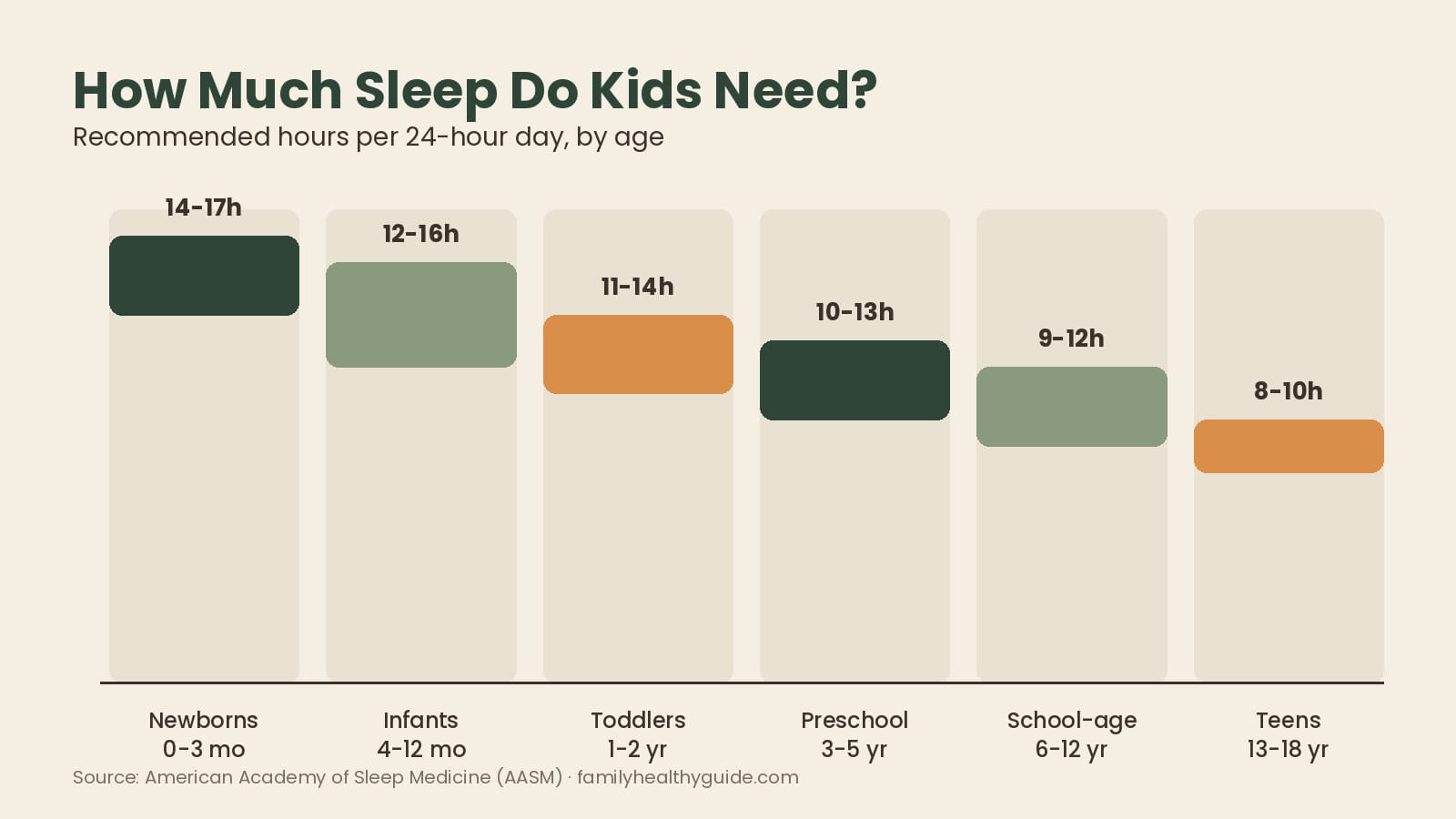
The ranges below (24-hour totals, including naps for younger children) reflect the official consensus recommendations of the American Academy of Sleep Medicine, endorsed by the American Academy of Pediatrics. For a full age-by-age breakdown with practical tips, see our complete guide: How Much Sleep Do Kids Need by Age?
| Age Group | Recommended Sleep (24-hour total) |
|---|---|
| Newborns (0–3 months) | 14–17 hours |
| Infants (4–12 months) | 12–16 hours (including naps) |
| Toddlers (1–2 years) | 11–14 hours (including naps) |
| Preschoolers (3–5 years) | 10–13 hours (including naps) |
| School-age (6–12 years) | 9–12 hours |
| Teens (13–18 years) | 8–10 hours |
Source: American Academy of Sleep Medicine consensus statement (ages 4 months–18 years), endorsed by the American Academy of Pediatrics. Newborn figures follow National Sleep Foundation recommendations (Hirshkowitz et al., 2015). General guidance only — individual needs vary.
If your child occasionally sleeps slightly more or less than these ranges but is growing well, alert during the day, and meeting developmental milestones, it may still be completely normal.
🔬 Science Says
Teenagers experience a natural biological shift — sleep timing and the body clock drift later across adolescence, and longitudinal tracking of the same young people shows the delay building gradually rather than arriving all at once — which is part of why many teens struggle to fall asleep early even with good habits, and why early school start times are a genuine mismatch with adolescent biology, not just a discipline issue.
Understanding Kids’ Sleep Cycles
Children cycle through light sleep, deep sleep, and REM sleep in cycles roughly 50–60 minutes long — shorter than adult cycles of about 90 minutes. This means kids pass through more transitions each night, which is part of why brief nighttime wake-ups are so common and developmentally normal.
Deep sleep concentrates in the first part of the night, which is why growth hormone release happens disproportionately during those early hours — one more reason consistent, reasonably early bedtimes matter.
Building a Healthy Bedtime Routine

A predictable bedtime routine is one of the single most effective tools for improving sleep at any age.
What makes a routine effective:
- Consistency over content — same sequence, same order, same time each night
- Keep it short — 20 to 40 minutes
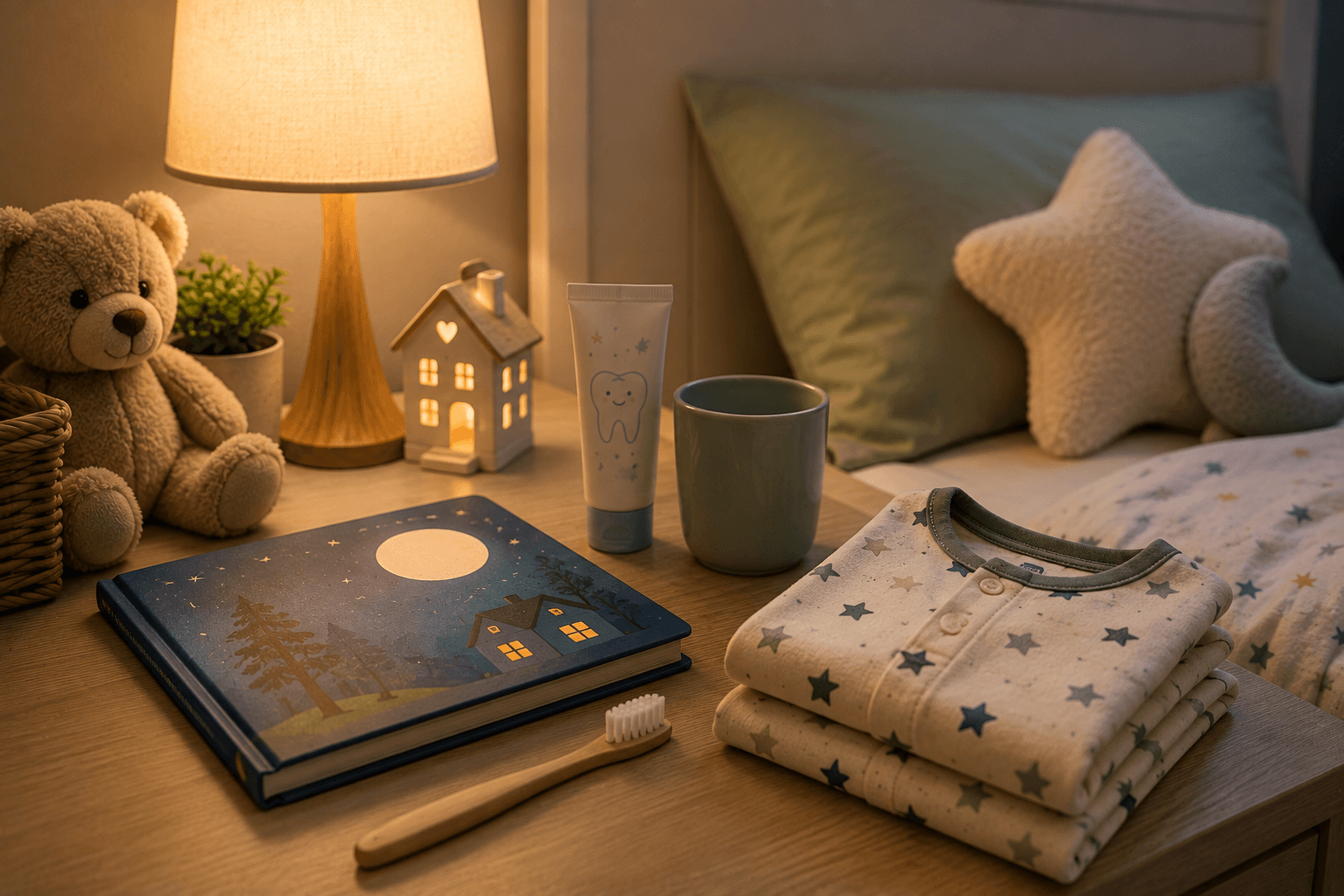
- Wind down, don’t wind up — bath, pajamas, teeth, a book, a brief cuddle
- End in the sleep room — helps the brain associate that space with sleep onset
- Start before the “overtired” window — watch for early tiredness cues
Sample routine by age:
- Toddlers/preschoolers: bath → pajamas → brush teeth → 1–2 books → dim lights → brief song → lights out
- School-age: wind-down activity → shower → brush teeth → dim lights → short chat → lights out
- Teens: screens off → hygiene routine → reading/journaling → lights out at a consistent time
We’ll explore bedtime routines step by step, including troubleshooting for resistant sleepers, in our dedicated guide: The Best Bedtime Routine for Children — What Neuroscience Actually Recommends.
Sleep Hygiene for Kids: The Basics
Consistent sleep and wake times — including weekends — regulates the circadian rhythm (the body’s internal 24-hour clock that helps regulate sleep and wakefulness).
A cool, comfortable bedroom — this supports better sleep for most children, and what feels comfortable varies from child to child.
Limit caffeine — its effects last longer in children than many parents realize.
Morning daylight exposure — far brighter than indoor lighting, and a practical way to anchor the start of the day.
Daytime physical activity — supports better sleep quality.
Reserve the bed for sleep — especially important for older kids and teens.
🔬 Science Says
The CDC notes that children who don’t get enough sleep are at higher risk for obesity, type 2 diabetes, poor mental health, and attention/behavior problems that can affect school performance — and that consistent sleep/wake times, a comfortable and dark room, and avoiding caffeine and large meals before bed are among the most effective, evidence-backed interventions parents can control directly.
Good sleep habits work hand in hand with balanced nutrition — see our Ultimate Guide to Kids’ Nutrition for the full picture. For teens specifically, see our dedicated Teen Sleep guide.
Screen Time and Sleep: What Parents Need to Know
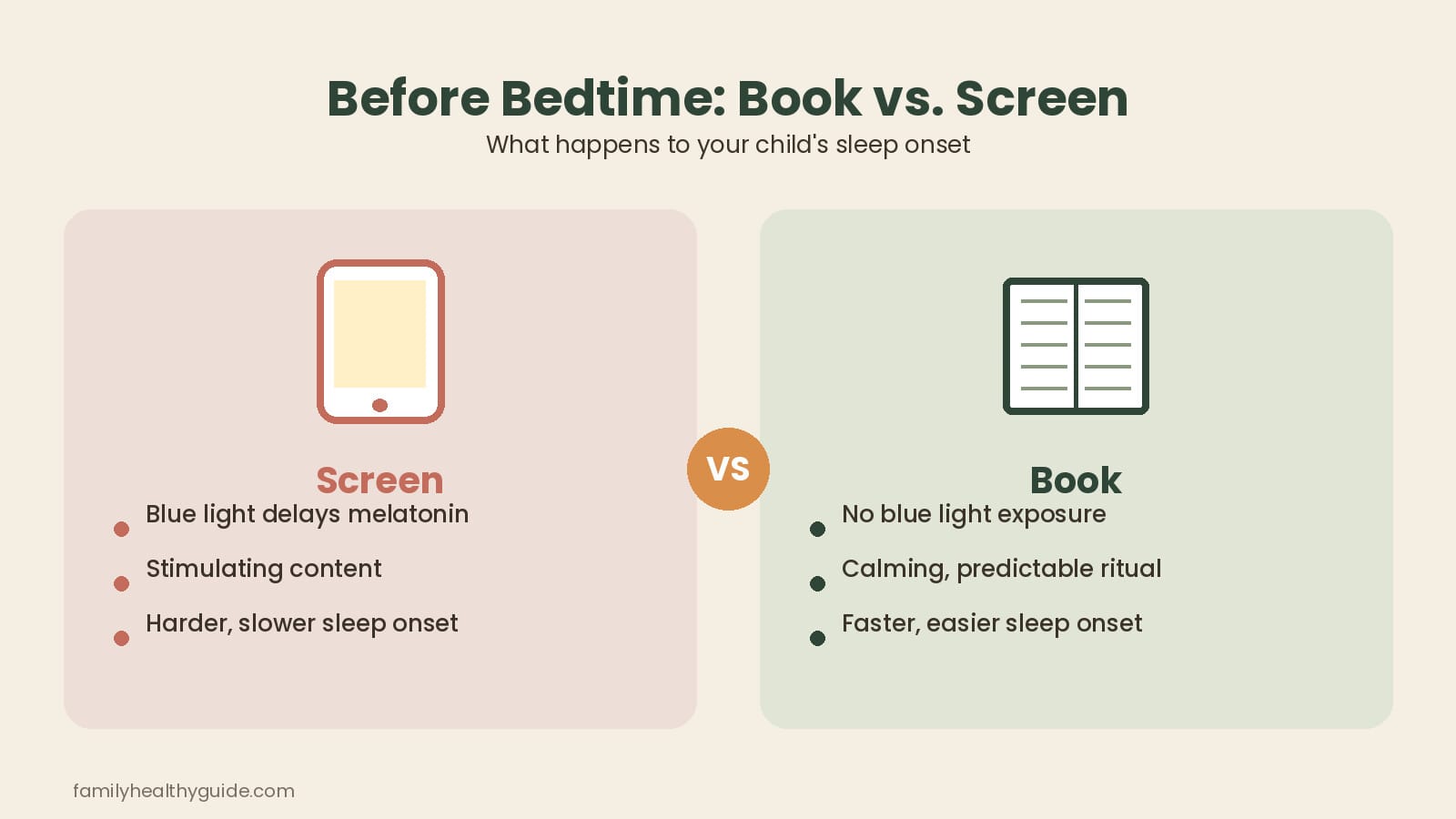
Blue light suppresses melatonin — delaying the body’s natural sleep signal.
Content is stimulating — independent of the light itself.
Screens displace wind-down time — less time for calming, sleep-promoting activities.
Practical guidance:
- Aim for a screen-free period of at least 1 hour before bedtime. Many pediatric sleep experts and the AAP encourage reducing screen exposure before sleep, especially during the last hour of the evening.
- Keep devices out of the bedroom overnight
- Night mode/blue-light filters help somewhat but don’t fully offset stimulation
- Model the behavior yourself
For a full action plan, see our guide: 7 Ways to Reduce Screen Time Without the Battles (Backed by Science).
Common Sleep Problems and How to Handle Them
Why Kids Wake Up at Night
Night waking is extremely common, particularly in toddlers. Common causes: passing through a lighter sleep stage, hunger or bathroom needs, separation anxiety (ages 1–3), nightmares or night terrors, illness/teething, or a disrupted routine. Brief, “boring” reassurance without lights or long conversation usually helps a child settle back down.
Helping a Child Fall Asleep Faster
Keep the routine calm and predictable, address anxiety directly with an earlier “worry time,” avoid bedtime negotiations, and make sure the child isn’t over- or under-tired.
The Overtired Toddler Cycle
Overtiredness can make settling down harder, not easier — possibly through activation of the body’s stress response. Breaking the cycle usually means an earlier bedtime for several days until the sleep debt is repaid.
We dig deeper into nighttime wake-ups in Why Kids Wake Up at Night, and into bedtime resistance and overtiredness in How to Help a Child Fall Asleep Faster.
Naps by Age: When Should Kids Stop Napping?
| Age | Typical Napping Pattern |
|---|---|
| 0–6 months | Multiple naps throughout the day |
| 6–12 months | Typically transitioning to 2 naps |
| 12–18 months | Transitioning from 2 naps to 1 |
| 18 months–3 years | Usually 1 afternoon nap |
| 3–5 years | Nap frequency varies widely |
| 5+ years | Most children no longer nap |
The transition away from napping is highly individual. A useful in-between step is replacing a nap with quiet, low-stimulation “rest time” rather than eliminating downtime abruptly.
Can Melatonin Help Kids Sleep?
- May help in specific situations (jet lag, certain sleep-onset difficulties, or under medical guidance) — but isn’t a first-line solution for typical bedtime resistance.
- Not FDA-regulated as a medication, so dosages and purity vary between products.
- Behavioral strategies address root causes more effectively and sustainably than a supplement.
- Should never be given without first discussing it with a pediatrician.
🔬 Science Says
Because melatonin supplements aren’t FDA-regulated for potency or purity the way medications are, independent testing has found significant variation between the labeled and actual melatonin content of supplements — a key reason pediatric guidance emphasizes medical consultation before use rather than over-the-counter self-dosing.
Sleep and School Performance
Well-rested children show better attention span, working memory, and impulse control in the classroom. Protecting bedtime — even if it means trimming an activity — tends to pay off more than the activity being trimmed.
Sleep and the Immune System in Children
During sleep, the body produces cytokines that help fight infection and inflammation. Chronically under-slept children may be more susceptible to common illnesses and may take longer to recover.
Weekend Sleep Schedules: Should Kids Sleep In?
Large swings between weekday and weekend sleep schedules (“social jet lag”) can make Monday mornings harder. Keep wake times within about an hour of the weekday schedule, even on weekends.
Common Sleep Myths Parents Should Stop Believing
| Myth | Fact |
|---|---|
| Keeping a child up later makes them sleep in longer | Overtired children often wake earlier |
| All kids should stop napping by age 3 | Napping needs vary widely; some benefit from naps into preschool |
| Weekend schedule slips don’t matter | Inconsistency can disrupt the circadian rhythm |
| Melatonin is a safe first option | Not risk-free; not a substitute for addressing habits |
| Kids will sleep when tired enough | Overtiredness often makes falling asleep harder |
| Night waking always signals a problem | Brief waking is developmentally normal, especially in toddlers |
| Calm content on screens before bed is fine | Blue light itself delays melatonin, regardless of content |
| Teens don’t need consistent bedtimes | Teens need 8–10 hours and benefit from consistency |
📋 Printable Healthy Sleep Checklist

The Healthy Sleep Formula: Consistent Routine + Same Sleep/Wake Time + Reduced Evening Screens + Cool, Comfortable Room + Daytime Physical Activity = Better Sleep
Nightly Checklist
- ☐ Same bedtime every night (including weekends, within ~1 hour)
- ☐ Screens off at least 1 hour before bed
- ☐ Bedroom is cool, comfortable, and quiet
- ☐ No caffeine or large meals close to bedtime
- ☐ Consistent wind-down routine (bath, book, teeth)
- ☐ Bed is reserved for sleep only
- ☐ Daytime physical activity and morning daylight exposure
- ☐ Lights out at the same time as the routine ends
When to Talk to a Pediatrician About Sleep
Worth discussing if a child shows: loud, persistent snoring or breathing pauses during sleep; extreme difficulty waking or excessive daytime sleepiness; sleep problems persisting for months despite consistent routines; significant bedtime anxiety; or restless sleep linked to leg discomfort.
Frequently Asked Questions
How much sleep does my child actually need?
It depends on age. See the age table above for the full breakdown and sources.
Is it normal for my toddler to wake up at night?
Yes — common and developmentally normal, especially ages 1–3.
Is melatonin safe for kids?
Only under a pediatrician’s guidance — not as a default first response.
How do I fix a bedtime that’s crept later and later?
Shift it earlier gradually, by 15-minute increments every few days.
Do teens still need a bedtime routine?
Yes — consistency remains one of the most effective tools at every age.
What’s the ideal room temperature for sleep?
Generally a comfortably cool room, though individual comfort varies.
Should weekend schedules match weekdays?
Ideally yes, within about an hour, to protect the circadian rhythm.
Key Takeaways
Healthy sleep isn’t about creating a perfect bedtime every night. It’s about building consistent habits that support your child’s growing brain and body over time. Small changes — like a predictable routine, fewer evening screens, and a consistent bedtime — can make a meaningful difference in your child’s health, learning, and emotional well-being.
- Sleep needs are biologically driven and change with age — see the table above for the recommended ranges and their sources.
- A short, consistent bedtime routine is the single most effective tool at any age.
- Reduced evening screen exposure supports faster, easier sleep onset.
- Night waking is developmentally normal, especially in toddlers.
- Overtiredness makes falling asleep harder, not easier.
- Melatonin isn’t a first-line solution and requires pediatrician guidance.
- Persistent sleep struggles, snoring, or excessive daytime sleepiness warrant a pediatrician visit.
References
- Paruthi S, Brooks LJ, D’Ambrosio C, et al. Recommended Amount of Sleep for Pediatric Populations: A Consensus Statement of the American Academy of Sleep Medicine. J Clin Sleep Med. 2016;12(6):785–786. aasm.org
- Centers for Disease Control and Prevention. Sleep and Health. cdc.gov
- Centers for Disease Control and Prevention. FastStats: Sleep in Children. cdc.gov
- American Academy of Pediatrics. Healthy Sleep Habits: How Many Hours Does Your Child Need? healthychildren.org
- Erland LAE, Saxena PK. Melatonin Natural Health Products and Supplements: Presence of Serotonin and Significant Variability of Melatonin Content. J Clin Sleep Med. 2017;13(2):275–281. doi.org
- World Health Organization. Guidelines on Physical Activity, Sedentary Behaviour and Sleep for Children Under 5 Years of Age. Geneva: WHO; 2019. who.int
- Van Cauter E, Plat L. Physiology of Growth Hormone Secretion During Sleep. J Pediatr. 1996;128(5 Pt 2):S32–S37. doi.org
- Klinzing JG, Niethard N, Born J. Mechanisms of Systems Memory Consolidation During Sleep. Nat Neurosci. 2019;22(10):1598–1610. doi.org
This article is for informational purposes only and does not replace personalized medical advice. Consult your child’s pediatrician for guidance specific to your child’s sleep needs.