Signs of Anxiety in Children by Age: What Parents Should Look For
Your seven-year-old’s stomach hurts every school morning and is fine by Saturday. Your twelve-year-old rewrites the same homework three times. Your teenager stops going out and says they just don’t feel like it.
None of these on its own means something is wrong. Worry is a normal part of growing up. But anxiety rarely announces itself — children almost never say “I feel anxious.” It shows up as stomachaches, avoidance, irritability, poor sleep, or endless requests for reassurance, and it looks different at four than it does at fourteen.
Quick answer
The signs worth paying attention to are not fear or worry themselves. They are patterns: worry that persists rather than fading, reactions much stronger than the situation calls for, and anxiety that starts interfering with school, sleep, friendships, family life, or play. Persistence, intensity, and interference are the three things to watch.
What anxiety is, and when it stops being ordinary
Anxiety is the body’s reaction to stress, and it can occur even when there is no current threat, as the National Institute of Mental Health explains. Some of it is useful — it sharpens focus before a test and keeps children cautious around genuine danger.
The line is not about what a child fears. It is about how long it lasts and what it costs them. The CDC notes that persistent or extreme forms of fear and sadness may be due to anxiety or depression, rather than treating occasional fears as a concern in themselves.
The American Academy of Pediatrics puts the practical threshold plainly: it is normal for children at any age to feel anxious sometimes, but when anxiety gets in the way of normal activities — sleeping alone at night, playing outside, going to school — it is time to take action.
Ordinary worry usually looks like this
- It attaches to a specific situation
- The child settles with support
- It eases as the situation becomes familiar
- School, sleep, play, and friendships continue normally
Worth a closer look when
- The worry keeps returning, or keeps growing
- Your child is avoiding more and more ordinary things
- Sleep, school, friendships, or family life are affected
- Physical complaints recur without a clear explanation
- Reassurance helps for minutes, then the worry returns
- The pattern is getting worse rather than better
How anxiety tends to look at different ages
The groupings below are a practical way to notice how anxiety changes shape as children grow — not a clinical checklist and not a diagnostic tool. Children develop at different rates, and two children with the same worry can look nothing alike.
Roughly ages 3–5
Preschoolers rarely have the language for “I’m worried about tomorrow.” The worry comes out as behavior instead — clinging, crying, refusing, or a sore stomach.
Many fears at this age are entirely normal. Young children can become especially unsettled by separation, unfamiliar situations, or major changes in their routine.
Patterns to notice:
- Unusual clinginess, or intense distress at separation that isn’t easing over time
- Repeatedly refusing preschool or a familiar activity
- New difficulty sleeping, or frequent nightmares
- Recurring stomachaches or headaches
- Fear of a specific thing that isn’t fading with familiarity
- Avoiding anything new
- Returning to behaviors they had outgrown
One difficult morning is not a pattern. A child who cries at drop-off for a week and then settles is adjusting. A child who cannot separate at all, is losing sleep, and is becoming more distressed rather than less may need more support.
Roughly ages 6–9
Worries become more concrete: schoolwork, mistakes, friendships, being away from parents, something embarrassing happening in front of the class.
At this age anxiety is frequently mistaken for something else — laziness, defiance, attention problems.
- Frequent stomachaches or headaches, especially on school days
- Asking to stay home; frequent visits to the school nurse
- Trouble concentrating or finishing work
- Heavy worry about making mistakes
- Avoiding sleepovers, groups, or being called on in class
- Asking the same reassuring question again and again
- Irritability or angry outbursts
- Lying awake because their mind won’t stop
- “I can’t do it” before trying
One clue parents can easily miss is avoidance, rather than obvious fear. You are unlikely to hear “I’m anxious about school.” You are far more likely to hear “my stomach hurts, I don’t want to go.” That does not mean a child is pretending — anxiety produces genuinely real physical symptoms.
Roughly ages 10–12
Academic pressure rises, friendships get more complicated, and children become sharply aware of how they are seen. Anxiety often becomes quieter here — and easier to miss.
NIMH describes some recognisable themes in children and teens with generalized anxiety: struggling with uncertainty, fear of making mistakes, and worry about disappointing others. It also notes that they may strive for perfection as a way of managing that anxiety — which is why the “high-achieving, no trouble at all” child is sometimes the one under most strain.
- Heavy worry about grades or performance
- Perfectionism, or redoing work that was already fine
- Fear of disappointing parents or teachers
- Avoiding presentations, sports, or social events
- Trouble falling asleep because their mind is busy
- Recurring headaches or stomachaches
- Irritability
- Spending more time alone
- A persistent sense that something bad is about to happen
Teenagers
Teenagers can hide anxiety far better than younger children. Instead of crying or clinging, they withdraw, get irritable, or insist they don’t care.
NIMH notes something important about avoidance: staying away from situations that cause anxiety can feel helpful in the short term, but the anxiety generally remains without treatment. A teenager who has stopped going out may look calmer while the underlying problem quietly grows.
- Pulling back from friends and social situations
- Missing school, or refusing specific classes
- Intense worry about grades or the future
- Fear of being judged or embarrassed
- Irritability or anger that seems out of character
- Sleep trouble; difficulty concentrating
- Recurring physical complaints
- Needing constant reassurance while insisting nothing is wrong
- A sudden drop in participation at school or with friends
The physical side is real
Anxiety is not only an emotional experience. The body’s stress response produces symptoms a child genuinely feels:
- Stomachaches and nausea
- Headaches
- Racing heartbeat
- Shortness of breath
- Sweating or trembling
- Muscle tension
- Fatigue
- Trouble falling or staying asleep
- Changes in appetite
Important
Do not assume a physical symptom is caused by anxiety. Recurring stomachaches, headaches, fatigue, or sleep problems should be discussed with your child’s healthcare provider, particularly when they are persistent, severe, or changing. Anxiety is one possible explanation among several, and it is not one to settle on at home.
Why school is where you often see it first
School asks children to perform, be observed, separate from home, and manage social pressure — all at once. An anxious child may ask to stay home, avoid answering questions, stop handing in work, avoid group activities, or become distressed before tests.
This is easily read as laziness or defiance. If school behavior changes noticeably, talk with your child and their teacher before drawing a conclusion, and raise it with your child’s healthcare provider.
A new school year brings temporary nerves for many children who are otherwise doing well. Our guide to back-to-school anxiety covers what tends to help in the weeks before term starts.
What helps at home
The goal is not to remove everything that makes your child anxious. It is to help them learn that uncomfortable feelings can be managed.
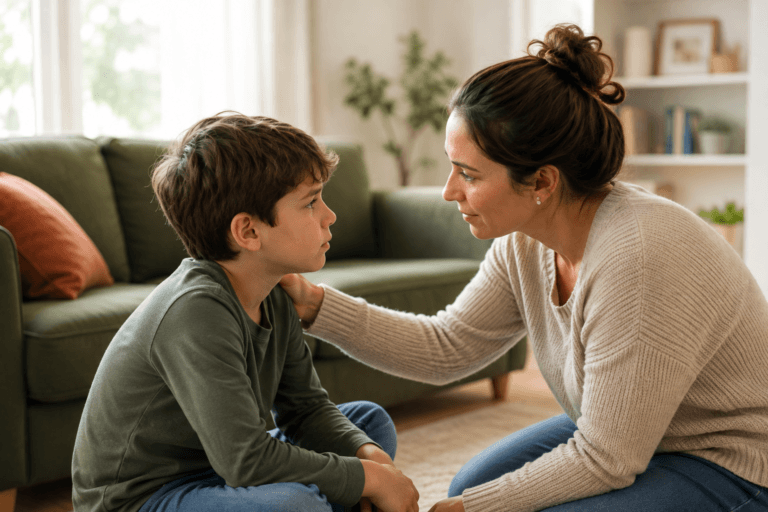
Lead with curiosity, not correction
Instead of “there’s nothing to be scared of,” try “I can see this feels scary — tell me what you’re worried might happen.”
The AAP is direct on this point: talk with your child about their anxieties and be sympathetic, explain that many children have fears and can learn to overcome them with support, and do not belittle or ridicule those fears, particularly in front of their peers. The same guidance advises against pressuring a child into being brave.
Make what’s coming predictable
Uncertainty feeds anxiety. Walking a child through what will happen removes some of it: “We’ll walk in together, you’ll hang up your bag, I’ll say goodbye, and I’ll be here at three.”
Watch what media is doing
The AAP suggests monitoring children’s media use, including exposure to frightening images in films, online video, and violent games, and keeping it age-appropriate. For an anxious child this is often more significant than parents expect.
Understand where gradual exposure belongs
Avoiding every anxious situation brings short-term relief and tends to strengthen the avoidance. But the structured version of facing fears — introducing the feared thing in small, manageable steps — is described by the AAP as part of a treatment plan under a therapist’s guidance, not as a home exercise.
At home, focus on listening, reassurance without feeding endless reassurance-seeking, predictable routines, and discussing manageable next steps. If a fear is strong enough that you are considering a structured exposure plan, talk with a qualified professional first.
Look after your own stress
The AAP makes a point worth repeating: children pick up on the stress and worries of adults, so getting support for yourself can help your child too.
Anxiety also interacts with the rest of a child’s day. Sleep debt lowers the threshold for everything — see signs your child isn’t getting enough sleep. For the broader picture of how emotional skills develop and what parents can do daily, start with our guide to children’s emotional health.
When should parents talk with a healthcare professional?
You do not need to wait for a crisis, and you do not need to work out which type of anxiety your child might have. That is not your job.
NIMH suggests seeking professional attention when symptoms last for weeks or months and interfere with daily life at home, at school, or with friends. The AAP adds practical triggers for getting back in touch with your child’s doctor: if the anxiety doesn’t go away or gets worse, if something frightening happens in your child’s life, or if you suspect anxiety is affecting another medical condition — for example, asthma worsening alongside it.
Raise it when:
- The anxiety persists or is intensifying
- It is interfering with school
- Your child is withdrawing from friends or normal activities
- Sleep is significantly affected
- Physical complaints are frequent or unexplained
- Reassurance only works briefly
- Family life is being shaped around avoiding the anxiety
- You are simply unsure whether this is typical
Your pediatrician can look at symptoms, development, physical health, school experience, and overall functioning, and can help you decide whether seeing a specialist would help. Cognitive behavioral therapy is one approach the AAP notes can be helpful for children with anxiety.
If your child’s behavior is unsafe, or if they talk about wanting to hurt themselves or someone else, seek help immediately. In the United States, the 988 Suicide & Crisis Lifeline can be reached by calling or texting 988. For a life-threatening emergency, call 911. Outside the US, contact your local emergency number or crisis service.
A five-question check-in
If you cannot tell whether what you are seeing is ordinary worry or something more:
- Is it persisting? Has it continued rather than gradually easing?
- Is it intense? Is the reaction much stronger than the situation would normally produce?
- Is your child avoiding things? School, friends, activities, sleepovers, sport.
- Is daily life affected? Sleep, school, eating, friendships, family life, play.
- Is the pattern changing? Is this noticeably different from how your child usually is?
The more of these you answer yes to — especially when the change has lasted — the more reasonable it is to raise your concerns with a professional.
The bottom line
Anxiety changes shape as children grow. A preschooler clings and develops new fears. A six-year-old’s stomach hurts every school morning. A tween rewrites homework and worries about disappointing everyone. A teenager goes quiet and stops going out.
None of these signs on its own means a child has an anxiety disorder. What matters is the pattern — worry that persists, feels disproportionate, and gets in the way of an ordinary life.
And noticing it early is not a sign that something has gone wrong with your parenting. It is the thing that gives a child the chance to learn how to handle anxiety while it is still manageable.
Sources
- National Institute of Mental Health — Generalized Anxiety Disorder: What You Need to Know
- National Institute of Mental Health — Children and Mental Health: Is This Just a Stage?
- CDC — About Children’s Mental Health
- American Academy of Pediatrics — Help Your Child Manage Anxiety
- American Academy of Pediatrics — Understanding Childhood Fears and Anxieties
FHG Science Note
Anxiety is a normal human response to stress, and childhood fears are part of ordinary development. What separates everyday worry from anxiety that may need attention is not the content of the fear but its persistence, its intensity, and its effect on daily functioning. Those three things — not any single symptom — are what a professional will be looking at too.
This article is educational and is not a diagnosis or a substitute for individualized medical or mental health care.