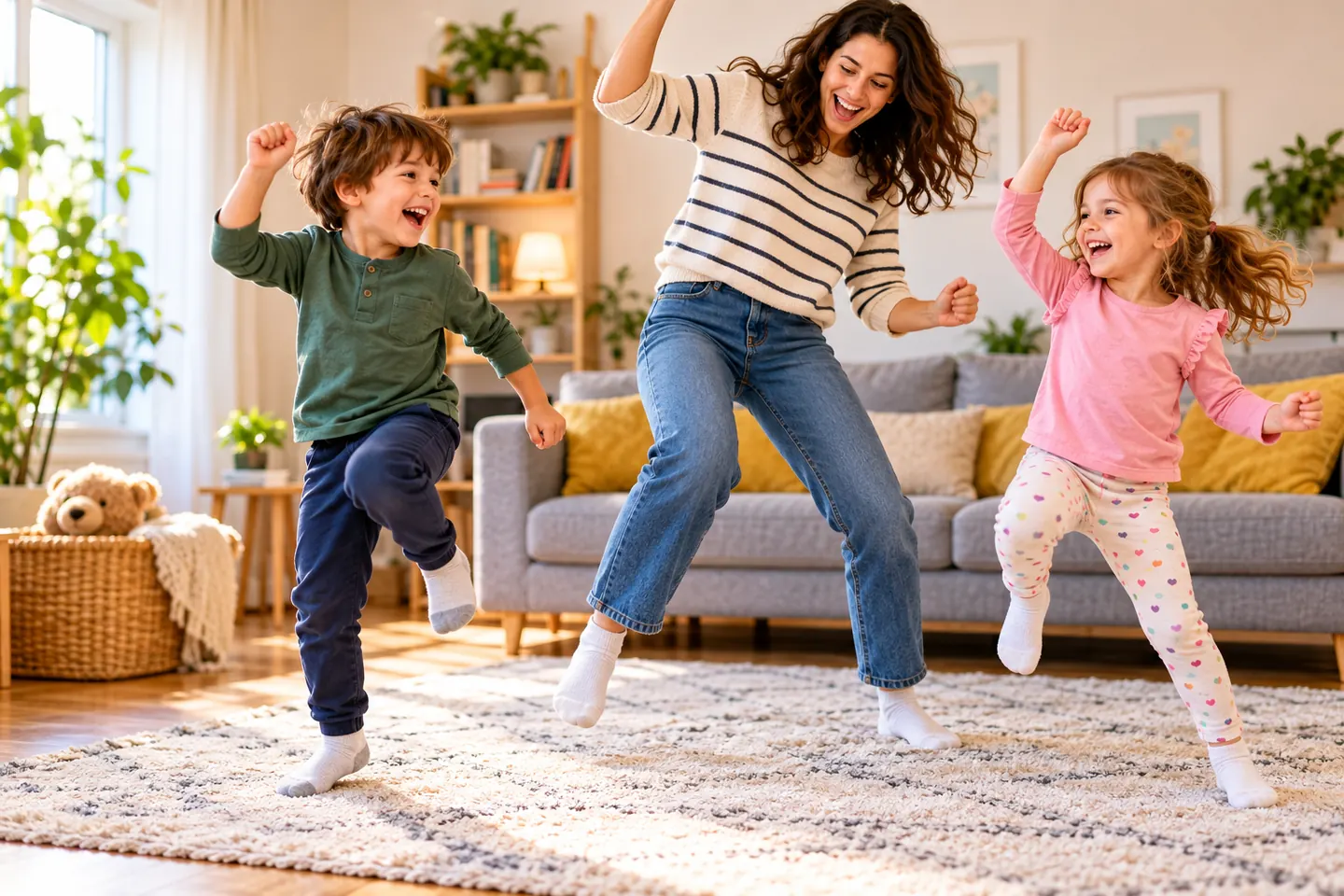
15 Active Indoor Games for Kids to Burn Energy at Home
Rainy day. Too cold to go outside. Your child has energy to spare, and the living room is starting to feel very small.
You don’t need a gym, special equipment, or a complicated plan. A cleared patch of floor, a few household items, and the right game are enough to get everyone moving — and laughing.
Many of these games need no special equipment — just a little open space and things you may already have at home. Others use simple items like painter’s tape, paper plates, or a soft ball.
These 15 games involve jumping, dancing, crawling, aiming, searching, and balancing. Use the quick guide below to pick one that fits your child’s age, your space, and how much energy needs burning.
Choose an Indoor Game in Seconds
| Game | Ages | Space | Energy |
|---|---|---|---|
| Freeze Dance | 3+ | Small | High |
| Simon Says | 3+ | Small | Medium–high |
| Red Light, Green Light | 3+ | Medium | High |
| Tape Hopscotch | 4+ | Small–medium | High |
| Fitness Dice | 4+ | Small | High |
| Animal Relay | 3+ | Medium | High |
| Movement Treasure Hunt | 4+ | Medium | High |
| Color Dash | 3+ | Medium | High |
| Indoor Obstacle Course | 4+ | Medium–large | High |
| Cushion Island Crossing | 4+ | Medium | Medium–high |
| Keep-It-Up Challenge | 4+ | Small–medium | Medium–high |
| Indoor Bowling | 3+ | Small–medium | Medium |
| Sock Basketball | 4+ | Small | Medium |
| Paper Plate Skating | 4+ | Medium (carpet only) | Medium |
| Family Dance Challenge | All ages | Small–medium | High |
Ages are starting points, not rules. Adjust any game to your child’s abilities and your space.
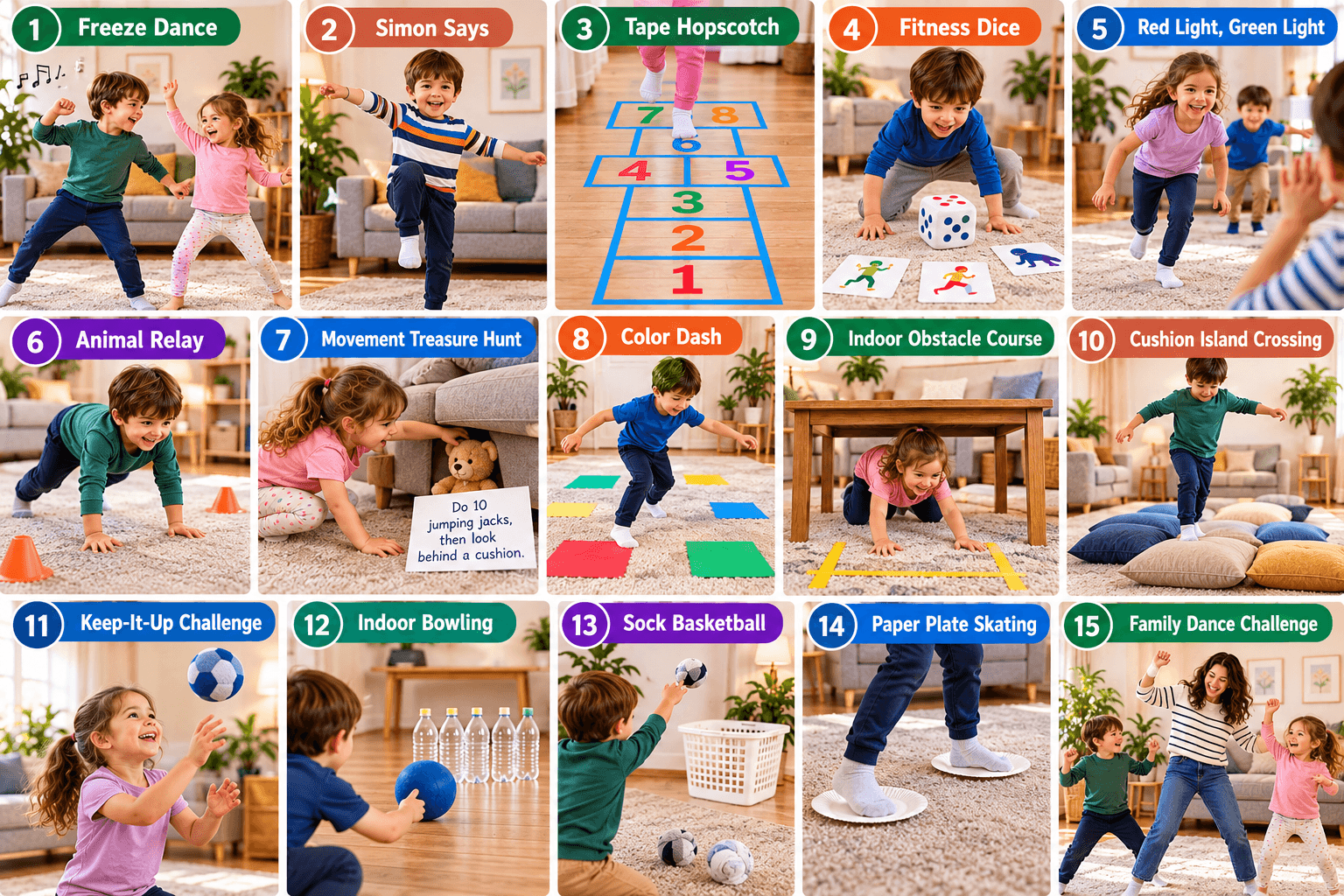
Active Games for Small Spaces
These work in a cleared living room or bedroom — no hallway or playroom needed.
1. Freeze Dance
Ages: 3+ · Space: Small · Tools: Music · Energy: High
Put on an upbeat song and dance — jump, spin, stomp, wave your arms. Pause the music without warning. Everyone freezes until it starts again.
Raise the energy by calling out a style for each round: robot, superhero, kangaroo, slow motion.
Quick win: Let your child control the music. Being the one who decides when everyone freezes is half the fun.
2. Simon Says: Active Edition
Ages: 3+ · Space: Small · Tools: None · Energy: Medium–high
Players follow only the commands that start with “Simon says.” Keep them physical:
- Simon says jump 10 times.
- Simon says run in place as fast as you can.
- Simon says do 5 star jumps.
- Simon says hop on one foot, then the other.
- Simon says touch the floor, then reach for the ceiling.
For younger children, skip the “you’re out” rule — the point is to keep everyone moving, not to catch mistakes. Let children take turns being Simon.
3. Tape Hopscotch
Ages: 4+ · Space: Small–medium · Tools: Painter’s tape · Energy: High
Tape a hopscotch grid onto a non-slip floor and number the squares. Hop on one foot through single squares, land with both feet on double squares, turn, and hop back.
Younger children can jump square to square with both feet. Older children can add a challenge: toss a sock into a square and hop over it.
Floor check: Painter’s tape peels off most floors cleanly, but test a small corner first on wood or delicate surfaces.
4. Fitness Dice
Ages: 4+ · Space: Small · Tools: A large die or six paper cards · Energy: High
Give each number a movement:
- 10 jumping jacks
- Run in place for 15 seconds
- 5 frog jumps
- Hop on one foot 5 times, then switch
- Dance until someone counts to 10
- Roller’s choice
Take turns rolling and doing the move together. Older kids can write their own movement cards — and they’ll usually make them harder than you would.
Games That Get Kids Moving Around the Room
With a bit more floor space, these games add running, chasing, and a goal to reach.
5. Red Light, Green Light
Ages: 3+ · Space: Medium · Tools: None · Energy: High
One player is the “traffic light” at one end of the room, back turned to the others. On “green light,” everyone moves toward them. On “red light,” the light turns around and everyone must freeze. Anyone caught moving goes back to the start. The first to gently tap the light’s shoulder takes over.
Clear a straight lane with nothing in the way. In a small room, swap running for fast walking or giant steps — the freezing is where the fun is anyway.
Change the movement on each round — tiptoe, hopping, crab walk — to keep it fresh.
6. Animal Relay
Ages: 3+ · Space: Medium · Tools: Two floor markers · Energy: High
Mark a start and a finish line. Players travel between them as different animals: frog jumps, bear crawls, crab walks, kangaroo hops, penguin waddles. Call out a new animal for each leg.
Several children can race, as long as there is room for everyone to move without bumping into each other or furniture. A child playing alone can race the clock instead. (Animal walks also make a quick five-minute reset after screen time — see What to Do After Screen Time.)
7. Movement Treasure Hunt
Ages: 4+ · Space: Medium · Tools: A few small toys plus picture or written clues · Energy: High
Hide a toy at each stop. Every clue includes a movement to complete before searching for the next one:
- “Do 10 jumping jacks, then look under the blue pillow.”
- “Bear-crawl to the bookshelf.”
- “Hop on one foot to the kitchen doorway.”
- “Run in place for 20 seconds, then look behind a cushion.”
Keep hiding spots at floor or waist level — nothing that requires climbing.
8. Color Dash
Ages: 3+ · Space: Medium · Tools: Colored paper taped flat to the floor · Energy: High
Tape sheets of colored paper around the room. Call out a color — players run to it. Then call a color and a movement: “Hop to red!” “Crab-walk to green!”
Older children can remember sequences: “Blue, then yellow, then red.” Tape every sheet down flat on all edges so it can’t slide underfoot, and keep the paths between colors clear. In a small room, make it a fast-walk game instead of a running one.
9. Indoor Obstacle Course
Ages: 4+ · Space: Medium–large · Tools: Pillows, a sturdy table, painter’s tape · Energy: High
Build a short course with four or five stations. For example:
- Crawl under a sturdy table with clear space on every side.
- Jump over a line of tape, both feet together, five times.
- Bear-crawl around a pillow.
- Do five star jumps on a marked spot.
- Crab-walk back to the start.
Time each round if your child enjoys it, but focus on completing the course safely rather than moving faster. Children can redesign one station each round.
Keep it on the floor: Crawling under is fine; climbing on furniture is not.
10. Cushion Island Crossing
Ages: 4+ · Space: Medium · Tools: Sofa cushions or pillows on a carpeted floor · Energy: Medium–high
The floor is a river; the cushions are islands. Children get from one side of the room to the other without touching the “water” — stepping and balancing from island to island.
Lay the cushions on carpet or a rug, touching edge to edge so there are no gaps to cross — children step from one to the next rather than leap. If the cushions shift underfoot, or on hard, smooth floors, use flat non-slip markers such as rubber-backed bath mats instead.
Aim, Throw, and Balance Games
Lower-key options for when children need to move but the room (or the adults) need a slightly calmer round.
11. Keep-It-Up Challenge
Ages: 4+ · Space: Small–medium · Tools: A soft, lightweight ball · Energy: Medium–high
Work as a team to keep a soft ball off the floor with taps. Count each touch and try to beat your family record.
Harder: players must take turns. Easier: allow one catch between taps.
12. Indoor Bowling
Ages: 3+ · Space: Small–medium · Tools: 6–10 empty plastic bottles and a soft ball · Energy: Medium
Line up empty plastic bottles as pins at the end of a hallway or cleared strip of floor. Roll a soft ball to knock them down.
Make it more active: players move quickly but safely to reset the pins after every roll. Move the pins closer for younger children. Remove all bottle caps first — they’re a choking risk for little ones.
13. Sock Basketball
Ages: 4+ · Space: Small · Tools: Rolled-up clean socks and a laundry basket · Energy: Medium
Roll socks into balls and shoot them into a laundry basket. Step back after every basket.
Make it more active: after each round, players collect their socks using a different movement — frog jumps, crab walk, hopping.
14. Paper Plate Skating
Ages: 4+ · Space: Medium · Tools: Two paper plates per child; carpet only · Energy: Medium
Stand with a paper plate under each foot and glide across the carpet like an ice skater, with slow, small slides forward and side to side. Skip spins and backward skating — that’s where falls happen.
Use this only on carpet, and test it first: have an adult take a few slides. If the plates slip unpredictably, choose another game. On wood, tile, or laminate, skip this one entirely.
A Game for the Whole Family
15. Family Dance Challenge
Ages: All ages · Space: Small–medium · Tools: Music · Energy: High
Each family member invents one dance move. String them together into a family routine and perform it to a favorite song — then speed it up.
Younger children can repeat simple moves; older siblings can add footwork or teach a move from a dance they know. Adults join in at their own pace. The goal is shared movement, not perfect choreography.
How Much Activity Do Children Need?
According to the CDC’s physical activity guidelines for children:
- Ages 3–5: Children should be physically active throughout the day.
- Ages 6–17: Children and teens need at least 60 minutes of moderate-to-vigorous physical activity each day, built up across the day.
The CDC also notes that jumping and running help build strong bones. A 15-minute indoor game is one part of that daily total, alongside outdoor play, walking, sports, and recess — not a replacement for all of it.
Simple Safety Checks Before You Start
- Clear the play area of cords, small toys, glass, and sharp furniture edges.
- Play barefoot or in grippy socks — not slippery socks on a smooth floor.
- Keep games away from stairs, windows, hot surfaces, and unstable furniture.
- Use soft balls and soft objects for anything thrown.
- Keep small items such as bottle caps away from young children, and supervise little ones throughout.
- Stop if anyone feels pain, dizziness, or unwell.
If your child has a medical condition or activity restrictions, ask their healthcare professional which kinds of play are right for them.
Frequently Asked Questions
How can I help my child burn energy indoors?
Pick a high-energy game that fits your space — Freeze Dance and Fitness Dice work in a small room; Red Light, Green Light and an obstacle course need more floor. Several short rounds with quick breaks usually work better than one long session.
What are good active indoor games for a 5-year-old?
Freeze Dance, Simon Says, Red Light, Green Light, Tape Hopscotch, and Animal Relay are easy to explain and need almost no equipment. Keep rounds short and let them take turns leading.
What can kids do indoors on a rainy day?
Mix one or two high-energy games with a calmer one. For example: Freeze Dance, then an obstacle course, then Sock Basketball to wind down.
How can the whole family play together?
Choose games where everyone takes turns leading or works toward a shared goal: Family Dance Challenge, Simon Says, and Keep-It-Up Challenge all work across ages.
Keep the Fun Going
You don’t need to try all 15 at once. Pick one that fits your room today, let your child choose the next one, and keep the ones your family loves on rotation for the next rainy afternoon.
For more on why child-led play matters, read Why Free Play Is More Powerful Than Organized Exercise.
References
- Centers for Disease Control and Prevention. Physical Activity Guidelines for Children and Adolescents. cdc.gov