How to Build a Healthy Skincare Routine for Your Teen — What Dermatologists Actually Recommend
Walk into any drugstore with a teenager and you’ll quickly feel overwhelmed. Shelves packed with serums, toners, exfoliants, and “miracle” treatments — most of them marketed directly at teens who are already anxious about their skin.
Here’s the truth: most teenagers don’t need a 10-step routine. They need three to four simple, evidence-based steps — done consistently. That’s it.
This guide cuts through the noise and gives you exactly what the research supports.
🔍 Quick Answer
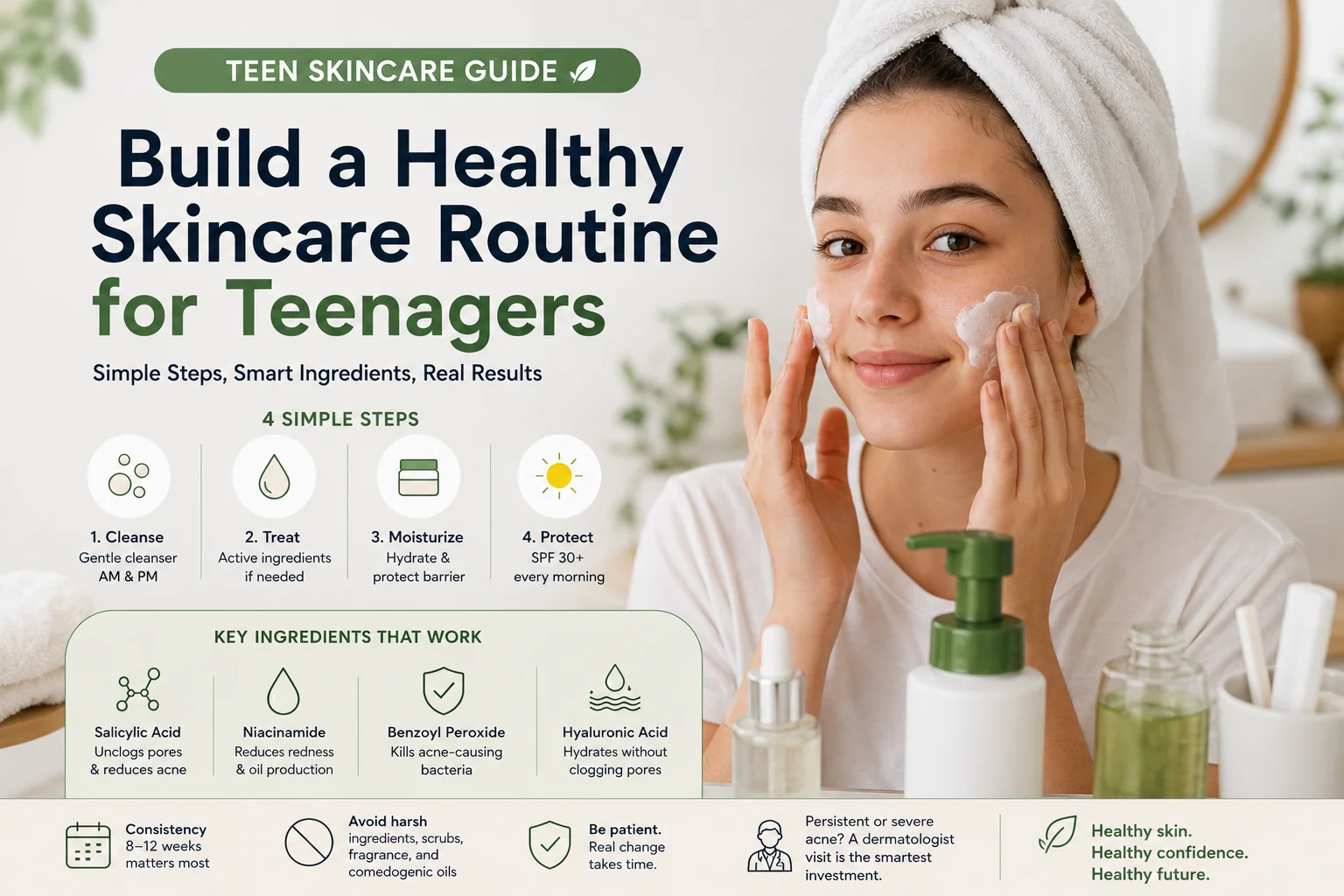
A healthy skincare routine for teenagers includes four core steps: a gentle cleanser, a lightweight moisturizer, daily SPF sunscreen, and — if acne is present — a targeted treatment like benzoyl peroxide or salicylic acid. Consistency matters far more than the number of products used.
1. Why Teen Skin Is Different
Teenage skin is biologically distinct from adult skin — and understanding why matters for building the right routine.
During puberty, rising androgen hormones cause the sebaceous (oil) glands to become significantly more active. This leads to:
- More sebum production — making skin oilier, especially in the T-zone (forehead, nose, chin)
- Larger, more visible pores
- Higher susceptibility to acne
- Increased sensitivity to harsh products
At the same time, teenagers’ skin has a strong natural capacity for repair and regeneration — faster than adult skin. This means that with the right routine, most teens see real improvement relatively quickly.
The goal isn’t to strip the skin or dry it out. The goal is to support its natural balance while reducing the conditions that lead to breakouts.
2. The 4-Step Core Routine
Step 1 — Gentle Cleanser
What it does: Removes excess oil, dirt, sweat, and environmental pollutants without disrupting the skin barrier.
What to look for:
- Labeled “gentle,” “non-comedogenic,” and “fragrance-free”
- Gel or foam formulas for oily/combination skin
- Cream formulas for dry or sensitive skin
What to avoid: Harsh scrubs, antibacterial soaps, or anything that leaves skin feeling “squeaky clean” — that’s a sign the skin barrier has been disrupted.
How often: Twice daily — morning and evening. Washing more than twice can trigger the skin to overproduce oil in response.
Research published in the Journal of the American Academy of Dermatology confirms that gentle, pH-balanced cleansers preserve the skin’s microbiome and reduce acne-related inflammation more effectively than harsh cleansers. (Draelos, 2006)
Step 2 — Lightweight Moisturizer
Common misconception: Teenagers with oily skin don’t need moisturizer.
The science: This is false. When the skin is dehydrated — even oily skin — it compensates by producing more oil. A lightweight, oil-free moisturizer actually helps regulate sebum production.
What to look for:
- “Oil-free” and “non-comedogenic” on the label
- Gel-based or water-based formulas
- Ingredients like hyaluronic acid or glycerin (hydrate without clogging pores)
How often: After every cleanse — morning and evening.
Step 3 — SPF Sunscreen (Non-Negotiable)
This is the most skipped step in teen skincare — and the most important for long-term skin health.
UV radiation is the leading cause of premature skin aging, hyperpigmentation, and skin cancer. Habits formed in adolescence have lifelong consequences for skin health.
What to look for:
- SPF 30 minimum (SPF 50 preferred)
- “Broad spectrum” (protects against both UVA and UVB)
- “Non-comedogenic” formula — won’t clog pores
- Lightweight, invisible finish for daily wear
How often: Every morning, rain or shine. Reapply every 2 hours during outdoor activities.
The American Academy of Dermatology recommends daily broad-spectrum sunscreen use starting in childhood, emphasizing that most sun damage accumulates before age 18. (AAD, 2022)
Step 4 — Targeted Treatment (If Acne Is Present)
If your teen has acne, this is where a targeted ingredient is added — but only after the first three steps are consistent.
The two most evidence-backed options for teens:
Benzoyl Peroxide (2.5–5%)
- Kills Cutibacterium acnes bacteria directly
- Reduces inflammation
- Start with 2.5% to minimize irritation
- Apply every other night initially, then nightly
Salicylic Acid (0.5–2%)
- Dissolves dead skin cells inside pores
- Prevents blackheads and whiteheads
- Good for mild, non-inflammatory acne
- Can be used in cleanser or leave-on form
A meta-analysis in the British Journal of Dermatology confirmed that benzoyl peroxide remains one of the most effective over-the-counter acne treatments, with consistent efficacy across age groups. (Kraft & Freiman, 2011)
3. Adding Acne Treatment — A Gradual Approach
Introduce one new product at a time. Wait two weeks before adding another. This makes it easy to identify what’s helping — or causing irritation.
Recommended introduction order:
- Week 1–2: Cleanser + Moisturizer + SPF
- Week 3–4: Add benzoyl peroxide (every other night)
- Week 5+: Increase frequency based on tolerance
If irritation occurs: reduce frequency, don’t stop entirely.
4. Ingredients Teens Should Look For
| Ingredient | Benefit | Best For |
|---|---|---|
| Hyaluronic Acid | Hydration without oil | All skin types |
| Niacinamide (4–10%) | Reduces sebum, calms redness | Oily/acne-prone |
| Benzoyl Peroxide (2.5%) | Kills acne bacteria | Inflammatory acne |
| Salicylic Acid (1–2%) | Unclogs pores | Blackheads, mild acne |
| Glycerin | Gentle hydration | Sensitive skin |
| Zinc | Anti-inflammatory | Acne-prone skin |
5. Ingredients Teens Should Avoid
| Ingredient | Why to Avoid |
|---|---|
| Fragrance | Common irritant, disrupts skin barrier |
| Alcohol (denat.) | Strips skin, triggers rebound oiliness |
| Physical scrubs | Micro-tears in skin, worsens inflammation |
| Coconut oil | Highly comedogenic — clogs pores |
| Heavy essential oils | Can cause contact dermatitis |
| Vitamin C (high %) | Can irritate teen skin, not a priority |
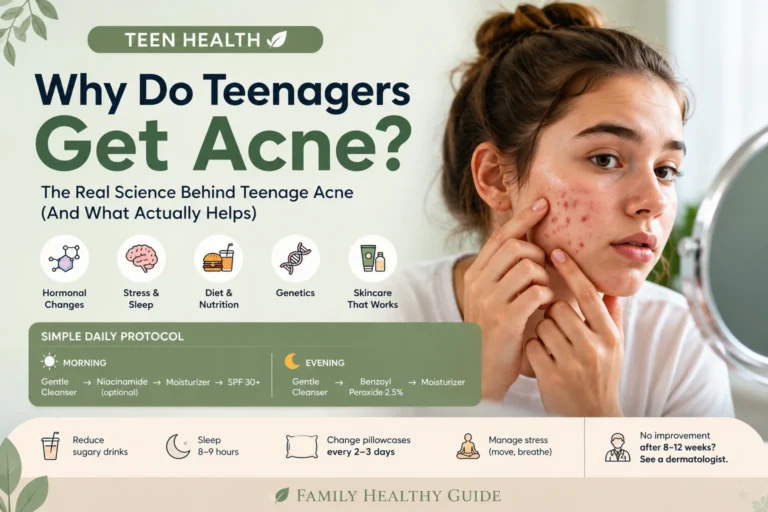
6. Morning vs. Evening Routine
Morning
- Gentle cleanser
- Lightweight oil-free moisturizer
- SPF 30–50 sunscreen
Total time: 3–5 minutes
Evening
- Gentle cleanser
- Benzoyl peroxide OR salicylic acid treatment (if needed)
- Lightweight moisturizer
Total time: 3–5 minutes
That’s it. Eight minutes a day, maximum. Simplicity is the point.
7. Common Mistakes Parents and Teens Make
Buying too many products at once
The skincare industry profits from complexity. More products mean more potential irritants, more confusion, and more expense. Start with three products and build from there.
Expecting results overnight
Skin cell turnover takes 28–40 days. Most evidence-based treatments require 8–12 weeks of consistent use before significant improvement is visible. Patience is part of the protocol.
Using adult skincare on teen skin
Anti-aging products (retinol creams, AHA peels, vitamin C serums) are formulated for adult skin concerns. They’re often too potent for teenage skin and can cause irritation and barrier disruption.
Popping pimples
Squeezing pimples pushes bacteria deeper into the skin, increases inflammation, and significantly raises the risk of permanent scarring. This one habit alone causes more long-term skin damage than almost anything else.
Skipping moisturizer because skin feels oily
As explained earlier, dehydrated skin produces more oil. Skipping moisturizer makes oily skin worse over time.
Not seeing a dermatologist for persistent acne
Over-the-counter products have real limits. Moderate to severe acne — or acne that isn’t responding after 12 weeks — needs professional evaluation. Prescription options are significantly more effective and can prevent permanent scarring.
✅ Key Takeaways
- Teen skin needs a simple, consistent routine — not a complex one
- The four essentials are: cleanser, moisturizer, SPF, and targeted treatment if needed
- Consistency over 8–12 weeks matters more than which products you choose
- Avoid harsh ingredients, scrubs, fragrance, and comedogenic oils
- For persistent or severe acne, a dermatologist visit is the smartest investment
The Bottom Line
Building a healthy skincare routine for your teenager doesn’t require expensive products, complicated regimens, or hours in the bathroom. It requires four simple steps, the right ingredients, and — most importantly — consistency.
The skin is a living organ that responds to gentle, consistent care. Give it that, and most teenagers will see real, meaningful improvement within a few months.
And if they don’t? That’s what dermatologists are for.
FAQ
What age should a teenager start a skincare routine?
Most dermatologists recommend starting a basic routine — cleanser, moisturizer, SPF — around ages 11–13, when puberty begins and sebum production increases. Acne treatments can be added if and when needed.
What is the best cleanser for teenage acne?
A gentle, fragrance-free, non-comedogenic cleanser is best. Look for gel or foam formulas for oily skin. Brands like CeraVe, La Roche-Posay, and Vanicream are frequently recommended by dermatologists for teen skin.
Should teenagers use toner?
Traditional alcohol-based toners are not recommended for teen skin — they strip the skin barrier and worsen oiliness. If a toner is desired, choose an alcohol-free formula with niacinamide or hyaluronic acid.
Can teenagers use retinol?
Low-dose retinoids (like adapalene 0.1%, available over the counter) can be appropriate for teen acne under dermatologist guidance. High-percentage retinol creams marketed for anti-aging are generally too potent and unnecessary for teenage skin.
How long before a teen skincare routine shows results?
Most evidence-based routines require 8–12 weeks of consistent use to show significant improvement. Skin cell turnover takes 28–40 days, meaning change is gradual and cumulative.
Is sunscreen really necessary for teenagers?
Absolutely. The American Academy of Dermatology estimates that most cumulative sun damage occurs before age 18. Daily SPF use during adolescence is one of the highest-impact health habits a teenager can form.
Scientific References
- Draelos, Z.D. (2006). The effect of cleanser type on skin condition. Journal of the American Academy of Dermatology, 54(5), 848–851.
- Kraft, J., & Freiman, A. (2011). Management of acne. British Journal of Dermatology, 164(6), 1277–1285.
- American Academy of Dermatology (2022). Sunscreen FAQs. AAD.org.
- Zouboulis, C.C. (2014). Acne as a chronic systemic disease. Clinics in Dermatology, 32(3), 389–396.
- Lynde, C.W., et al. (2016). The skin microbiome in acne and its relationship to cleansing. Journal of Cutaneous Medicine and Surgery, 20(3), 215–221.
At Family Healthy Guide, we believe understanding the science behind your child’s health empowers better decisions. This article is for informational purposes only. Always consult a qualified dermatologist for personalized medical advice.