The Gut-Brain-Skin Connection in Adolescents: What the Science Reveals
Your teenager’s skin is breaking out. They’re anxious about school. Their digestion seems off. You might assume these are three separate problems requiring three separate solutions.
Emerging science suggests they may all be connected — through a remarkable biological network researchers are calling the gut-brain-skin axis.
Understanding this connection won’t just change how you think about your teen’s acne. It may change how you think about their wellbeing altogether.
🔍 Quick Answer
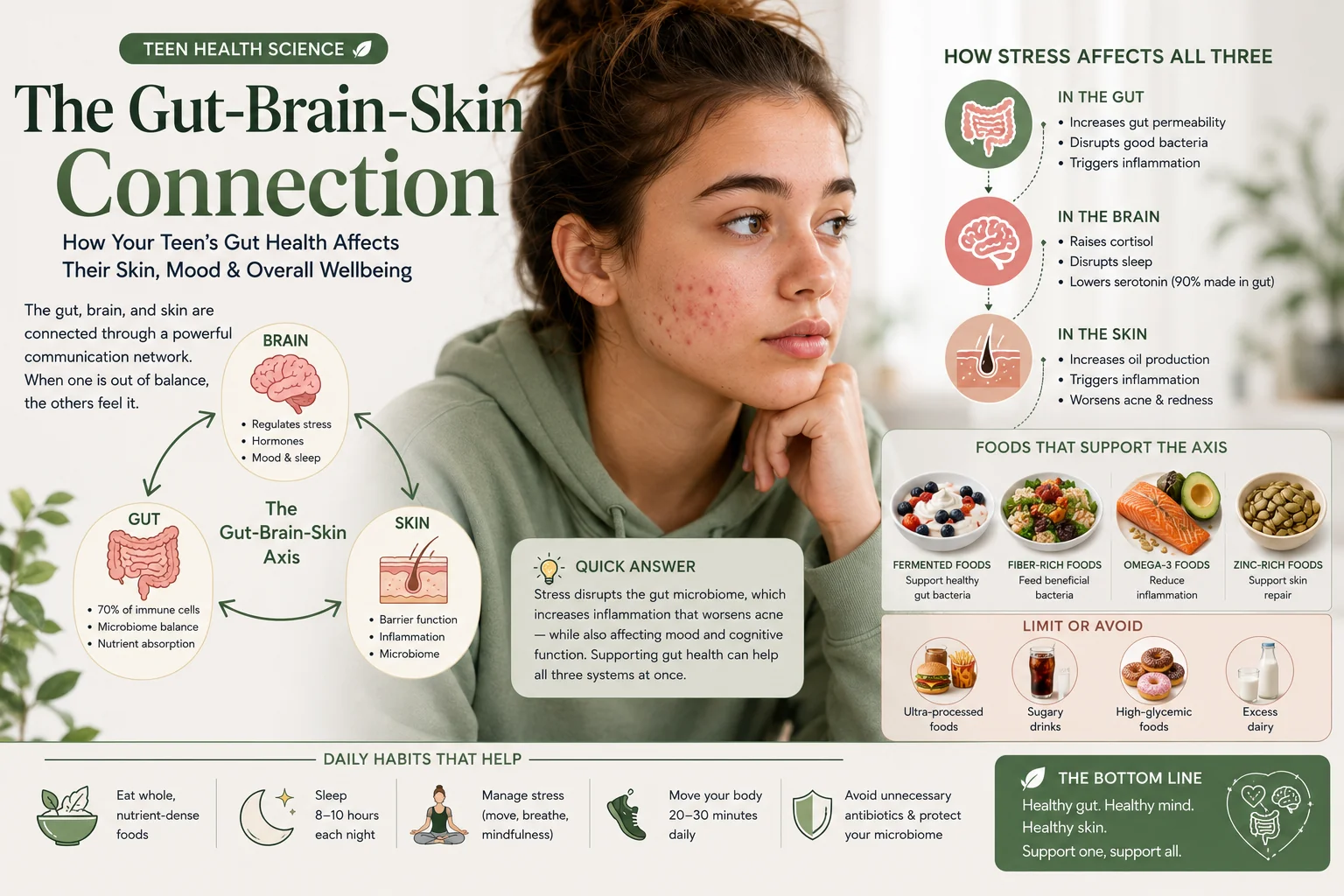
The gut, brain, and skin are connected through a bidirectional communication network involving the nervous system, immune system, and hormones. In teenagers, stress disrupts the gut microbiome, which increases inflammation, which worsens skin conditions like acne — while also affecting mood and cognitive function. Supporting gut health through diet, sleep, and stress management can benefit all three systems simultaneously.
1. What Is the Gut-Brain-Skin Axis?
The gut-brain-skin axis is a three-way communication network connecting three organ systems that might seem unrelated at first glance.
The gut houses approximately 70% of the body’s immune cells and contains the enteric nervous system — sometimes called the “second brain” — with over 500 million neurons. It communicates constantly with the brain via the vagus nerve.
The brain regulates stress hormones, inflammation levels, and immune responses — all of which directly affect both gut health and skin condition.
The skin is the body’s largest organ and a direct reflection of internal health. It has its own microbiome and immune system, and responds to signals from both the gut and the brain.
When one system is disrupted, the other two feel it. This isn’t metaphor — it’s measurable biology.
Research published in Frontiers in Microbiology describes the gut-skin axis as a bidirectional relationship in which gut microbiota influence skin health and vice versa, mediated through immune, hormonal, and neural pathways. (Salem et al., 2018)
2. The Teenage Gut Microbiome
The gut microbiome — the trillions of bacteria, fungi, and viruses living in the digestive tract — undergoes significant changes during adolescence.
Puberty alters the composition of the gut microbiome through:
- Hormonal shifts — androgens and estrogens influence which bacterial species thrive
- Dietary changes — teens often shift toward higher-sugar, more processed diets
- Sleep disruption — irregular sleep patterns alter gut bacteria composition
- Antibiotic exposure — commonly used for acne treatment, which ironically can further disrupt gut balance
- Stress — perhaps the most powerful disruptor of all
A 2020 study in Nature Reviews Gastroenterology & Hepatology found that adolescence represents a critical window for microbiome development — and that disruptions during this period can have lasting effects on immune function, mental health, and metabolic health. (Shanahan et al., 2020)
3. How Stress Disrupts the Gut — and the Skin
This is where the three systems become strikingly interconnected.
When a teenager experiences chronic stress — academic pressure, social anxiety, family tension — the brain activates the HPA axis and releases cortisol and adrenaline.
These stress hormones do the following:
In the gut:
- Reduce blood flow to the intestinal lining
- Increase intestinal permeability (sometimes called “leaky gut”)
- Alter gut motility (causing constipation or diarrhea)
- Shift the balance of gut bacteria toward pro-inflammatory species
In the skin:
- Stimulate sebaceous glands to produce more oil
- Trigger mast cells to release inflammatory compounds
- Slow skin barrier repair
- Worsen existing conditions like acne, eczema, and psoriasis
In the brain:
- Sustain a state of heightened alertness and anxiety
- Disrupt sleep architecture
- Disrupt signalling along the gut-brain axis, which runs through the vagus nerve, immune messengers, and microbial metabolites
Bowe and Logan describe this as a loop rather than a line: psychological distress alters gut motility and microbial balance → intestinal permeability rises → inflammatory and oxidative load increases → in susceptible teenagers, sebum production and acne worsen → self-esteem drops → distress increases further. (Bowe & Logan, 2011) It is a proposed pathway with growing support, not a settled one.
A review of stress and gastrointestinal physiology lists increased intestinal permeability among the major effects of stress on the gut, alongside altered motility, changed secretion, and negative effects on the intestinal microbiota. (Konturek et al., 2011) The proposal that this allows bacterial endotoxins to reach the circulation and drive systemic inflammation comes from the gut-brain-skin literature specifically. (Bowe & Logan, 2011)
4. The Inflammation Link
If there’s one biological thread connecting the gut, brain, and skin in teenagers, it’s inflammation.
Chronic low-grade inflammation — driven by gut dysbiosis, poor diet, stress, and sleep deprivation — circulates throughout the body and manifests differently in different tissues:
- In the gut: bloating, irregular digestion, food sensitivities
- In the brain: anxiety, low mood, brain fog, difficulty concentrating
- In the skin: acne, redness, eczema, rosacea
Teenagers with moderate to severe acne do show higher rates of anxiety and depression. Part of that is the emotional weight of the condition itself. Researchers have also proposed that shared inflammatory signalling contributes — but this remains a proposed mechanism rather than a demonstrated one, and which specific molecules are involved is still debated.
A study of nearly 5,000 people across 13 European countries found clinical depression in 10.1% of dermatology patients compared with 4.3% of controls, and clinical anxiety in 17.2% compared with 11.1%. (Dalgard et al., 2015)
5. Diet, the Microbiome, and Teen Skin
What teenagers eat directly shapes their gut microbiome — which in turn influences their skin.
Foods That Disrupt the Gut-Skin Axis
Ultra-processed foods and high-glycemic diets
Refined carbohydrates and sugary foods spike insulin and IGF-1, which stimulate sebum production. They also feed pro-inflammatory gut bacteria, increasing systemic inflammation.
Dairy products
Particularly skim milk, which has been associated with acne in multiple studies. The proposed mechanism involves hormones naturally present in milk (including IGF-1) that stimulate sebaceous gland activity.
Artificial additives and emulsifiers
Emerging research suggests that certain food emulsifiers (used in processed foods to improve texture) may disrupt the gut mucosal barrier and alter microbiome composition.
Foods That Support the Gut-Skin Axis
Fermented foods
Yogurt, kefir, sauerkraut, and kimchi contain live bacteria that directly support microbiome diversity. A randomized trial published in Cell found that a high-fermented-food diet significantly increased microbiome diversity and reduced inflammatory markers in just 10 weeks. (Wastyk et al., 2021)
Fiber-rich foods
Vegetables, legumes, whole grains, and fruits feed beneficial gut bacteria (acting as prebiotics) and reduce inflammation. Teens eating higher-fiber diets show lower rates of acne in epidemiological studies.
Omega-3 fatty acids
Found in fatty fish, walnuts, and flaxseeds, omega-3s reduce prostaglandin-driven inflammation and have shown modest benefits for acne severity in controlled trials.
Zinc-rich foods
Zinc plays a critical role in skin repair and has demonstrated anti-inflammatory properties. Low zinc status has been found in multiple studies of acne patients. Sources include pumpkin seeds, chickpeas, and lean meats.
6. What the Research Shows
The gut-brain-skin axis remains an active area of research, and it’s important to be honest about where the science stands:
Established:
- Stress increases intestinal permeability and systemic inflammation ✅
- High-glycemic diets worsen acne severity ✅
- Gut microbiome diversity correlates with skin health markers ✅
- Fermented foods increase microbiome diversity ✅
Emerging (promising but not yet conclusive):
- Specific probiotic strains improving acne outcomes 🔬
- “Leaky gut” as a primary driver of inflammatory skin conditions 🔬
- Psychobiotic interventions (targeting gut bacteria to improve mental health) 🔬
Still unclear:
- Which specific probiotic strains are most beneficial for teen skin
- Whether gut-focused interventions alone can replace topical acne treatment
- The precise mechanisms linking gut bacteria species to specific skin conditions
This nuance matters. The gut-brain-skin axis is real — but it’s not a simple fix, and it doesn’t replace dermatological care.
7. Practical Ways to Support All Three Systems
The good news: the same habits that support gut health also support brain health and skin health. This is one area where the science genuinely converges.
Diet
- Reduce ultra-processed foods and sugary drinks
- Increase vegetable and fiber intake daily
- Add fermented foods 3–5 times per week (yogurt, kefir, kimchi)
- Include omega-3 sources 2–3 times per week
- Reduce dairy if acne is a concern (trial period of 4–6 weeks)
Sleep
- Prioritize 8–10 hours per night — sleep directly regulates cortisol, gut motility, and skin repair
- Consistent sleep and wake times support the circadian rhythm, which governs the gut microbiome
Stress Management
- Regular physical activity (even 20–30 minutes daily) reduces cortisol and increases gut microbiome diversity
- Mindfulness practices have shown measurable effects on gut permeability in controlled studies
- Nature exposure reduces cortisol and inflammatory markers
Avoid Unnecessary Antibiotics
- Oral antibiotics (commonly prescribed for acne) can significantly disrupt the gut microbiome for months
- If antibiotics are necessary, pair them with a high-quality probiotic supplement and discuss duration carefully with a physician
✅ Key Takeaways
- The gut, brain, and skin communicate through a shared biological network — disruption in one affects all three
- Stress is the most powerful disruptor of the gut-skin axis in teenagers
- Diet, sleep, and stress management support all three systems simultaneously
- Ultra-processed foods and high-glycemic diets worsen both gut health and acne
- Fermented foods and fiber actively support the microbiome — and may benefit teen skin
- The research is promising but evolving — gut health supports skin health, but doesn’t replace dermatological care
The Bottom Line
The gut-brain-skin connection reframes how we think about teenage health. Acne isn’t just a surface problem. Anxiety isn’t just in the mind. Digestive issues aren’t just about food.
In many cases, they’re three signals from the same underlying biological conversation — and the most effective interventions address all three together.
For parents, this means that supporting your teenager’s skin health isn’t separate from supporting their mental health or their nutrition. It’s the same work, through the same systems, toward the same goal: a teenager who feels well in their body and confident in their life.
FAQ
What is the gut-skin axis?
The gut-skin axis refers to the bidirectional communication between the gut microbiome and the skin, mediated through immune signaling, hormones, and the nervous system. A healthy gut microbiome supports reduced inflammation, which benefits skin clarity and condition.
Can fixing gut health clear teenage acne?
Improving gut health — through diet, sleep, and stress management — can meaningfully reduce acne severity in many teens. However, it’s unlikely to fully replace targeted topical treatments for moderate to severe acne. Think of gut health as a powerful supporting strategy, not a standalone cure.
What probiotics are best for teenage acne?
Research is still emerging. Strains from the Lactobacillus and Bifidobacterium families have shown the most promise in preliminary studies. However, eating fermented foods (yogurt, kefir) may be more effective than supplements for building overall microbiome diversity.
How does stress affect teen skin through the gut?
Stress raises cortisol, which increases intestinal permeability, allowing bacterial byproducts to enter the bloodstream. This triggers systemic inflammation that manifests in the skin as increased sebum production and worsened acne.
Does diet alone cause acne?
No. Diet is one factor among several — including genetics, hormones, stress, sleep, and skincare habits. But high-glycemic diets and dairy appear to amplify acne severity in susceptible individuals by influencing insulin, IGF-1, and gut microbiome composition.
Can improving my teen’s gut health also help their anxiety?
Possibly, though the evidence is still early. Most of the body’s serotonin is produced outside the brain, largely by enterochromaffin cells in the gut, where it acts on motility, secretion, and inflammation rather than mood. That serotonin does not cross into the brain — so the popular shorthand that “gut serotonin controls mood” is misleading. Gut and brain do communicate, through the vagus nerve, immune signalling, and compounds such as short-chain fatty acids produced by gut bacteria, which in turn influence serotonin release in the gut itself. (Spohn & Mawe, 2017) Diet, sleep, and stress management plausibly benefit both mood and skin, but this is a developing field and gut-focused changes are not a treatment for anxiety.
Scientific References
- Salem, I., et al. (2018). The gut microbiome as a major regulator of the gut-skin axis. Frontiers in Microbiology, 9, 1459.
- Shanahan, F., et al. (2020). Feeding the microbiota: transducer of nutrient signals for the host. Nature Reviews Gastroenterology & Hepatology, 17(6), 369–383.
- Konturek, P.C., et al. (2011). Stress and the gut: pathophysiology, clinical consequences, diagnostic approach and treatment options. Journal of Physiology and Pharmacology, 62(6), 591–599.
- Dalgard, F.J., et al. (2015). The psychological burden of skin diseases: a cross-sectional multicenter study among dermatological out-patients in 13 European countries. Journal of Investigative Dermatology, 135(4), 984–991.
- Wastyk, H.C., et al. (2021). Gut-microbiota-targeted diets modulate human immune status. Cell, 184(16), 4137–4153.
- Bowe, W.P., & Logan, A.C. (2011). Acne vulgaris, probiotics and the gut-brain-skin axis. Gut Pathogens, 3(1), 1.
- Spohn, S.N., & Mawe, G.M. (2017). Non-conventional features of peripheral serotonin signalling — the gut and beyond. Nature Reviews Gastroenterology & Hepatology, 14(7), 412–420.
At Family Healthy Guide, we believe understanding the science behind your child’s health empowers better decisions. This article is for informational purposes only. Always consult a qualified healthcare provider for personalized medical advice.