Melatonin for Kids: Is It Safe? Benefits, Risks & What Parents Should Know
Estimated reading time: 16–20 minutes
Melatonin gummies are now one of the most common “natural” sleep aids parents reach for — but easy access doesn’t necessarily mean it’s the right first step for a child who’s struggling to fall asleep. Here’s what the research and major pediatric organizations actually say about melatonin’s safety, when it may be appropriate, and what to try first.
✅ Quick Answer
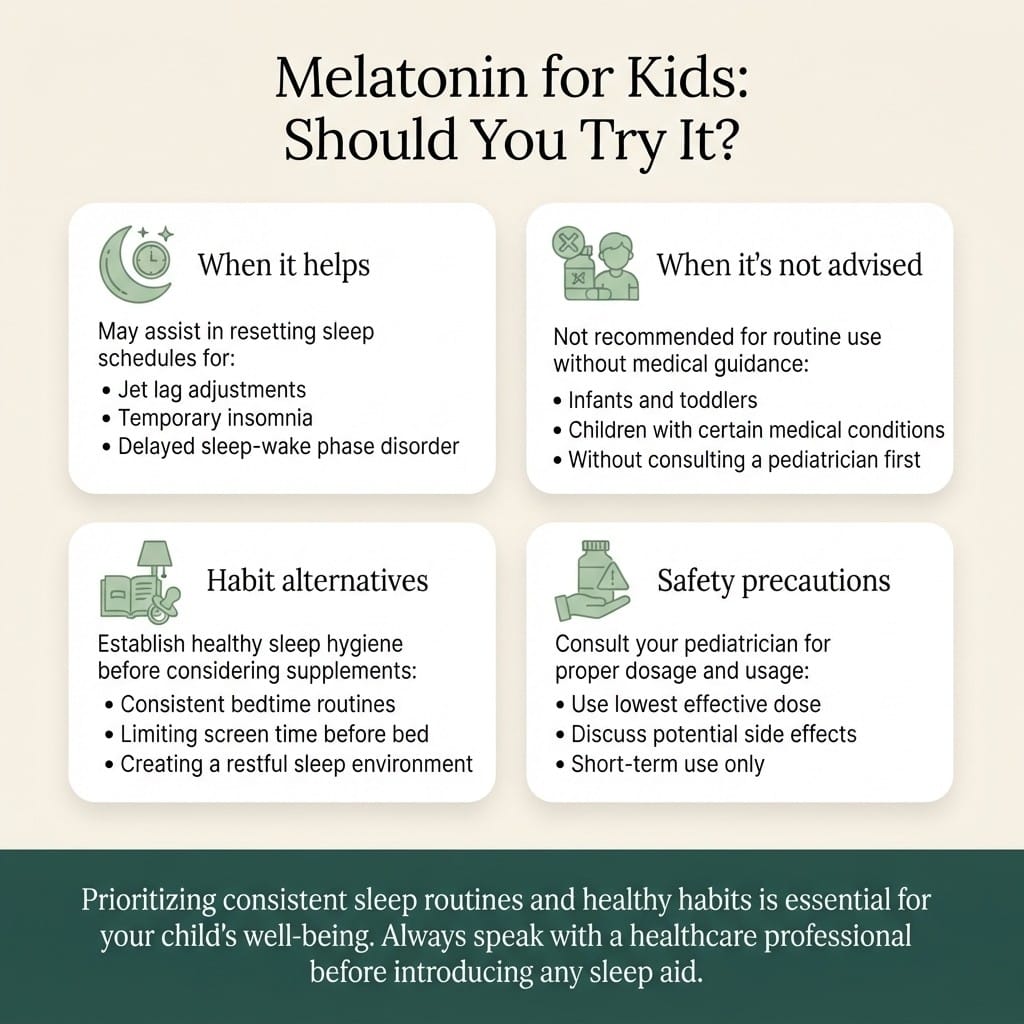
Melatonin may be appropriate for some children, but it should not be the first solution for common bedtime struggles. Most sleep experts recommend improving sleep habits first and using melatonin only under guidance from a pediatrician.
| Melatonin at a Glance | |
|---|---|
| Works best for | Falling asleep earlier |
| Not recommended for | Routine bedtime struggles |
| First step | Improve sleep habits |
| Long-term use | Only under medical supervision |
| Always consult | Your child’s pediatrician |
This article is part of our complete Ultimate Guide to Healthy Sleep for Kids. If bedtime struggles are the main issue, see How to Help a Child Fall Asleep Faster and Sleep Hygiene for Kids for non-supplement strategies first.
Table of Contents
What Is Melatonin? · Is Melatonin Safe for Kids? · When Doctors May Recommend It · Possible Side Effects · Long-Term Safety: What We Know · When NOT to Use Melatonin · Natural Ways to Improve Sleep First · When to Talk to a Pediatrician · FAQ
What Is Melatonin?
Melatonin is a hormone the brain produces naturally in response to darkness, signaling to the body that it’s time to prepare for sleep. Levels rise in the evening and fall toward morning as part of the circadian rhythm.
The melatonin sold in stores is a synthetic or animal/plant-derived version of this hormone, taken as a supplement — most commonly as gummies, tablets, or liquid drops — to help shift or support the body’s natural sleep signal.
Is Melatonin Safe for Kids?
Short-term melatonin use appears to be relatively well tolerated in children based on the studies conducted so far. However, major pediatric and sleep medicine organizations are notably cautious: the American Academy of Pediatrics advises that melatonin decisions be made jointly by parents and pediatricians, cautiously and carefully, rather than treated as a routine sleep aid, and the American Academy of Sleep Medicine’s 2022 health advisory similarly urges parents to consult a healthcare provider before giving melatonin to a child.
Does melatonin make kids sleep longer? Not necessarily. Melatonin primarily helps some children fall asleep earlier or faster — it does not reliably improve overall sleep quality or prevent night waking once a child is asleep.
🔬 Science Says
Independent testing has found that some melatonin supplements contain significantly more or less melatonin than their labels indicate, and a small number have contained additional, undisclosed ingredients. This is one reason sleep experts recommend discussing melatonin with a pediatrician before using it.
When Doctors May Recommend Melatonin
| Situation | Is Melatonin Appropriate? |
|---|---|
| Child occasionally resists bedtime | ❌ Usually not — address habits first |
| Inconsistent or poor bedtime routine | ❌ Fix the routine first |
| Jet lag or short-term schedule shift | ✅ Sometimes, short-term |
| Autism, ADHD, or other conditions with sleep issues | ✅ May be recommended by a doctor |
| Long-term nightly use | ❌ Not without medical supervision |
Pediatricians may consider melatonin in specific situations, including:
- Certain neurodevelopmental conditions associated with significant sleep difficulties, where research support is strongest
- Circadian rhythm issues, such as a sleep schedule that’s significantly out of sync with a needed routine (for example, after travel across time zones)
- As a short-term tool alongside — not instead of — consistent bedtime routines and sleep hygiene habits
In these cases, a pediatrician determines whether melatonin is appropriate and, if so, guides the dose, timing, and duration individually — this isn’t something to determine on your own from a product label or general online guidance.
Possible Side Effects
Reported side effects of melatonin in children are generally mild:
| Common | Less Common |
|---|---|
| Daytime drowsiness | Increased bedwetting |
| Headache | Mood changes |
| Dizziness | Morning grogginess |
| Nausea or stomach discomfort | Vivid dreams |
Most side effects are temporary and resolve after reducing the dose or stopping melatonin, but any persistent or concerning symptoms should be discussed with your child’s pediatrician.
Because melatonin is a hormone rather than a simple sedative, there are also open questions about its effects on other hormone-regulated processes when used regularly over time — which is part of why medical guidance recommends short-term, supervised use rather than nightly long-term use without a doctor’s involvement.
Long-Term Safety: What We Know (and Don’t Know)
Most existing research on melatonin in children has focused on short-term use, often a few weeks to a few months. Some longer-term studies — generally in children with specific neurodevelopmental conditions — have not identified major red flags for sleep quality or general development over the periods studied.
That said, researchers and pediatric organizations are candid that long-term safety data in otherwise healthy children remains limited. This gap in long-term research is a central reason major organizations recommend involving a pediatrician rather than using melatonin as an ongoing, unsupervised solution.
Researchers are also still studying whether long-term melatonin use could affect puberty or hormonal development, although current evidence has not confirmed this in healthy children.
When NOT to Use Melatonin
- As a first response to occasional bedtime resistance or a single rough night
- As a substitute for a consistent bedtime routine and healthy sleep habits
- Without first discussing it with your child’s pediatrician
- In a dose or product not specifically recommended for your child, since over-the-counter products vary widely in strength and purity
- As a long-term nightly solution without medical follow-up
Keep Melatonin Out of Reach
Melatonin gummies often look and taste like candy, and accidental ingestions have become a growing concern in the United States. A CDC report found that pediatric melatonin ingestions reported to poison control centers increased 530% between 2012 and 2021, with the sharpest rise among children age 5 and under — occasionally resulting in serious outcomes.
- Store melatonin in its original, child-resistant container — not a pillbox or unmarked container
- Keep it out of children’s sight and reach, the same as any medication
- Don’t refer to melatonin gummies as “candy” or “treats” to a child
- If you suspect your child has ingested more than the intended amount, contact Poison Control or seek medical care promptly
Natural Ways to Improve Sleep Before Trying Supplements
Pediatric guidance consistently points to behavioral strategies as the first step, before considering a supplement, roughly in this order of priority:
- Consistent bedtime and wake time — see Sleep Hygiene for Kids
- Screen-free evening, with devices off well before bedtime
- A calm, predictable bedtime routine
- Bedroom environment — cool, dark, and quiet
- Daytime physical activity
- Morning sunlight exposure
- Discuss melatonin with a pediatrician if sleep struggles persist
These approaches address the underlying causes of many sleep struggles and, unlike a supplement, build habits that continue to support sleep over the long run.
When to Talk to a Pediatrician
Reach out to your child’s pediatrician before starting melatonin, and especially if:
- Sleep difficulties persist despite consistent bedtime routines and sleep hygiene
- Your child has a diagnosed neurodevelopmental or medical condition affecting sleep
- You’re unsure about product quality, dosing, or timing
- Your child experiences side effects while using melatonin
- You’re considering melatonin for regular, ongoing use rather than an occasional or short-term situation
Frequently Asked Questions
Is melatonin safe for kids?
Short-term use appears relatively well tolerated based on current research, but major pediatric organizations recommend consulting a pediatrician before use rather than treating it as a routine, over-the-counter sleep aid.
What dose of melatonin should I give my child?
Dosing should be determined by your child’s pediatrician based on their age, weight, and specific situation, since over-the-counter products vary in strength and purity and are not FDA-regulated the way medications are.
Can melatonin be used every night long-term?
Long-term safety data in otherwise healthy children is limited, which is why medical guidance generally recommends short-term, supervised use rather than ongoing nightly use without a doctor’s involvement.
What are common side effects of melatonin in kids?
Reported side effects are generally mild and can include daytime drowsiness, headache, dizziness, nausea, or increased bedwetting in some children.
Should I try melatonin before improving sleep habits?
No. Pediatric guidance recommends addressing sleep habits and routine first, since melatonin is not meant to replace consistent bedtime routines and healthy sleep hygiene.
Key Takeaways
- Melatonin is a natural sleep hormone; supplements are a synthetic or derived version, not FDA-regulated as a medication.
- Major pediatric organizations don’t recommend it for routine, general use — a pediatrician should be involved in the decision.
- Side effects are usually mild, but long-term safety data in healthy children remains limited.
- Behavioral sleep strategies should come first; melatonin is a short-term, supervised tool, not a bedtime routine replacement.
For most children, healthy sleep habits solve the problem more effectively than supplements. Melatonin can be helpful in specific situations, but it works best as part of a broader sleep plan created with your child’s pediatrician — not as a nightly shortcut.
Start with the strategies most likely to help first: Sleep Hygiene for Kids and How to Help a Child Fall Asleep Faster, or explore our complete Ultimate Guide to Healthy Sleep for Kids.
References
- American Academy of Pediatrics / HealthyChildren.org. Melatonin for Kids: What Parents Should Know About This Sleep Aid. healthychildren.org
- American Academy of Sleep Medicine. Health Advisory: Melatonin Use in Children and Adolescents. 2022. aasm.org
- Erland LAE, Saxena PK. Melatonin Natural Health Products and Supplements: Presence of Serotonin and Significant Variability of Melatonin Content. J Clin Sleep Med. 2017;13(2):275–281. jcsm.aasm.org
- Esposito S, et al. Efficacy and Safety of Supplemental Melatonin for Delayed Sleep–Wake Phase Disorder in Children: An Overview. National Center for Biotechnology Information (NCBI/PMC, NIH). ncbi.nlm.nih.gov
- Paruthi S, Brooks LJ, D’Ambrosio C, et al. Recommended Amount of Sleep for Pediatric Populations: A Consensus Statement of the American Academy of Sleep Medicine. J Clin Sleep Med. 2016;12(6):785–786. aasm.org
- Centers for Disease Control and Prevention. About Sleep. cdc.gov
- Lelak K, Vohra V, Neuman MI, Toce MS, Sethuraman U. Pediatric Melatonin Ingestions — United States, 2012–2021. MMWR Morb Mortal Wkly Rep. 2022;71(22):725–729. cdc.gov
This article is for informational purposes only and does not replace personalized medical advice. Always consult your child’s pediatrician before starting melatonin or any supplement.