Teen Sleep
If you’ve ever wondered why your teenager can’t seem to fall asleep before midnight — even on school nights — the answer isn’t simply poor discipline. Many parents assume their teenager just isn’t trying hard enough to go to bed earlier. In reality, adolescence brings predictable biological changes that make falling asleep early much more difficult, even for responsible teens.
Understanding what’s happening inside the teenage brain at night can help families build a sleep routine that works with, rather than against, a teen’s natural body clock. Sleep also interacts with other areas of teenage health, including the topics covered in our guide to the gut-brain-skin connection.
In 2023, 23% of American high school students reported sleeping eight or more hours on an average school night, down from 32% in 2013 — according to the CDC’s Youth Risk Behavior Survey trends report covering that period. Chronic sleep deprivation is one of the most common health challenges of adolescence.
Every teenager’s sleep needs and natural rhythm are a little different. The information below reflects general research-based patterns rather than fixed rules for every family.
Why Teens Naturally Stay Up Later
During puberty, the body’s internal clock begins to shift. The evening release of melatonin — the hormone that signals it’s time to sleep — shifts to a later time as puberty progresses.
At the same time, teenagers still need 8 to 10 hours of sleep per 24 hours. Early school start times often make getting enough sleep extremely difficult.
Understanding the Circadian Rhythm
Every person has an internal 24-hour clock called the circadian rhythm. During puberty, this clock naturally shifts later, meaning teenagers simply don’t become sleepy as early as children or most adults.
This biological delay explains why forcing an early bedtime often leads to frustration instead of sleep. It’s not laziness — it’s a normal stage of development.
Why Phones Make Falling Asleep Even Harder
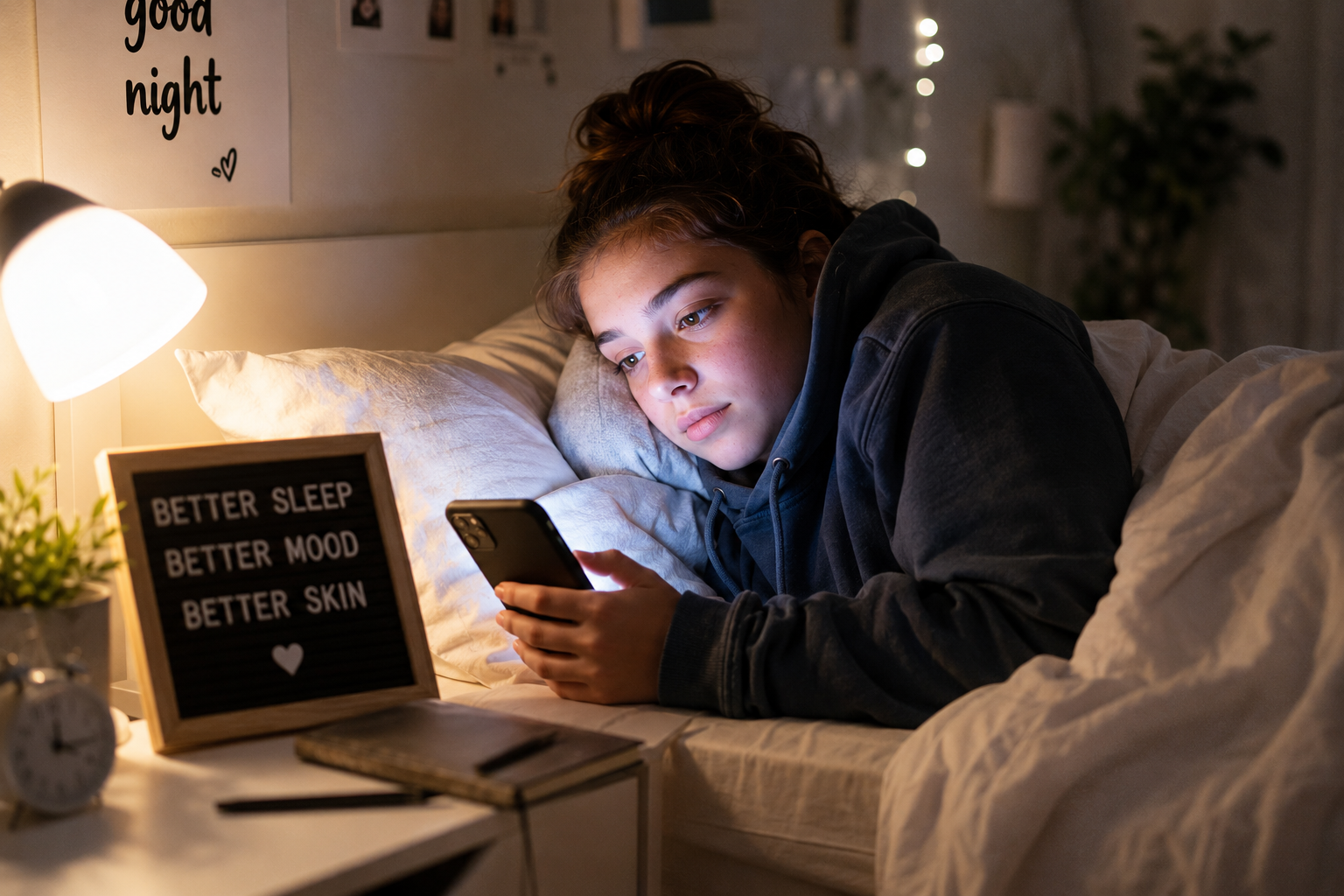
Smartphones interfere with sleep in more than one way. Blue light suppresses melatonin production, making it harder for the brain to recognize that it’s time to sleep. At the same time, social media, gaming, messaging, videos, and endless scrolling keep the brain mentally stimulated when it should be winding down.
The evidence here is about habits rather than moments. In a small randomised pilot trial, college students with poor sleep who avoided their phones for the half hour before bed fell asleep faster and slept longer over four weeks. Research of this kind has not tested what a single glance at a notification does, and most of it has not been run in teenagers — so what the evidence supports is the consistent evening limit, not the one check.
Hidden Sources of Caffeine
Many teenagers consume more caffeine than they realize. Besides coffee, caffeine is found in:
- Tea
- Energy drinks
- Cola and other caffeinated soft drinks
- Pre-workout supplements
- Some chocolate products
Because caffeine can remain in the body for several hours, it’s best to avoid it after the early afternoon whenever possible.
Exercise Supports Better Sleep
Regular physical activity improves sleep quality in children and teenagers — a finding supported by a meta-analysis of 27 randomised trials. The same analysis found the effect on how quickly they fall asleep was much less consistent, with results ranging from a large benefit to none at all. Outdoor exercise offers an additional benefit by exposing the body to natural daylight.
Very intense exercise close to bedtime is reasonable to avoid, though estimates of how close vary. A meta-analysis of evening exercise trials found sleep was affected mainly when vigorous exercise ended within about an hour of bed; a large study using wearable data suggested a wider window for strenuous sessions. Most of this research has been done in adults.
What Is Sleep Debt?
Missing just one or two hours of sleep each night may not seem like much, but over the course of a school week those lost hours add up into what’s known as sleep debt.
Sleep Patterns That May Point to Not Enough Sleep
Sleep debt can show up in different ways during the day or across the week. The patterns below can be worth noticing, but none of them alone proves that a teen is not getting enough sleep.
- Difficulty waking up in the morning, especially when it happens alongside short sleep or persistent daytime sleepiness
- Sleeping noticeably longer on weekends after getting less sleep on school nights
- More irritability or moodiness than usual
- More difficulty concentrating, staying focused, or keeping up with schoolwork
- Falling asleep during quiet or passive activities, such as watching TV or riding in a car
- Craving sugary or highly palatable foods more often than usual
Extra weekend sleep can be a normal response to accumulated sleep loss. That makes the pattern across the whole week more useful to notice than weekend sleep alone.
Sleep and School Performance
Sleep is essential for memory, attention, learning, and problem-solving. Even a single night without sleep measurably reduces sustained attention and alertness the next day. Effects on retaining new information and on classroom results have mainly been demonstrated after a week of restricted sleep rather than one bad night.
The Sleep-Skin Connection
Poor sleep may also play a role in skin problems, alongside other factors we cover in diet and teen acne.
Sleep is when much of the skin’s repair work happens: overnight, the body supports skin-cell renewal and recovery from daily environmental stress. The evidence connecting how much a teenager sleeps to visible skin problems such as acne is largely observational, however, and a large genetic study did not find evidence of a causal link. Sleep is worth protecting for many reasons; clearer skin is not a guaranteed result.
Create a Sleep-Friendly Bedroom
The bedroom environment plays a bigger role than many families realize. A cool, dark, and quiet room helps signal to the brain that it’s time to sleep. Comfortable bedding, blackout curtains when needed, and reducing bright lights before bedtime can make falling asleep easier. Whenever possible, phones and other electronic devices should stay outside the bedroom overnight.
Should Teens Sleep In on Weekends?
Sleeping an extra hour or two on weekends can help reduce fatigue. However, sleeping until late morning or early afternoon often shifts the body’s internal clock even later, making Sunday night and Monday morning especially difficult. A good goal is to keep the weekend wake-up time close to the usual weekday schedule.
Are Naps Helpful?
A short nap in the early afternoon may improve alertness without interfering with nighttime sleep. Long naps — or naps taken late in the afternoon — often make it harder to fall asleep at bedtime.
Building a Sleep Routine That Actually Works
Healthy sleep habits don’t have to be complicated.
- Keep screens out of the bedroom or stop using them at least 60 minutes before bedtime
- Wake up at roughly the same time every day, keeping your weekend wake-up time reasonably close to your weekday schedule
- Get natural sunlight soon after waking up
- Avoid caffeine after the early afternoon
- Create a relaxing bedtime routine such as reading, gentle stretching, journaling, or taking a warm shower
- Keep the bedroom cool, dark, and quiet
Recommended Sleep by Age
| Age | Recommended Sleep (per 24 hours) |
|---|---|
| 6-12 years | 9-12 hours |
| 13-18 years | 8-10 hours |
Healthy Evening Habits
| Instead of | Try |
|---|---|
| Scrolling social media | Reading a book |
| Energy drinks | Water or herbal tea |
| Gaming before bed | Gentle stretching or journaling |
| Bright bedroom lights | Dim lighting |
| Sleeping until noon on weekends | Waking close to your weekday schedule |
Teen Sleep Checklist
- ✅ Wake up at roughly the same time every day, including weekends when possible
- ✅ Get morning sunlight
- ✅ Stay physically active
- ✅ Avoid caffeine after lunch
- ✅ Turn off screens at least 60 minutes before bed
- ✅ Keep the bedroom cool, dark, and quiet
- ✅ Aim for 8-10 hours of sleep per 24 hours
Consistency Matters More Than Perfection
Missing the routine once in a while won’t undo healthy sleep habits. What matters most is following a consistent schedule on most days. Small habits practiced regularly have a much greater impact than trying to be perfect.
In trials where teenagers gradually extended their sleep at home — typically over periods of a week or more — sleep duration and sleep quality improved and daytime sleepiness decreased, though the degree of improvement varied considerably between groups.
When Poor Sleep May Need Medical Advice
Healthy habits solve many sleep problems, but not all of them. If your teenager experiences persistent insomnia, loud snoring, pauses in breathing during sleep, severe daytime sleepiness, frequent headaches, or ongoing anxiety or low mood, it’s important to seek medical advice. The American Academy of Pediatrics recommends that all children and adolescents be screened for snoring, and that regular snoring accompanied by other symptoms be evaluated further.
Still have questions? Here are some of the most common concerns parents ask about teen sleep.
Frequently Asked Questions
Why does my teen fall asleep so late even with an early bedtime?
During puberty, melatonin naturally begins to rise later in the evening, making it biologically difficult for many teenagers to fall asleep early.
Does lack of sleep really affect acne?
Possibly, but the evidence is weaker than it is usually presented. Some observational studies have linked poor sleep quality with more severe acne, but these are largely cross-sectional and cannot establish cause. A large genetic study using Mendelian randomisation did not find evidence of a causal link between sleep traits and acne. Sleep matters for many aspects of teenage health; acne is not the strongest example.
How much sleep does a teenager actually need?
Most teenagers need 8 to 10 hours of sleep per 24 hours, although many get considerably less because of early school schedules and evening screen use.
Can teens catch up on sleep over the weekend?
Sleeping a little longer can reduce fatigue, but sleeping in too late may make it harder to fall asleep on Sunday night. Keeping your weekend wake-up time reasonably close to your weekday schedule can help keep your sleep routine on track.
Is melatonin safe for teenagers?
Melatonin can help in specific situations, such as when a teenager’s body clock is clearly out of step with their schedule. The American Academy of Sleep Medicine notes that there is little evidence that melatonin is effective for insomnia in otherwise healthy children, and advises parents to discuss its use with a pediatric health care professional before starting it. Many sleep problems can be better managed by adjusting schedules, habits, or behaviors rather than taking melatonin.
How much screen time is too much before bed?
The American Academy of Pediatrics recommends avoiding phones, tablets, computers, televisions, and other bright screens for at least one hour before bedtime whenever possible.
Final Thoughts
Better sleep isn’t just about avoiding daytime fatigue. It’s one of the foundations of a teenager’s physical health, emotional well-being, and academic performance.
By understanding how the teenage body clock works — and by building realistic habits that support it — families can replace bedtime battles with routines that help teenagers thrive for years to come.
This article focuses on teen sleep specifically. For younger kids, sleep cycles, hygiene, and troubleshooting common problems, see our complete Ultimate Guide to Healthy Sleep for Kids.
References
- Centers for Disease Control and Prevention. Youth Risk Behavior Survey Data Summary & Trends Report: 2013-2023. U.S. Department of Health and Human Services; 2024.
- Crowley SJ, Van Reen E, LeBourgeois MK, Acebo C, Tarokh L, Seifer R, Barker DH, Carskadon MA. A longitudinal assessment of sleep timing, circadian phase, and phase angle of entrainment across human adolescence. PLoS One. 2014;9(11):e112199. doi:10.1371/journal.pone.0112199
- Paruthi S, Brooks LJ, D’Ambrosio C, Hall WA, Kotagal S, Lloyd RM, Malow BA, Maski K, Nichols C, Quan SF, Rosen CL, Troester MM, Wise MS. Recommended amount of sleep for pediatric populations: a consensus statement of the American Academy of Sleep Medicine. J Clin Sleep Med. 2016;12(6):785-786. doi:10.5664/jcsm.5866
- van der Lely S, Frey S, Garbazza C, Wirz-Justice A, Jenni OG, Steiner R, Wolf S, Cajochen C, Bromundt V, Schmidt C. Blue blocker glasses as a countermeasure for alerting effects of evening light-emitting diode screen exposure in male teenagers. J Adolesc Health. 2015;56(1):113-119. doi:10.1016/j.jadohealth.2014.08.002
- He JW, Tu ZH, Xiao L, Su T, Tang YX. Effect of restricting bedtime mobile phone use on sleep, arousal, mood, and working memory: a randomized pilot trial. PLoS One. 2020;15(2):e0228756. doi:10.1371/journal.pone.0228756
- Song H, Jiang X, Li Y, Cao Y, et al. Effects of physical activity on sleep in children and adolescents: a systematic review and meta-analysis of randomised controlled trials. Eur Child Adolesc Psychiatry. 2026;35:397-411. doi:10.1007/s00787-025-02892-6
- Stutz J, Eiholzer R, Spengler CM. Effects of evening exercise on sleep in healthy participants: a systematic review and meta-analysis. Sports Med. 2019;49(2):269-287. doi:10.1007/s40279-018-1015-0
- Leota J, Presby DM, Le F, Czeisler MÉ, Mascaro L, Capodilupo ER, Wiley JF, Drummond SPA, Rajaratnam SMW, Facer-Childs ER. Dose-response relationship between evening exercise and sleep. Nat Commun. 2025;16:3297. doi:10.1038/s41467-025-58271-x
- Louca M, Short MA. The effect of one night’s sleep deprivation on adolescent neurobehavioral performance. Sleep. 2014;37(11):1799-1807. doi:10.5665/sleep.4174
- Tian C. No associations between genetically predicted chronotype, insomnia, daytime sleepiness, or physical activity and acne vulgaris: a two-sample Mendelian randomization study. Clin Cosmet Investig Dermatol. 2025;18:827-835. doi:10.2147/CCID.S510739
- Niu X, Zhou S, Casement MD. The feasibility of at-home sleep extension in adolescents and young adults: a meta-analysis and systematic review. Sleep Med Rev. 2021;58:101443. doi:10.1016/j.smrv.2021.101443
- Marcus CL, Brooks LJ, Draper KA, Gozal D, Halbower AC, Jones J, Schechter MS, Sheldon SH, Spruyt K, Ward SD, Lehmann C, Shiffman RN. Diagnosis and management of childhood obstructive sleep apnea syndrome. Pediatrics. 2012;130(3):576-584. doi:10.1542/peds.2012-1671
- American Academy of Sleep Medicine. Health Advisory: Melatonin Use in Children and Adolescents. Adopted September 9, 2022.
- American Academy of Pediatrics. Healthy Sleep Habits: How Many Hours Does Your Child Need? HealthyChildren.org.
- Owens J; Adolescent Sleep Working Group; Committee on Adolescence. Insufficient sleep in adolescents and young adults: an update on causes and consequences. Pediatrics. 2014;134(3):e921-e932. doi:10.1542/peds.2014-1696
- Munzer T, Parga-Belinkie J, Milkovich LM, et al; American Academy of Pediatrics, Council on Communications and Media. Digital Ecosystems, Children, and Adolescents: Policy Statement. Pediatrics. 2026;157(2):e2025075320. doi:10.1542/peds.2025-075320