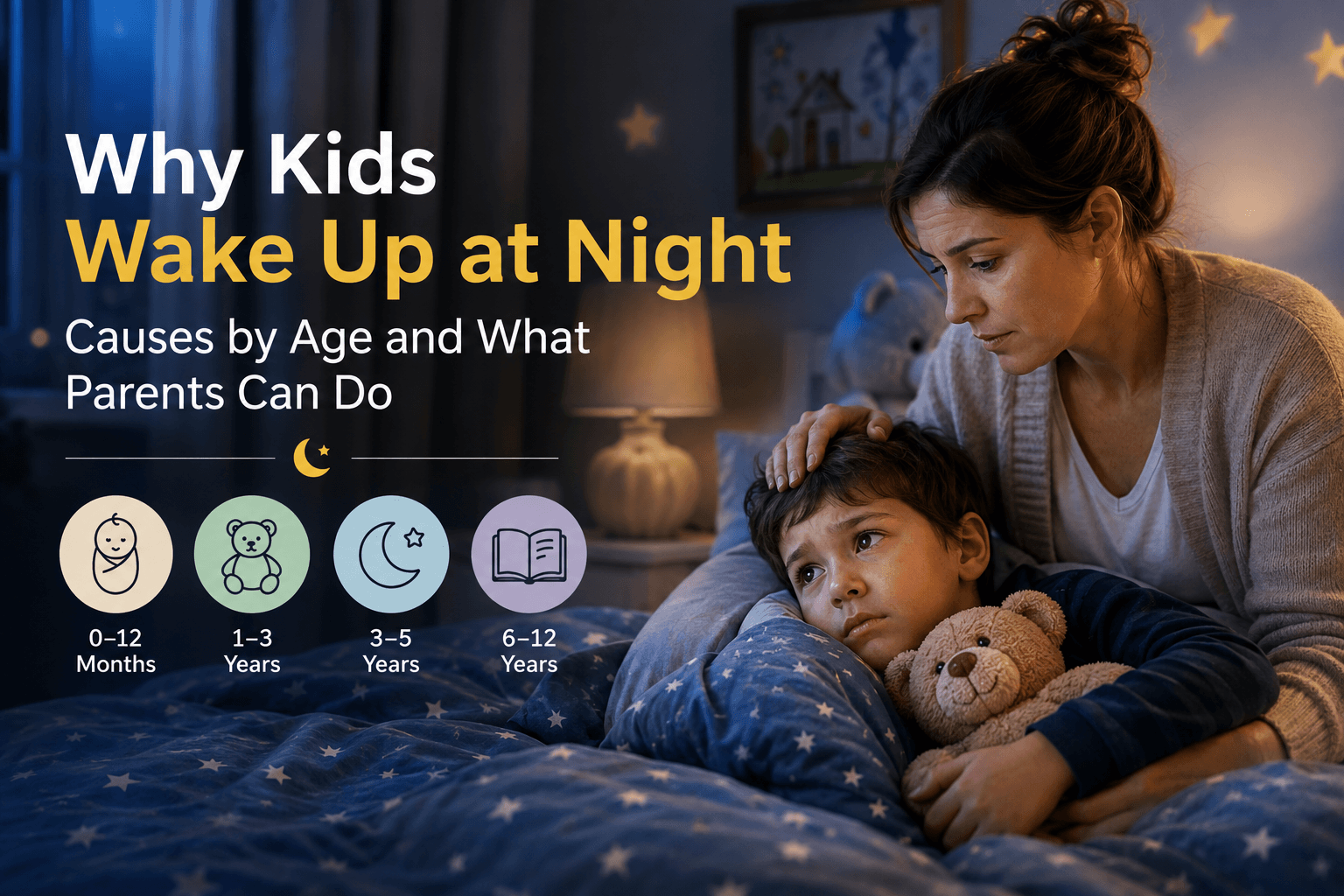
Why Kids Wake Up at Night: Causes by Age and What Parents Can Do (Science-Based Guide)
Estimated reading time: 20–24 minutes
Few parenting challenges are as exhausting as a child who wakes up several times during the night. Whether it’s a baby who needs feeding, a toddler calling for a parent, or a school-age child frightened by a nightmare, nighttime waking can leave the whole family sleep deprived.
The reassuring news is that waking during the night is often a normal part of child development. However, the reasons — and what actually helps — change significantly as children grow. Understanding what’s typical at each age helps parents respond in a way that supports both comfort and healthy, independent sleep.
This article is part of our complete Ultimate Guide to Healthy Sleep for Kids. For sleep duration by age, see How Much Sleep Do Kids Need by Age, and for the daily habits that support better sleep overall, see Sleep Hygiene for Kids.
Table of Contents
Is It Normal for Kids to Wake Up at Night? · Why Babies Wake Up · Why Toddlers Wake Up · Why Preschoolers Wake Up · Why School-Age Kids Wake Up · Medical Causes · Emotional Causes · How Parents Can Help · When to Call a Doctor · FAQ
Is It Normal for Kids to Wake Up at Night?
Yes — in most cases, and at nearly every age. Sleep cycles are shorter in young children than in adults and gradually lengthen with age, and each cycle includes a brief transition through a lighter stage of sleep. Passing through that lighter stage is a natural moment for a brief wake-up — the difference between children who “sleep through the night” and those who don’t often comes down to whether a child can settle back to sleep independently, not whether they wake up at all.
🔬 Science Says
The Sleep Disorder Center at Nationwide Children’s Hospital notes that all children wake briefly throughout the night — typically four to six arousals — regardless of age. Most children fall back asleep within seconds without any memory of waking, which is why the real question for parents usually isn’t “why did they wake up” but “why can’t they resettle on their own.”
Why Babies Wake Up at Night (0–12 Months)
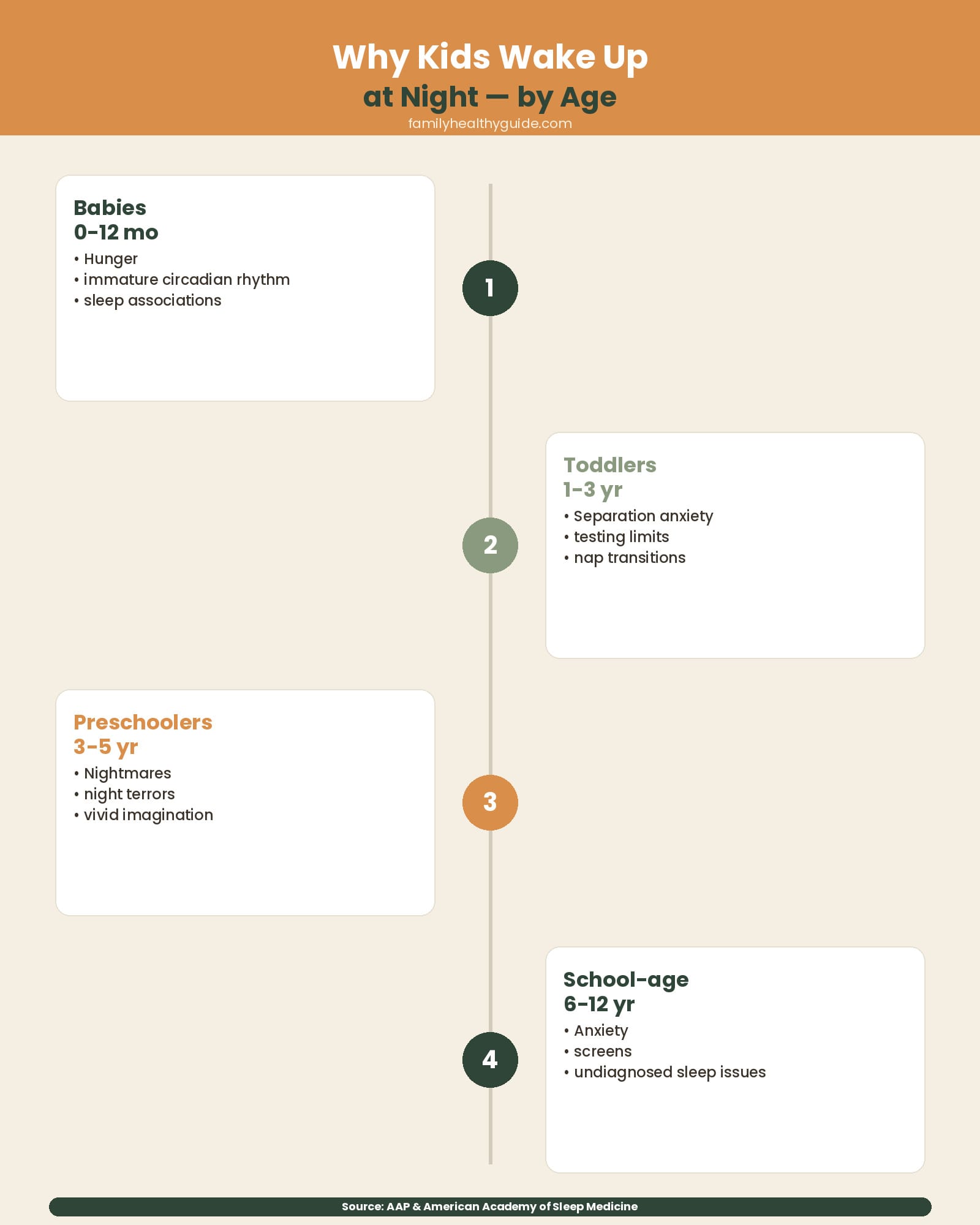
Hunger. Newborns have small stomachs and need to feed every 2–4 hours around the clock; this is biologically necessary, not a sleep problem to solve.
Immature circadian rhythm. Babies aren’t born with an adult day/night cycle. Circadian rhythms begin to mature during the first few months of life, with melatonin secretion gradually becoming more established after birth — which is part of why day/night confusion is common in the earliest weeks.
Sleep associations. Babies who fall asleep being rocked, fed, or held often wake fully when they surface into a lighter sleep stage and the same conditions aren’t present — not because something is wrong, but because that’s how they learned to fall asleep in the first place. The American Academy of Pediatrics notes it’s normal for a 6-month-old to wake briefly and resettle within a few minutes on their own.
Developmental leaps and regressions. Often referred to as the “4-month sleep regression,” this period reflects a normal developmental change in infant sleep architecture rather than a medical condition. Similar temporary increases in night waking are common again around 8–10 months and 12 months, often coinciding with new physical or cognitive skills (rolling, crawling, standing, object permanence).
Teething and growth spurts. Both can cause temporary discomfort or increased hunger that disrupts otherwise established sleep.
Why Toddlers Wake Up at Night (1–3 Years)
Separation anxiety. This peaks developmentally around 12–18 months and often produces a toddler who previously slept well but now wakes calling for a parent.
Testing independence and limits. As toddlers develop a stronger sense of self, bedtime and night waking can become an arena for asserting control — this is a normal developmental stage, not defiance.
Nap transitions. Moving from two naps to one (typically 15–18 months) or dropping naps too early or too late can throw off nighttime sleep pressure in either direction.
Nightmares. These can begin to emerge as imagination and memory develop, typically in the second half of this age range.
💡 Quick Parent Tip
When a toddler wakes and calls out, a brief, calm, low-stimulation check-in (“brief and boring,” as Nationwide Children’s Hospital sleep guidance puts it) tends to help more than a long conversation or bringing them into another bed — both of which can unintentionally reinforce night waking as a rewarding event.
Why Preschoolers Wake Up at Night (3–5 Years)
Nightmares and night terrors both peak in this window. Nightmares are remembered, occur during REM sleep later in the night, and often come with genuine fear the child can describe. Night terrors are not remembered by the child, occur during non-REM deep sleep earlier in the night, and can look alarming (crying, thrashing, sitting up looking scared) despite the child not being truly awake or aware.
Vivid imagination. Preschoolers’ rapidly developing imagination — a cognitive strength — can also make them more prone to fear of the dark, monsters, or specific nighttime worries.
Overtiredness. Skipping a still-needed nap or an overly late bedtime at this age can paradoxically increase night waking, rather than simply causing deeper sleep.
Illness. Preschoolers are frequently exposed to common colds and minor illnesses at daycare or school, which regularly disrupt sleep temporarily.
Why School-Age Kids Wake Up at Night (6–12 Years)
Night waking becomes less frequent at this age for most children, which means new or ongoing waking is more often worth paying closer attention to.
Anxiety. Worries about school, friendships, or family events can surface specifically at night, when a child is alone with their thoughts.
Screen exposure. Evening screen use — even passive viewing — can both delay sleep onset and reduce sleep quality, increasing the likelihood of waking.
Undiagnosed sleep disorders. This is the age range where conditions like sleep-disordered breathing or restless leg symptoms more often become noticeable, since school-age children can better describe what they’re experiencing.
Irregular schedules. Sports, activities, and social schedules can pull bedtime and wake time in inconsistent directions, disrupting the circadian rhythm that supports staying asleep.
Common Medical Causes of Night Waking
While most night waking is developmentally normal, certain medical causes are worth knowing about — not to alarm parents, but to help identify when a pattern deserves a conversation with a pediatrician.
| Possible Cause | What to Watch For |
|---|---|
| Obstructive sleep apnea | Habitual snoring (3+ nights/week); pauses in breathing; gasping; restless sleep; daytime irritability or hyperactivity |
| Allergies or nasal congestion | Mouth breathing, difficulty breathing while lying flat, frequent waking during allergy season |
| Acid reflux (GERD) | Waking with discomfort, coughing, or crying shortly after lying down, especially in infants |
| Eczema or skin irritation | Visible skin flare-ups, scratching during sleep, waking distressed |
| Restless legs or growing pains | Complaints of leg discomfort, an urge to move legs, especially in school-age children |
| Ear infections | Waking crying, tugging at ears, often alongside cold symptoms |
🔬 Science Says
The American Academy of Pediatrics recommends that all children be screened for snoring, defining habitual snoring as snoring three or more nights per week — a potential sign of obstructive sleep apnea, most often caused by enlarged tonsils or adenoids in children, and a condition that’s treatable once identified.
Emotional Causes: Stress, Anxiety, and Nightmares
Emotional factors are among the most under-recognized causes of night waking, particularly in preschool and school-age children.
Everyday stress. Changes at home, a new sibling, starting school, or even an exciting event can temporarily increase night waking in an otherwise good sleeper.
Anxiety. Generalized worry or specific fears (the dark, being alone, monsters) can make both falling asleep and staying asleep harder — and often shows up more at night simply because there are fewer daytime distractions.
Nightmares vs. night terrors. According to the American Academy of Pediatrics, nightmares can begin as early as 6 months and tend to peak between ages 3 and 12; a child having a nightmare wakes up, is often frightened, and typically seeks comfort. Night terrors, per the Mayo Clinic, involve intense fear, crying, or thrashing while the child remains asleep and unaware — most children outgrow them by adolescence. For a full breakdown, see our dedicated guide: Nightmares vs. Night Terrors: What’s the Difference?
💡 Quick Parent Tip
For a child with recurring nighttime worries, a short “worry time” earlier in the evening — a few minutes to talk through concerns well before the bedtime routine begins — can reduce the tendency for anxious thoughts to surface right at lights-out.
How Parents Can Help
Keep responses calm, brief, and consistent. A predictable, low-key response to night waking — rather than an unpredictable or highly engaged one — helps a child settle back to sleep faster over time and avoids unintentionally reinforcing the waking itself.
Protect a consistent bedtime and wake time. A steady schedule supports the circadian rhythm most directly involved in staying asleep through the night. See our complete Sleep Hygiene for Kids guide for the full set of supporting habits.
Address fears directly, not dismissively. Validating a fear (“that sounds scary”) while offering reassurance and a simple coping tool (a nightlight, a favorite stuffed animal) tends to work better than telling a child there’s nothing to be afraid of.
Rule out simple physical causes first. Room temperature, hunger, an uncomfortable pajama, or a wet diaper are common, easily fixed causes worth checking before assuming a deeper issue.
Avoid creating new sleep associations during a rough patch. It’s tempting to rock, feed, or co-sleep during a difficult stretch — reasonable in the short term, but worth returning to the previous routine once the disruption passes to avoid a new dependency forming.
Give it time during developmental leaps. Sleep regressions tied to development are usually temporary — maintaining consistency through the disruption, rather than overhauling the whole routine, is often the most effective approach.
When to Call a Doctor
Most night waking resolves on its own or with consistent routines. It’s worth a conversation with your child’s pediatrician if you notice:
- Loud, habitual snoring (3+ nights per week) or pauses in breathing during sleep
- Night waking that persists for more than a few weeks despite consistent routines
- Significant daytime sleepiness, irritability, or behavior changes
- Signs of pain, itching, or physical discomfort during sleep
- Frequent, distressing nightmares that affect a child’s willingness to sleep, or sleep terrors that raise safety concerns
- Sudden onset of new night waking in a child who previously slept well, without an obvious cause
Frequently Asked Questions
Is it normal for my child to wake up every night?
Brief night waking is developmentally normal at nearly every age. What matters most is whether your child can settle back to sleep with minimal support, and whether the pattern is stable or worsening over time.
At what age do most kids stop waking up at night?
Many children sleep through the night more consistently by school age, though occasional waking can continue at any age, especially during stress, illness, or developmental changes.
Should I go to my child every time they wake up?
A brief, calm check-in is usually enough. Keeping the response low-key and consistent helps children learn to settle back to sleep more independently over time.
Can teething really cause night waking?
Yes, teething discomfort can cause temporary night waking in infants and toddlers, though it’s often blamed for waking that has other causes as well.
What’s the difference between a nightmare and a night terror?
A nightmare wakes a child, who is often frightened and can usually describe the dream. A night terror happens while a child remains asleep and unaware, and they typically have no memory of it the next morning.
When should I be concerned about my child’s night waking?
Habitual loud snoring, breathing pauses, persistent waking despite consistent routines, or significant daytime symptoms are all reasons to talk with your child’s pediatrician.
Key Takeaways
- Night waking is developmentally normal at nearly every age — the specific causes shift as children grow.
- Babies wake primarily for hunger and an immature circadian rhythm; toddlers and preschoolers more often wake due to separation anxiety, nightmares, or developmental leaps; school-age waking is more often tied to anxiety, screens, or an underlying sleep issue.
- A calm, brief, and consistent response helps most children return to independent sleep faster than an elaborate one.
- Habitual snoring, persistent waking despite good routines, or significant daytime symptoms are reasons to consult a pediatrician.
Continue building healthy sleep habits with our complete Ultimate Guide to Healthy Sleep for Kids, check your child’s sleep needs in How Much Sleep Do Kids Need by Age, or build a stronger routine with our Sleep Hygiene for Kids guide.
References
- American Academy of Pediatrics. Diagnosis and Management of Childhood Obstructive Sleep Apnea Syndrome. Pediatrics. 2012. publications.aap.org
- American Academy of Pediatrics / HealthyChildren.org. Getting Your Baby to Sleep. healthychildren.org
- American Academy of Pediatrics / HealthyChildren.org. Nightmares, Night Terrors & Sleepwalking in Children. healthychildren.org
- Nationwide Children’s Hospital, Sleep Disorder Center. Nightwakings. nationwidechildrens.org
- Mayo Clinic. Sleep Terrors (Night Terrors): Symptoms and Causes. mayoclinic.org
- National Center for Biotechnology Information (NCBI Bookshelf, NIH). Physiology, Circadian Rhythm. ncbi.nlm.nih.gov
- Paruthi S, Brooks LJ, D’Ambrosio C, et al. Recommended Amount of Sleep for Pediatric Populations: A Consensus Statement of the American Academy of Sleep Medicine. J Clin Sleep Med. 2016;12(6):785–786. aasm.org
- Centers for Disease Control and Prevention. About Sleep. cdc.gov
This article is for informational purposes only and does not replace personalized medical advice. Consult your child’s pediatrician for guidance specific to your child’s sleep concerns.