How to Help a Child Fall Asleep Faster: 12 Science-Based Strategies That Actually Work
Estimated reading time: 17–21 minutes
A child who takes 45 minutes to fall asleep — or who needs a parent lying beside them every night — isn’t unusual, but it is exhausting for the whole family. The encouraging news is that how quickly a child falls asleep is highly responsive to a handful of specific, well-studied strategies.
This guide covers 12 science-based strategies proven to help children fall asleep faster, from simple timing adjustments to a gentle technique called bedtime fading for children who resist sleep more persistently.
This article is part of our complete Ultimate Guide to Healthy Sleep for Kids. For the daily habits that support sleep overall, see Sleep Hygiene for Kids, and if your child also wakes during the night, see Why Kids Wake Up at Night.
Table of Contents
Quick Answer: Common Causes & Fixes · What Affects How Fast a Child Falls Asleep? · A Quick Note on Age · 12 Science-Based Strategies · Bedtime Fading · What to Avoid · When to Talk to a Doctor · FAQ
Quick Answer: Common Causes & Fixes
| Common Cause | What Helps |
|---|---|
| Bedtime too early or too late | Adjust bedtime to match your child’s natural sleepiness cues |
| Too much evening screen time | Stop screens 30–60 minutes before bed |
| Inconsistent schedule | Keep bedtime and wake time consistent, including weekends |
| Anxiety or nighttime worries | Address worries earlier in the evening, not at lights-out |
| Strong sleep associations (rocking, feeding) | Gradually encourage falling asleep independently |
What Affects How Fast a Child Falls Asleep?
Sleep onset depends on two systems working together: the circadian rhythm (the body’s internal clock signaling it’s nighttime) and sleep pressure (the natural drive to sleep that builds the longer a child has been awake). A child can struggle to fall asleep quickly when either system is out of sync — bedtime is too early or too late relative to their body clock, or the environment sends signals that work against sleep.
🔬 Science Says
A landmark set of practice parameters from the American Academy of Sleep Medicine, based on a review of behavioral sleep research in young children, found that behavioral strategies produce reliable, clinically significant improvements in how quickly kids fall asleep and how often they wake at night — with the strongest evidence supporting consistent routines, graduated independence at bedtime, and techniques like bedtime fading.
A Quick Note on Age
The best approach depends on your child’s age — babies often need different sleep support than toddlers or school-age children. For a full age-by-age breakdown, see How Much Sleep Do Kids Need by Age. If your child also wakes up during the night rather than just struggling to fall asleep initially, our guide on Why Kids Wake Up at Night covers age-specific causes in depth.
12 Science-Based Strategies
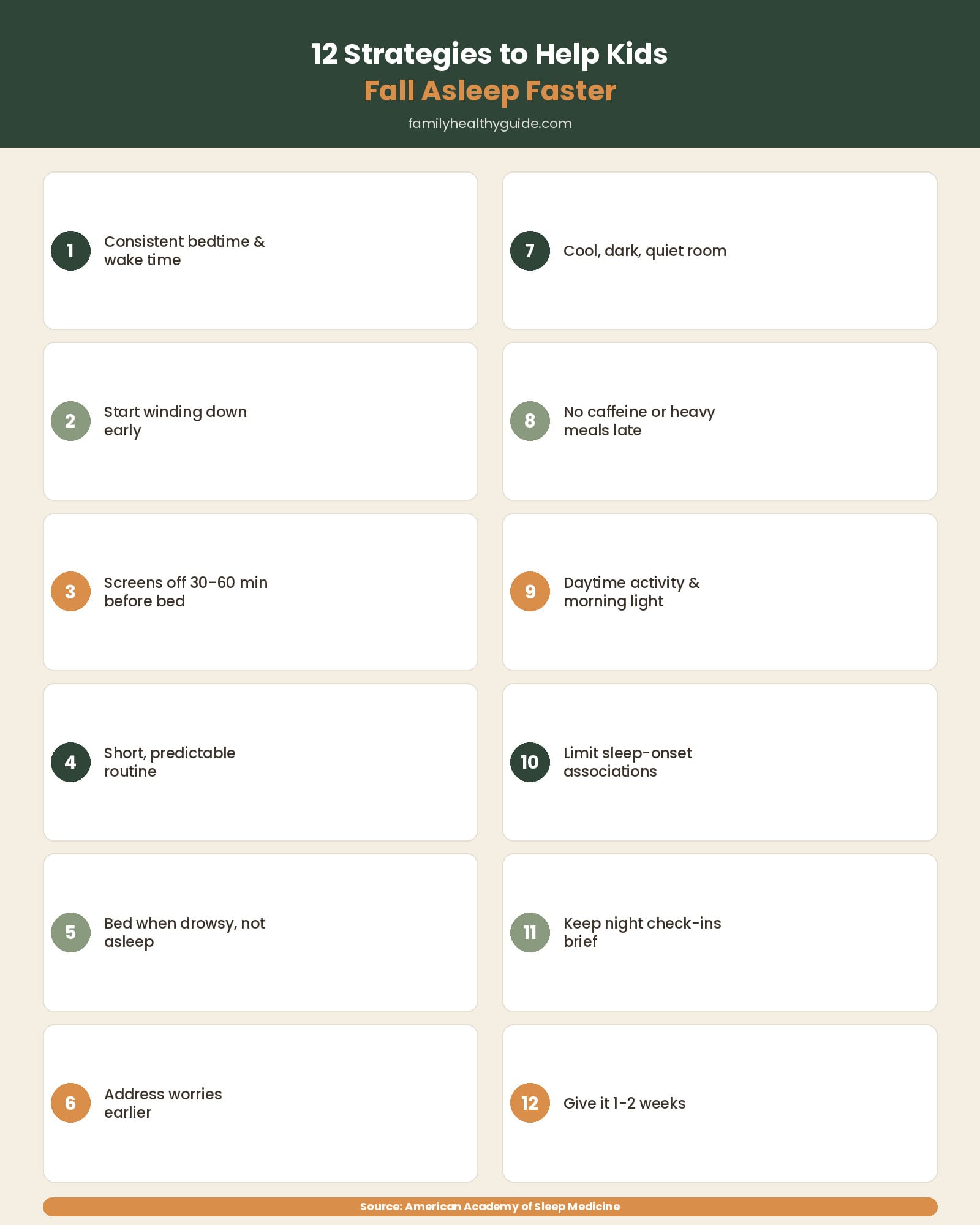
1. Keep bedtime and wake time consistent — every day. A steady schedule, including weekends, is the single highest-leverage habit for helping the body anticipate and prepare for sleep at a predictable time. This is one of the core pillars covered in our Sleep Hygiene for Kids guide.
2. Start winding down before your child needs to be asleep. Sleep preparation begins 30–90 minutes before lights-out, not at bedtime itself. Starting the routine “on time” is often already too late for the body to catch up.
3. Dim lights and turn off screens at least 30–60 minutes before bed. Research suggests that evening exposure to bright and blue-enriched light can suppress melatonin production and delay the body’s natural sleep timing, making it harder for children to fall asleep — an effect that isn’t fully offset by choosing calmer screen content.
4. Keep the bedtime routine short and predictable. A 20–40 minute sequence (bath, book, lights out) — done the same way nightly — cues the brain that sleep is coming next.
5. Put your child to bed drowsy but still awake. The American Academy of Pediatrics notes that children who fall fully asleep before being placed in bed often struggle more to fall back asleep independently if they wake during the night, since the conditions that helped them fall asleep initially aren’t present later.
6. Address worries earlier in the evening, not at lights-out. A brief “worry time” well before the bedtime routine begins can reduce the tendency for anxious thoughts to surface right when a child is trying to fall asleep.
7. Keep the bedroom cool, dark, and quiet. A room around 65–70°F (18–21°C) supports the natural body temperature drop that accompanies falling asleep; consistent low-level sound (like white noise) can mask disruptive noise more effectively than silence.
8. Avoid caffeine and heavy meals close to bedtime. Caffeine’s effects can last longer in children than many parents expect; a heavy meal too close to bedtime can also make settling down harder.
9. Build in daytime physical activity and morning light. Both support a stronger circadian signal, making the body’s evening sleepiness more pronounced and predictable.
10. Avoid rocking, feeding, or lying down with a child until full sleep as the only path to sleep. These can become sleep associations a child comes to depend on — useful occasionally, but worth balancing with opportunities to fall asleep independently.
11. Keep any nighttime interaction brief and low-key. If your child calls out while falling asleep, a calm, short response reinforces that nighttime is for sleep, not conversation or negotiation.
12. Give any new strategy one to two weeks before judging it. Most behavioral sleep changes show meaningful improvement within this window — switching approaches too quickly rarely gives any single method a fair chance to work.
Bedtime Fading: For Persistent Bedtime Resistance
For children who consistently resist sleep even with a good routine, bedtime fading is a gentle, well-studied technique. Rather than fighting to enforce an early bedtime a child’s body isn’t ready for, it works with the child’s natural sleep pressure:
- Temporarily set bedtime later — close to when your child is actually falling asleep now, so sleep pressure is high and falling asleep is easy.
- Keep the same wind-down routine, just later in the evening.
- Once your child is reliably falling asleep quickly at this later time (typically after several nights), move bedtime earlier by about 15 minutes and hold there until sleep is quick and easy again.
- Repeat the 15-minute shifts every few nights until you reach your target bedtime.
This approach trades a few nights of a later bedtime for a much lower-stress path to an earlier one. A comprehensive American Academy of Sleep Medicine review of behavioral treatments found this approach, along with related graduated techniques, to be among the most effective options studied for bedtime problems in young children.
What to Avoid
Introducing several new strategies at once. Changing everything simultaneously makes it hard to know what’s actually helping — and can be overwhelming for a child used to a different routine.
Treating a calm screen as a safe wind-down tool. The light itself works against melatonin release, independent of how calming the content is.
Punishing or escalating during bedtime resistance. Frustration tends to increase a child’s stress response, which works directly against sleep onset.
Expecting overnight results. Behavioral sleep changes are effective but not instant — most improvement unfolds over one to two weeks of consistency.
When to Talk to a Doctor
Consult your child’s pediatrician if difficulty falling asleep persists for more than a few weeks despite consistent strategies, is paired with loud snoring or breathing pauses, or seems connected to significant anxiety that doesn’t improve with reassurance and routine.
Frequently Asked Questions
How long should it take a child to fall asleep?
Many healthy children fall asleep within about 15 to 30 minutes after lights out; regularly taking much longer can signal that bedtime timing, routine, or environment needs adjustment.
Is it bad to rock or feed my child to sleep?
Not inherently, but relying on it as the only way to fall asleep can make independent sleep, including resettling after normal night waking, harder to develop over time.
What is bedtime fading and does it really work?
It’s a gradual, evidence-supported technique that temporarily delays bedtime to match a child’s natural sleep readiness, then shifts it earlier in small steps. Clinical research supports its effectiveness for bedtime resistance in young children.
How quickly will these strategies work?
Many families see initial improvement within a few days, with more consistent results typically by one to two weeks of steady practice.
Should I try everything on this list at once?
No. Starting with one or two changes, such as a consistent bedtime and a screen-free wind-down, tends to work better than overhauling the whole routine simultaneously.
Key Takeaways
- Sleep onset depends on aligning both the circadian clock and natural sleep pressure — timing matters as much as routine.
- Small, consistent changes (bedtime, screens, room environment) often help more than one big overhaul.
- Bedtime fading is a gentle, evidence-supported option for children with persistent bedtime resistance.
- Give any new strategy one to two weeks before judging whether it’s working.
Continue building healthy sleep habits with our complete Ultimate Guide to Healthy Sleep for Kids, check your child’s sleep needs in How Much Sleep Do Kids Need by Age, or address night waking in our Why Kids Wake Up at Night guide.
References
- Morgenthaler TI, Owens J, Alessi C, et al. Practice Parameters for Behavioral Treatment of Bedtime Problems and Night Wakings in Infants and Young Children. Sleep. 2006;29(10):1277–1281. aasm.org
- Mindell JA, Kuhn B, Lewin DS, Meltzer LJ, Sadeh A; American Academy of Sleep Medicine. Behavioral Treatment of Bedtime Problems and Night Wakings in Infants and Young Children. Sleep. 2006;29(10):1263–1276. pubmed.ncbi.nlm.nih.gov
- American Academy of Pediatrics / HealthyChildren.org. Getting Your Baby to Sleep. healthychildren.org
- Paruthi S, Brooks LJ, D’Ambrosio C, et al. Recommended Amount of Sleep for Pediatric Populations: A Consensus Statement of the American Academy of Sleep Medicine. J Clin Sleep Med. 2016;12(6):785–786. aasm.org
- Centers for Disease Control and Prevention. About Sleep. cdc.gov
This article is for informational purposes only and does not replace personalized medical advice. Consult your child’s pediatrician for guidance specific to your child’s sleep concerns.