How Much Sleep Do Kids Need by Age? (Science-Based Guide)
Estimated reading time: 16–20 minutes
“Is my child getting enough sleep?” is one of the most common questions parents ask — and for good reason. Sleep needs change dramatically from birth through the teenage years, and what’s normal at one age can be a red flag at another.
This guide breaks down exactly how much sleep kids need at every stage, what those numbers actually look like in daily life, and the signs that tell you whether your child is getting enough.
This article is part of our complete Ultimate Guide to Healthy Sleep for Kids, which covers sleep hygiene, common sleep problems, and more.
Table of Contents
Quick Reference Chart · Newborns (0–3 Months) · Infants (4–12 Months) · Toddlers (1–2 Years) · Preschoolers (3–5 Years) · School-Age (6–12 Years) · Teens (13–18 Years) · Why These Are Ranges · When Kids Need More Sleep · Signs of Not Enough Sleep · FAQ
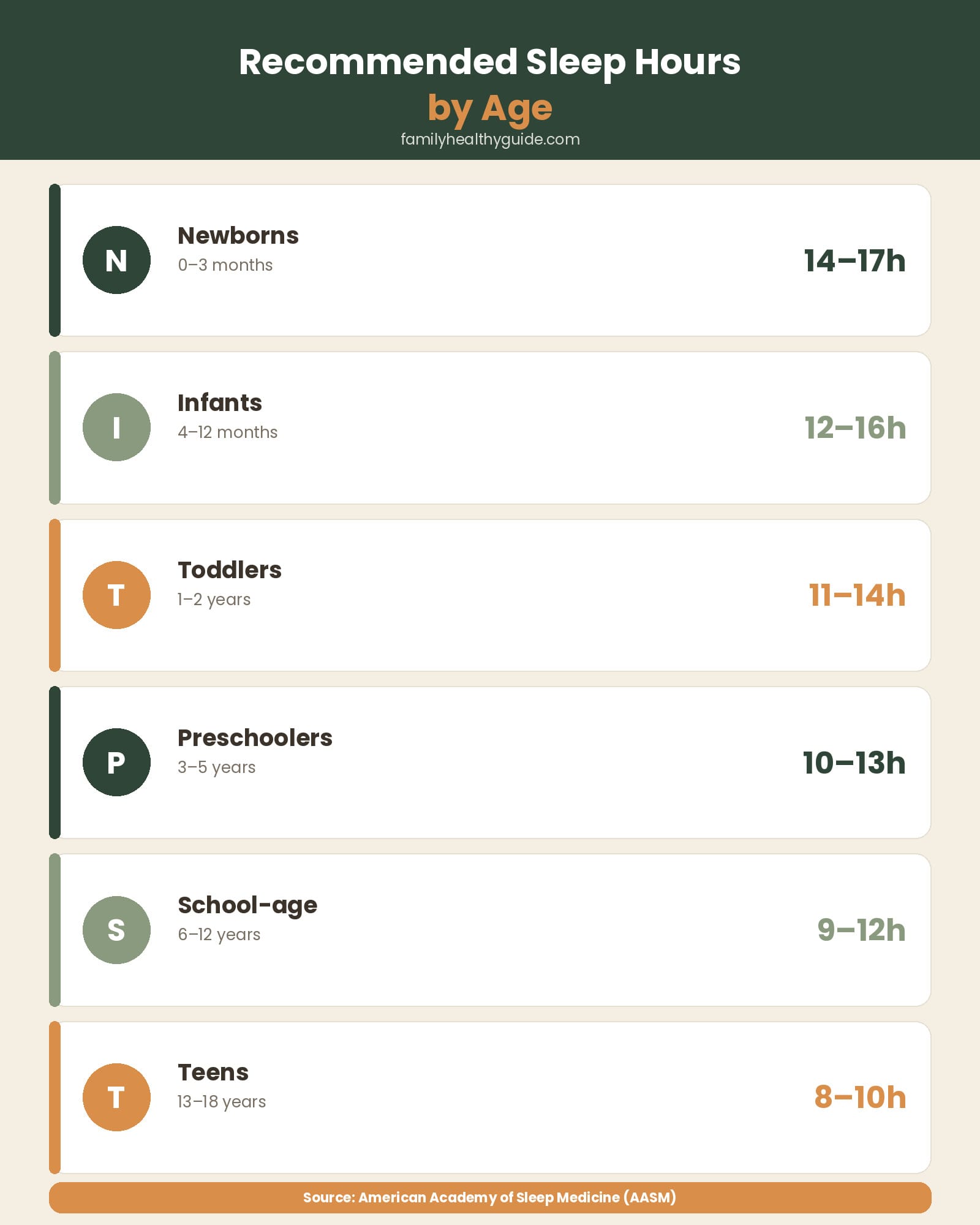
Quick Reference: Sleep Needs by Age
| Age Group | Recommended Total Sleep (24 hours) |
|---|---|
| Newborns (0–3 mo) | 14–17 hours |
| Infants (4–12 mo) | 12–16 hours |
| Toddlers (1–2 yr) | 11–14 hours |
| Preschoolers (3–5 yr) | 10–13 hours |
| School-age (6–12 yr) | 9–12 hours |
| Teens (13–18 yr) | 8–10 hours |
Source: American Academy of Sleep Medicine consensus statement (ages 4 months–18 years), endorsed by the American Academy of Pediatrics. Newborn figures follow National Sleep Foundation recommendations (Hirshkowitz et al., 2015). General guidelines — individual needs vary by up to an hour or more in either direction for a healthy child.
🔬 Science Says
These recommendations come from a 2016 AASM consensus panel that reviewed 864 published studies before setting official targets.
💡 Quick Parent Tip
Don’t panic if your child sleeps slightly above or below these ranges occasionally. Look at the overall pattern across several weeks rather than judging any single night.
Newborns (0–3 Months): 14–17 Hours
Newborns sleep more than any other age group, but rarely in one stretch. Their sleep is spread across the day and night in cycles of 2–4 hours, driven by hunger rather than a day/night rhythm — which hasn’t developed yet.
What this looks like in practice: frequent waking for feeds, no predictable nap schedule, and day/night confusion that usually starts resolving around 6–8 weeks as sleep-wake patterns become more established.
What’s normal: waking every 2–3 hours, sleeping in short bursts, seeming to have no schedule at all. This is not a problem to fix — it’s biology.
Infants (4–12 Months): 12–16 Hours
This is often when sleep starts consolidating into more predictable patterns. Circadian rhythm develops significantly during this window, and many babies begin sleeping longer nighttime stretches.
Nap pattern shift: most infants move from 3 naps down to 2 naps somewhere between 6–9 months.
Sleep regressions: many parents notice temporary disruptions around 4 months, 8–10 months, and 12 months, usually tied to developmental leaps (rolling, crawling, standing) rather than a lasting problem.
🔬 Science Says
The 4-month sleep regression has a real physiological basis: around this age, infant sleep architecture matures to resemble adult sleep cycles more closely, with more defined light-sleep stages — which can temporarily increase night waking even though it reflects healthy development.
Toddlers (1–2 Years): 11–14 Hours
Toddler sleep needs decrease gradually, and this is the age where nap transitions and bedtime resistance often begin — usually tied to a toddler’s growing independence, not a sleep problem.
Nap pattern: most toddlers are down to 1 nap by 15–18 months, typically 1–3 hours in the early afternoon.
Common challenge: separation anxiety peaks around 12–18 months and can cause new nighttime waking or bedtime protest in a toddler who previously slept well.
Preschoolers (3–5 Years): 10–13 Hours
This is the age range with the widest individual variation in nap needs. Some preschoolers still need a daily nap through kindergarten; others drop naps entirely by age 3.
How to tell if your preschooler still needs a nap: if skipping a nap leads to a meltdown-prone late afternoon or an earlier-than-usual bedtime that still doesn’t fully resolve tiredness, they likely still need one. If a nap consistently pushes bedtime later without any tiredness signs beforehand, they may be ready to drop it.
Nightmares and night terrors both peak in this age range — nightmares (remembered, occur during REM sleep, later in the night) and night terrors (not remembered, occur during deep sleep, earlier in the night) are both developmentally normal here and typically fade by early school age.
School-Age Children (6–12 Years): 9–12 Hours
Sleep needs decrease further, but this age range often sees new pressures on sleep: homework, extracurricular activities, and — increasingly — earlier access to screens and devices.
The consistency window: school-age children benefit enormously from a consistent sleep/wake schedule, since irregular sleep at this age has been linked to more attention and behavior difficulties at school than the same total sleep hours delivered consistently.
Growth spurts and sleep: many parents notice their school-age child sleeping unusually long during growth spurts — this is normal, as growth hormone release is tied to deep sleep.
Teens (13–18 Years): 8–10 Hours
Teen sleep needs remain high — comparable to school-age children — even as most teens get significantly less than they need. This isn’t a motivation problem; it’s biology.
The circadian shift: during puberty, the body’s internal clock shifts later by up to about two hours, delaying natural melatonin release into the later evening for many teens — which collides directly with early high school start times.
For a full breakdown of teen-specific sleep science, screen habits, and troubleshooting, see our dedicated guide: Teen Sleep.
Why Sleep Recommendations Are Ranges, Not Exact Numbers
Every range in the chart above spans 2–4 hours for a reason: no single number fits every child. A few factors explain why:
Genetics. Some children are naturally “short sleepers” or “long sleepers” from infancy, independent of habits or environment — the same way adults vary in their natural sleep needs.
Activity level. Highly active children often need slightly more sleep to recover, while more sedentary children may need somewhat less — though this effect is modest compared to age-driven differences.
Illness and growth spurts. Both temporarily increase sleep needs, sometimes noticeably, as the body redirects energy toward immune response or physical growth.
Overall pattern matters more than any single night. A child who sleeps 30–60 minutes outside the typical range but wakes easily, stays alert, and grows normally is very likely getting the sleep they need — the guideline is a reference point, not a strict target.
When Kids May Need More Sleep Than Usual
| Situation | May Need More Sleep? |
|---|---|
| During illness | ✅ Yes |
| Growth spurts | ✅ Yes |
| Very active or athletic children | Sometimes |
| Recovering from chronic sleep deprivation | ✅ Yes (“catch-up” sleep, though it doesn’t fully erase a sleep debt) |
| Started a new schedule (school, daycare) | Often, temporarily |
Signs Your Child Might Not Be Getting Enough Sleep
Total hours matter, but behavior is often the clearest signal. Watch for:
- Difficulty waking up, or needing to be woken multiple times
- Irritability, meltdowns, or a noticeably short fuse
- Hyperactivity (paradoxically common in overtired young children)
- Falling asleep during car rides or quiet daytime activities
- Trouble concentrating or increased clumsiness
- Increased cravings for sugary or high-carb foods
🔬 Science Says
In young children, overtiredness often produces hyperactivity rather than sleepiness — which can look like a behavior problem when it’s actually a sleep problem, which is why pediatric sleep specialists often ask about sleep before addressing attention or mood concerns.
We cover this topic in full depth, including a symptom-by-symptom breakdown, in our guide Signs Your Child Isn’t Getting Enough Sleep.
Frequently Asked Questions
Is it bad if my child sleeps an hour less than the guideline every night?
Not necessarily. These ranges represent averages with real individual variation. What matters more is whether your child wakes easily, stays alert through the day, and isn’t showing signs of sleep deprivation.
Do sleep needs decrease gradually or in jumps?
Gradually — there’s no single age where a child suddenly needs dramatically less sleep. The ranges above overlap intentionally to reflect this.
My child sleeps more than the range on this chart — should I be concerned?
Usually not, as long as your child is otherwise healthy, growing normally, and easy to wake. Some children simply need more sleep than average. Consult a pediatrician if excessive sleepiness is new or paired with other symptoms.
Does quality matter as much as quantity?
Yes. A child who sleeps the “right” number of hours but wakes frequently, snores loudly, or sleeps restlessly may still show signs of sleep deprivation. Quality and consistency both matter alongside total hours.
When should I talk to a doctor about my child’s sleep?
If sleep problems persist for more than a few weeks despite consistent routines, or if you notice loud snoring, breathing pauses, or extreme daytime sleepiness, it’s worth a conversation with your pediatrician.
Key Takeaways
- Sleep needs decrease gradually from 14–17 hours at birth to 8–10 hours by the teen years.
- Naps phase out gradually and individually — there’s no single “correct” age to drop them.
- Behavior — not just the clock — is often the clearest sign of whether a child is getting enough sleep.
- Consistency in sleep/wake timing matters as much as total hours, especially for school-age kids and teens.
- These numbers are ranges, not strict targets — genetics, activity, illness, and growth spurts all shift individual needs.
Knowing how many hours your child needs is only the first step. Equally important are healthy bedtime routines, a sleep-friendly environment, and recognizing common sleep problems early. Continue with our Ultimate Guide to Healthy Sleep for Kids to learn how to put these recommendations into practice — or explore the neuroscience behind what actually works in The Best Bedtime Routine for Children.
References
- Paruthi S, Brooks LJ, D’Ambrosio C, et al. Recommended Amount of Sleep for Pediatric Populations: A Consensus Statement of the American Academy of Sleep Medicine. J Clin Sleep Med. 2016;12(6):785–786. aasm.org
- Hirshkowitz M, Whiton K, Albert SM, et al. National Sleep Foundation’s updated sleep duration recommendations: final report. Sleep Health. 2015;1(4):233–243. doi.org
- American Academy of Pediatrics. Healthy Sleep Habits: How Many Hours Does Your Child Need? healthychildren.org
- Centers for Disease Control and Prevention. FastStats: Sleep in Children. cdc.gov
This article is for informational purposes only and does not replace personalized medical advice.