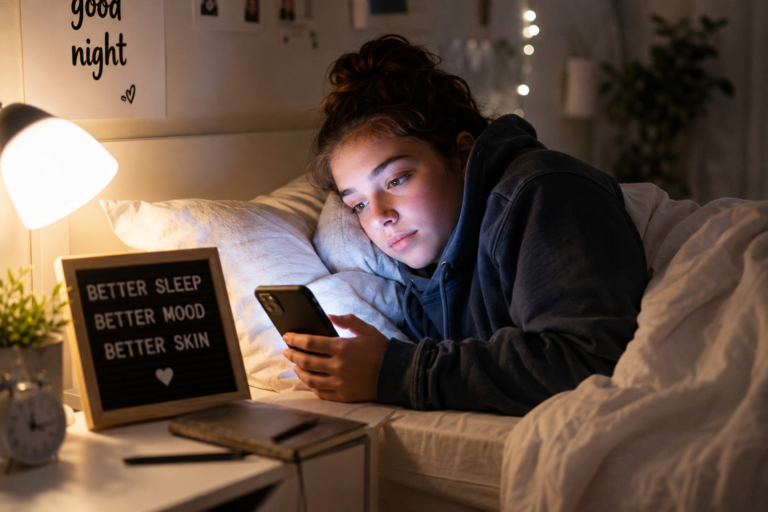
Screen Time Before School Starts: A Parent’s Guide to Resetting Routines
Quick Answer
This is a transition plan from summer screen habits to school-night routines, not a set of screen-time limits. Start seven to ten days before term, and adjust when screens happen before you argue about how much. Set a fixed evening cut-off, move devices out of the bedroom overnight, and put screens after the morning sequence rather than before it. The reset tends to go better when it is framed as a schedule change rather than a punishment.
By mid-August, most family screen rules have quietly stopped existing. Summer does that. Bedtimes drifted, mornings became optional, and the tablet filled the long empty afternoons that no one had planned for. Then the school calendar arrives and the whole arrangement has to be undone in a matter of days.
Most parents approach this as a quantity problem — cut the hours, take the device away, announce a new rule at dinner. It rarely holds, and it is also not quite the right frame. For school-night sleep, when screens are used matters alongside how much they displace sleep, routines, and other activities. An hour of video at four in the afternoon and an hour at nine at night are not equivalent, even though a tracking app counts them the same way.
This guide is a transition plan rather than a rulebook: how to move a household from summer screen habits to school-night routines in the last two weeks before term, in what order, and what to look for while it settles. It is part of our wider back-to-school guide for parents, which sequences the whole transition by timing rather than topic.
Why the evening hours matter more than the total
Two separate things happen when a child uses a screen late in the evening, and it helps to keep them apart.
The first is displacement. Time spent on a device in the hour before bed is time not spent winding down, and it tends to push the whole bedtime sequence later. This is the less discussed mechanism, but for school-age children it is usually the larger one. A child who starts a new episode at 8:45 is not asleep at 9:00, regardless of what the screen is emitting.
The second is engagement. Evening light exposure is part of this, but it is not the whole of it — autoplay, notifications, and content designed to hold attention can all keep a child involved past the point where they would otherwise have wound down. The American Academy of Pediatrics recommends screen-free times and places, including keeping devices out of bedrooms and away from the period immediately before bed. We cover the light mechanism specifically in how screen time affects kids’ sleep.
For the two weeks before school, that suggests a practical starting point: changing the evening cut-off is usually a smaller negotiation than changing the daily allowance, and it targets the part of the day that sits closest to sleep.
Key Facts
- The AAP advises keeping screens out of bedrooms overnight and avoiding screen use in the period right before bed.
- American Academy of Sleep Medicine consensus guidance puts sleep needs at roughly 10–13 hours for ages 3–5, 9–12 hours for ages 6–12, and 8–10 hours for teenagers.
- Evening screen use can affect sleep through two routes — displacing wind-down time, and keeping a child engaged past the point of winding down. Displacement is usually the easier of the two for a family to act on.
- The AAP frames screen use through a Family Media Plan rather than fixed hour limits for school-age children, because context and timing matter more than a single number.
The reset, in three steps
Do these in order. Each one is easier if the previous one is already in place, and attempting all three on the same evening is the most common reason a reset collapses by day three.
Step 1 — Set one fixed evening cut-off
Choose a single time when all recreational screens stop, and make it the same on every day of the reset. Roughly an hour before the intended bedtime works for most families.
The important detail is that the cut-off is attached to the clock, not to the content. “After this episode” is not a cut-off — it hands the decision to whatever is playing. A fixed time removes the nightly negotiation, which is the part that exhausts everyone.
If bedtime itself has drifted far from where it needs to be, move the cut-off in the same gradual increments you use for the bedtime shift — our guide to fixing your child’s sleep schedule before school covers the pacing.
Step 2 — Move devices out of the bedroom overnight
A device that sleeps in the bedroom undoes a cut-off silently. This is less about trust than about proximity: a phone within arm’s reach at 11pm is a decision a tired child has to make repeatedly, and most adults would not pass that test either.
Establish a single charging point outside bedrooms — a kitchen counter or hallway shelf — and put every household device there, including the adults’. A rule that applies to everyone provokes far less resistance than one aimed at a single child.
If the phone is currently the alarm clock, replace it before you introduce the rule, not after. A basic clock removes the last legitimate objection.
Step 3 — Protect the school-morning sequence
Mornings are the part most families forget, and the part that shows up first once term starts. This one is a scheduling strategy rather than a health rule: a device picked up on waking tends to absorb whatever time was allocated to getting ready, and the morning then runs late for reasons that look unrelated to screens.
The rule that works is a sequence rather than a prohibition: dressed, breakfast eaten, bag by the door — then a screen, if there is time left. Framing it as an order of operations rather than a ban means it survives contact with a rushed Tuesday. Our guide to building a school morning routine covers how to structure the rest of the sequence.
What this looks like by age
The three steps are the same at every age. What changes is how much of the enforcement sits with the parent and how much is negotiated.
Ages 4–7
Almost entirely parent-controlled, and easier for it. Attach the cut-off to a visible event rather than a number on a clock — after the bath, or when the kitchen light goes off. Children this age tend to track routines more reliably than clock times. Some protest in the first few evenings is normal, and it often eases as the new sequence becomes familiar.
Ages 8–12
This is the age where the reasoning starts to matter. A child who understands that the rule exists because of school mornings will cooperate considerably more than one who experiences it as an arbitrary reversal of summer. Say the reason once, clearly, and then stop repeating it.
Devices at this age are increasingly social, so a cut-off can mean leaving a group conversation mid-sentence. Letting your child send a “going offline now” message before the cut-off costs nothing and removes a genuine source of resistance.
Teenagers
Adolescent body clocks shift later for biological reasons, which means a teenager who cannot fall asleep at 10pm is often not being difficult. Imposing an early cut-off on a body clock that is genuinely running late produces conflict without producing sleep.
The more workable approach is to negotiate the cut-off jointly, keep the overnight charging rule non-negotiable, and pay attention to morning light exposure, which the AAP notes can help with regulating the body clock. The wider picture is in our guide to teen sleep.
What to watch for in the first week
A reset commonly feels harder before it feels easier, and knowing that in advance stops families abandoning it after a difficult evening. The pattern below is what parents often describe rather than a fixed timeline — your household may move faster or slower.
- Early on: More negotiation, more requests, and possibly a longer time to fall asleep. The evening can feel harder rather than calmer.
- As it settles: Resistance tends to drop as the sequence becomes predictable, even if wake times are still adjusting.
- Once established: The routine starts to hold with less active enforcement — which is the point of doing it before term rather than during it.
If sleep is still visibly disrupted after two weeks of consistency, the issue is probably not the screens. Signs your child isn’t getting enough sleep covers what else to look at, including the daytime symptoms that are easy to misread as behaviour.
Common mistakes
Announcing the change the night before school starts. The reset needs seven to ten days to hold. Starting it on the last Sunday of summer means the first week of term is spent enforcing a brand new rule on an already stressful schedule.
Framing it as a consequence. A reset that arrives as a punishment invites a fight about fairness rather than a change in routine. It is a schedule adjustment for school, in the same category as moving bedtime — and saying so plainly works better than any incentive scheme.
Cutting total hours instead of moving them. Halving the daily allowance is a much harder sell than moving the same amount of time earlier in the day, and it delivers less for school readiness. Move first; reduce later if you still want to. Our guide to reducing screen time without the battles covers reduction as a separate project.
Exempting adults. Children notice, and the rule loses its status as a household norm the moment it becomes a child-only restriction.
Abandoning it after one bad night. The second night is frequently the worst. A reset judged on night two will almost always be judged a failure.
Where this fits with everything else
The screen reset is one component of a larger transition, and it works considerably better when the sleep schedule is being adjusted alongside it. If you are starting from scratch two weeks out, the sequence that works is: sleep schedule first, screens second, mornings third.
Underlying habits — bedroom setup, consistency of timing, wind-down routine — are covered in sleep hygiene for kids, and the age-by-age sleep requirements themselves in how much sleep do kids need by age.
Frequently asked questions
How far in advance should we start the screen reset?
Seven to ten days before the first day of school is enough for most families. If the summer schedule has drifted by more than two hours, start closer to two weeks out and move the cut-off gradually rather than all at once.
Does homework on a laptop count as screen time?
For the purposes of the evening cut-off, treat schoolwork separately from recreational use. The concern is engaging, alerting content in the wind-down period — not a document being edited. That said, homework that runs right up to bedtime creates the same displacement problem, so it is worth finishing schoolwork before the cut-off where the schedule allows.
Do blue light filters and night mode solve the problem?
They address only part of it. Reducing the light output does nothing about the engagement of the content or the time it displaces, and for school-age children those are usually the bigger factors. A filter is a reasonable addition to a cut-off, but not a substitute for one.
My teenager needs their phone as an alarm — what do we do?
Buy a basic alarm clock before you introduce the overnight charging rule. It is a small cost and it removes the only genuine objection to keeping the phone out of the bedroom.
What if my child’s sleep doesn’t improve at all?
Give the reset a full two weeks of consistency before concluding it hasn’t worked. If sleep is still disrupted after that — or if there is loud snoring, long delays falling asleep, or persistent daytime exhaustion — speak to your child’s pediatrician. Screens are a common contributor, not the only one.
Sources
- American Academy of Pediatrics — guidance on children’s media use and the Family Media Plan framework.
- American Academy of Sleep Medicine — consensus recommendations on sleep duration for children and adolescents.
- Centers for Disease Control and Prevention — sleep and school-age children.
This article is educational content based on established health recommendations and peer-reviewed research. It does not replace individual medical advice. Persistent sleep difficulties, loud snoring, or pauses in breathing during sleep should be assessed by your child’s pediatrician.