Vegetables for Picky Eaters: Where to Start
You put a vegetable on the table, hoping this time might be different. Your child takes one look and refuses it — or accepts it one day and turns it down the next. It can be hard to know what to do next.
You do not need to turn that moment into a battle. There are simple, low-pressure ways to make the next opportunity feel more manageable.
Quick answer
Some vegetables may be harder for some children to accept. You can start with a few practical vegetable options, try different preparations, and keep the pressure low. The goal is not to make your child eat a particular vegetable, but to create a calm opportunity to encounter it and notice how your child responds.
Why some vegetables can be harder
Some research has looked at whether differences in how children perceive bitter tastes may be related to how they respond to certain vegetables.
Keller and Adise (2016) described a hypothesis that children who perceive PROP — a bitter-tasting compound researchers use to classify taste sensitivity — as bitter may like and eat fewer bitter foods, including some cruciferous vegetables. This is a proposed explanation, not a general explanation for picky eating.
One study by Bell and Tepper (2006) looked at 65 preschool children, classified as PROP tasters or nontasters. The children freely chose among five vegetables: black olives, cucumber, carrot, red bell pepper, and raw broccoli. In that brief free-choice test, nontasters ate more vegetables than tasters, with differences particularly apparent for the three more bitter items — olives, cucumber, and raw broccoli. Nontasters also gave raw broccoli higher liking ratings. These findings show an association in this study; they do not establish that PROP tasting causes children to eat fewer vegetables.
Other research points to the possibility that repeated experience with a specific vegetable can also matter. Mohd Nor and colleagues (2021) studied 172 preschool children aged 3–5 and found that repeated exposure to steamed, mashed turnip was associated with increased acceptance of that specific Brassica vegetable.
Together, these studies suggest that children’s responses to vegetables may be shaped by more than one factor. And none of it can tell you how your own child will respond to a particular vegetable.
Starting-Point Vegetables to Try
This is a practical starting list, not a ranking of which vegetables are easiest or most likely to be accepted. Choose an option that fits what you already serve and how your child usually encounters food.
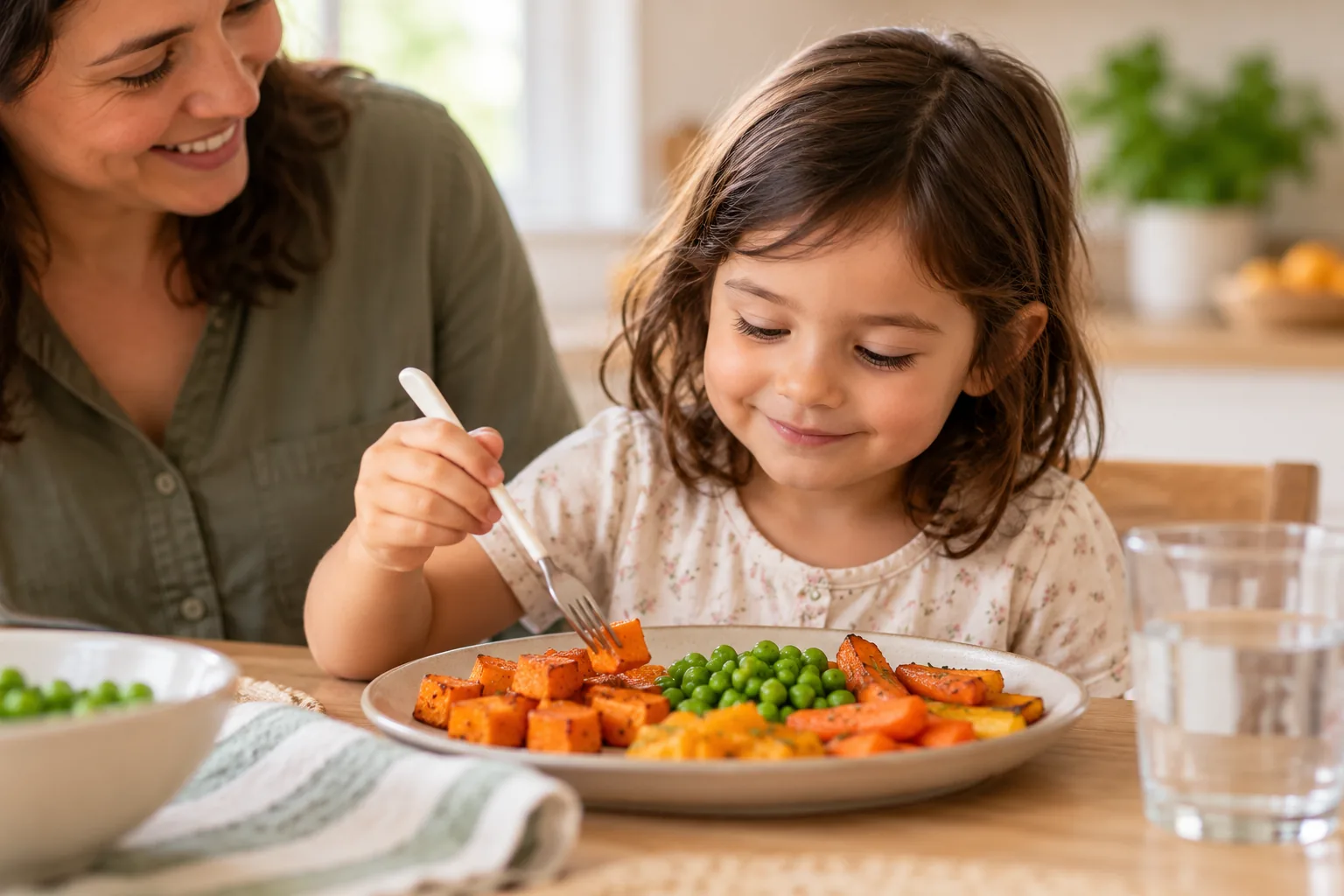
- Sweet potatoServe cooked and soft, such as roasted, baked, or mashed.
- PeasServe cooked and soft, on their own or alongside a familiar food.
- CornServe cooked, as loose kernels on their own or mixed into a familiar dish.
- Butternut squashServe cooked and soft, such as roasted, baked, or mashed.
- CarrotsServe roasted until soft.
The aim here is simply to give you a few practical vegetables to choose from. You do not need to start with a particular one.
Looking for more ideas? See our guide to Best High-Fiber Foods for Kids.
Change the preparation, not the pressure
In a 2023 study of 74 UK adults, Mohd Nor and colleagues found that the cooking method made a significant difference to how much people liked turnip, with liking higher when the preparation produced a sweeter taste profile. Brassica vegetables such as turnip get their bitterness mainly from compounds called glucosinolates.
The same vegetable can offer a different experience when it is prepared differently, so trying another preparation is one practical option before moving on.
You can change the preparation without turning it into a test your child has to pass. Try changing one practical detail — such as the texture, shape, or cooking method — while keeping the mealtime calm and pressure low.
Same vegetable, different presentations
Sweet potato
- Roasted
- Baked
- Mashed
Change one detail: texture · shape · cooking method
For more everyday food ideas, see our guide to Healthy Snacks for Kids: 25 Nutritious Snack Ideas.
One small action this week
Start here
- Pick one
- Change one thing
- Watch the response
Choose one vegetable from the starting list and offer it in one simple preparation.
Keep the moment low-pressure. You do not need to ask your child to taste it or finish it. Simply offer the food and notice how your child responds.
The goal is to create one calm opportunity to encounter the vegetable, without turning the moment into a test.
If your child still refuses
If your child refuses the vegetable, you do not need to turn the moment into a bigger struggle.
A refusal is simply a response to that particular opportunity. You can keep the mealtime calm and move on without pressure.
The aim is not to make every vegetable work. It is to give your child opportunities to encounter different foods without making eating them a condition of a peaceful meal.
When to ask for help
If your child persistently refuses entire categories of textures, or you are concerned about your child’s growth or nutrition, talk with your pediatrician or a feeding specialist.
You do not need to work out the reason on your own. A healthcare professional can help you understand what may be going on and whether further support would be useful.
Sources
- Keller KL, Adise S. Variation in the ability to taste bitter thiourea compounds: implications for food acceptance, dietary intake, and obesity risk in children. Annual Review of Nutrition. 2016;36:157–182. doi:10.1146/annurev-nutr-071715-050916
- Bell KI, Tepper BJ. Short-term vegetable intake by young children classified by 6-n-propylthiouracil bitter-taste phenotype. American Journal of Clinical Nutrition. 2006;84(1):245–251. doi:10.1093/ajcn/84.1.245
- Mohd Nor ND, Houston-Price C, Harvey K, Methven L. The effects of taste sensitivity and repeated taste exposure on children’s intake and liking of turnip (Brassica rapa subsp. rapa); a bitter Brassica vegetable. Appetite. 2021;157:104991. doi:10.1016/j.appet.2020.104991
- Mohd Nor ND, Mullick H, Zhou X, Oloyede O, Houston-Price C, Harvey K, Methven L. Consumer liking of turnip cooked by different methods: the influence of sensory profile and consumer bitter taste genotype. Foods. 2023;12(17):3188. doi:10.3390/foods12173188
FHG Science Note
Research on children’s responses to vegetables points to more than one possible influence, including differences in taste perception and experience with specific foods. But the studies discussed here looked at particular foods, age groups, and study conditions. They may help explain why vegetables may not be equally accepted, but they cannot predict how an individual child will respond.
This article is educational and is not a diagnosis or a substitute for individualized medical care.