Signs Your Child Isn’t Getting Enough Sleep (By Age)
Estimated reading time: 16–20 minutes
Not every sleep-deprived child looks tired. In fact, many parents are surprised to learn that an overtired child running on too little sleep often seems more energetic, not less — bouncing off the walls instead of dozing off. Recognizing the real signs of insufficient sleep, which look different at different ages, is often the first step toward fixing the problem.
This guide covers the daytime and nighttime signs of sleep deprivation in children by age, common causes of lack of sleep in kids, what’s happening behind the scenes, and when it’s time to talk to a pediatrician.
This article is part of our complete Ultimate Guide to Healthy Sleep for Kids. Check your child’s target sleep hours in How Much Sleep Do Kids Need by Age, build better habits with Sleep Hygiene for Kids, and if bedtime or night waking is the issue, see Why Kids Wake Up at Night and How to Help a Child Fall Asleep Faster.
Table of Contents
Quick Answer: Symptom → Likely Cause · Daytime Signs · Nighttime Signs · Signs by Age · Impact on Learning, Behavior & Immunity · When to See a Doctor · FAQ
Quick Answer: Symptom → Likely Cause
| What You Notice | Possible Cause |
|---|---|
| Hyperactive, “wired” evenings | Overtiredness — not excess energy |
| Hard to wake, groggy mornings | Insufficient total sleep hours |
| Falling asleep in the car or during quiet activities | Accumulated sleep debt |
| Frequent meltdowns or short temper | Emotional regulation strained by insufficient sleep |
| Trouble focusing, forgetfulness at school | Sleep-related impact on attention and memory consolidation |
| Sleeping much later on weekends | Body attempting to repay accumulated sleep debt |
💡 Quick Parent Tip
If you notice several of these signs for more than two weeks, first review your child’s total sleep hours and bedtime routine before assuming the behavior has another cause.
Daytime Signs of Sleep Deprivation
Difficulty waking up, or needing multiple wake-up attempts. A child who is genuinely well-rested typically wakes with relative ease at a consistent time.
Hyperactivity rather than sleepiness. This is one of the most counterintuitive and under-recognized signs of an overtired child. In many children, overtiredness is associated with increased alertness and hyperactive behavior, possibly due to activation of the body’s stress response — showing up as silliness, restlessness, or an inability to sit still rather than obvious fatigue.
Irritability, mood swings, or frequent meltdowns. Sleep plays a direct role in emotional regulation; even modest sleep loss can noticeably shorten a child’s fuse.
Trouble focusing or following instructions. Teachers may notice distractibility or difficulty retaining new information, even in children who are otherwise capable.
Falling asleep at unplanned times. Dozing off during car rides, screen time, or other quiet moments is a clear sign of accumulated sleep debt.
Some children may seem to crave quick sources of energy, such as sugary snacks, although eating patterns and appetite vary from child to child.
Sleeping significantly longer on weekends. A large gap between weekday and weekend wake times often reflects the body catching up on a sleep debt built up during the week.
🔬 Science Says
Research published in the American Academy of Pediatrics’ journal found that even a modest reduction in nightly sleep — as little as 39 minutes less per night in school-age children — was associated with measurably worse quality of life, including physical well-being and functioning at school, compared to nights with adequate sleep.
Nighttime Signs Worth Watching
Resisting bedtime despite clear tiredness. Paradoxically, an overtired child often fights sleep harder, not less.
Frequent night waking or difficulty resettling. While some night waking is normal at every age (see Why Kids Wake Up at Night), a marked increase can signal insufficient total sleep.
Loud, habitual snoring or restless sleep. This can indicate a physical cause — like sleep-disordered breathing — that’s reducing sleep quality even when total time in bed looks adequate.
Taking a long time to fall asleep despite an appropriate bedtime. This may point to a timing mismatch between bedtime and the child’s natural sleep readiness — see our guide on How to Help a Child Fall Asleep Faster for strategies.
Signs by Age
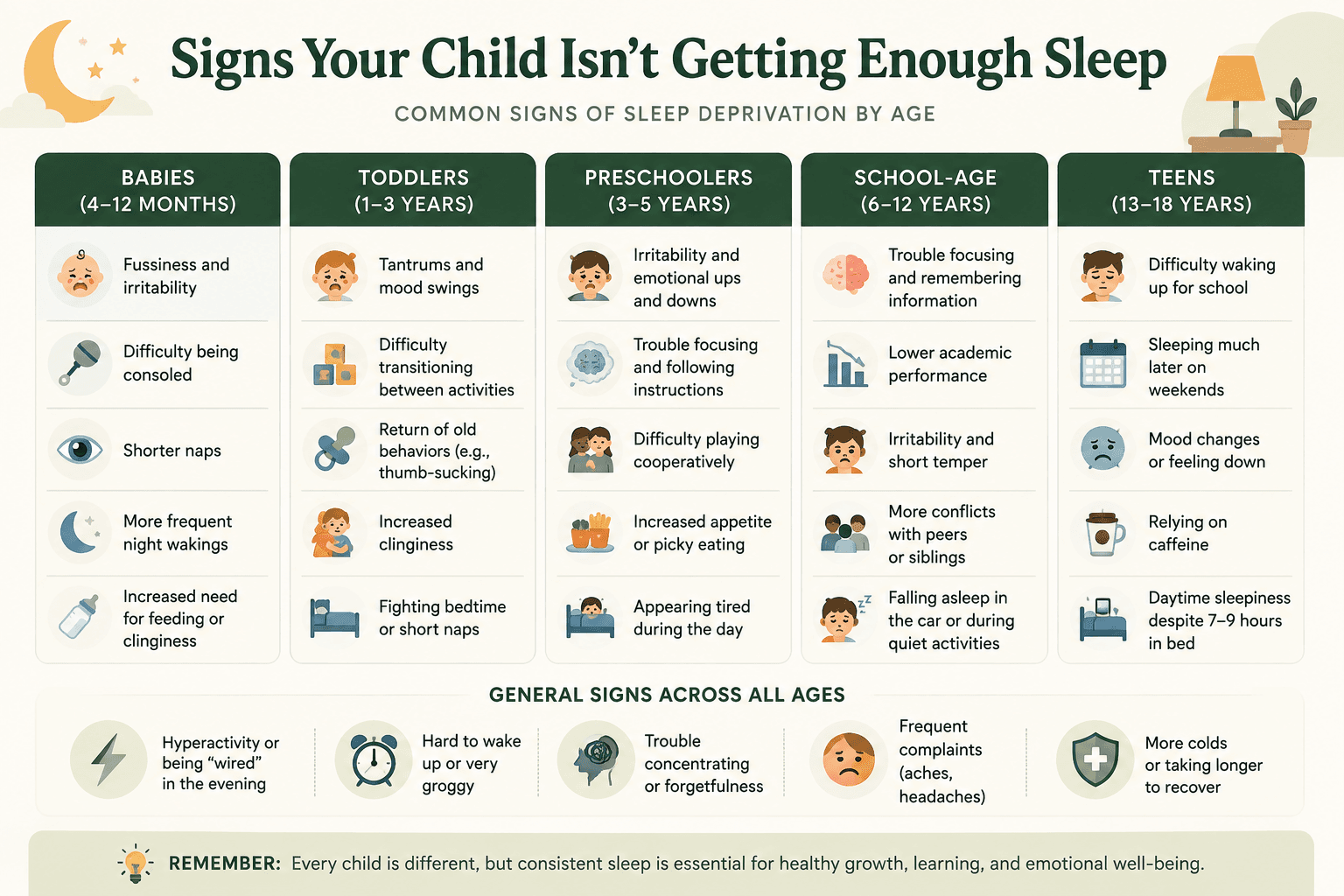
Babies and toddlers. Fussiness, difficulty being consoled, frequent crying, and clinginess are common signs, since younger children can’t yet describe how they feel.
Preschoolers. Increased tantrums, difficulty transitioning between activities, and a return to behaviors like thumb-sucking or increased clinginess can all signal insufficient sleep.
School-age children. Attention and behavior problems at school, declining academic performance, and increased conflict with peers are common — and are easy to mistake for unrelated behavioral issues.
Teens. Difficulty waking for school, sleeping dramatically later on weekends, and mood changes are frequent signs; see our dedicated Teen Sleep guide for more detail specific to this age group.
Common Reasons Kids Don’t Get Enough Sleep
If you’re noticing signs of sleep deprivation in children at home, a few common culprits are worth checking first:
- Bedtime that’s too late for their age
- Inconsistent sleep and wake schedules
- Evening screen use close to bedtime
- Anxiety or stress
- Sleep disorders such as obstructive sleep apnea
Our guides on Sleep Hygiene for Kids and Why Kids Wake Up at Night walk through each of these in detail.
Impact on Learning, Behavior, and Immunity
Learning and memory. Sleep plays a direct role in consolidating what a child learned during the day; insufficient sleep can measurably reduce attention, working memory, and problem-solving the following day.
Behavior and emotional regulation. Chronic insufficient sleep is linked to higher rates of attention and behavior problems, independent of any underlying diagnosis.
Immune function. Chronic insufficient sleep may reduce immune function, potentially making some children more susceptible to common infections.
When to See a Doctor
It’s worth discussing your child’s sleep with a pediatrician if you notice:
- Signs of sleep deprivation that persist despite consistent bedtime and wake times
- Loud, habitual snoring (three or more nights per week) or breathing pauses during sleep
- Significant, ongoing daytime sleepiness or difficulty functioning at school
- A sudden, unexplained change in sleep patterns or behavior
- Signs of sleep deprivation alongside physical symptoms like frequent headaches or illness
Frequently Asked Questions
Can a sleep-deprived child seem hyperactive instead of tired?
Yes. Overtiredness in many children produces hyperactivity or silliness rather than obvious sleepiness, which is one of the most commonly missed signs of insufficient sleep.
How much less sleep actually makes a difference?
Research has found that even a modest reduction of under an hour per night can measurably affect a child’s quality of life and daytime functioning.
Is sleeping in a lot on weekends a bad sign?
Sleeping notably longer on weekends often reflects the body catching up on sleep debt accumulated during the week, which is worth addressing with a more consistent weekday sleep schedule.
How can I tell if it’s sleep deprivation or a behavior issue?
Signs like irritability, hyperactivity, and trouble focusing overlap with other behavioral concerns, which is why it’s worth ruling out insufficient sleep first, since the fix is often simpler than it appears.
When should I take my child to a doctor about sleep deprivation?
If signs persist despite consistent routines, or are paired with loud snoring, breathing pauses, or significant daytime impairment, it’s worth a conversation with your child’s pediatrician.
Key Takeaways
- Sleep-deprived children often look hyperactive rather than tired — this is one of the most missed signs.
- Signs differ by age: fussiness and clinginess in younger children, attention and mood changes in school-age kids and teens.
- Even a modest reduction in nightly sleep can measurably affect mood, learning, and daily functioning.
- Persistent signs, loud snoring, or significant daytime impairment are reasons to consult a pediatrician.
Compare your child’s sleep against age-based guidelines in How Much Sleep Do Kids Need by Age, strengthen daily habits with Sleep Hygiene for Kids, or explore our complete Ultimate Guide to Healthy Sleep for Kids.
References
- Taylor RW, Haszard JJ, Jackson R, et al. Sleep Deprivation and Quality of Life in Healthy Children. Summarized in AAP Grand Rounds, American Academy of Pediatrics. publications.aap.org
- American Academy of Pediatrics. Diagnosis and Management of Childhood Obstructive Sleep Apnea Syndrome. Pediatrics. 2012. publications.aap.org
- Mindell JA, Meltzer LJ. Behavioural Sleep Disorders in Children and Adolescents. Ann Acad Med Singap. 2008;37(8):722–728. pubmed.ncbi.nlm.nih.gov
- Paruthi S, Brooks LJ, D’Ambrosio C, et al. Recommended Amount of Sleep for Pediatric Populations: A Consensus Statement of the American Academy of Sleep Medicine. J Clin Sleep Med. 2016;12(6):785–786. aasm.org
- Centers for Disease Control and Prevention. About Sleep. cdc.gov
This article is for informational purposes only and does not replace personalized medical advice. Consult your child’s pediatrician for guidance specific to your child’s sleep concerns.