How Much Sleep Do Kids Need by Age? (Science-Based Guide)
How much sleep do kids need? Science-based sleep hour guidelines for every age — newborns to teens — plus signs of too little sleep and practical tips.
Sleep shapes almost everything else about a child’s day — attention at school, emotional regulation, appetite, and growth. It is also one of the few areas of children’s health where consistent changes produce noticeable results within a week or two.
Start here. The Ultimate Guide to Healthy Sleep for Kids covers the full picture: sleep needs by age, routines, common disruptions, and when a pediatrician should be involved. Every other guide in this section connects back to it.
How much is enough? Requirements shift substantially between infancy and adolescence, and the gap between what children need and what they get tends to widen with age. How Much Sleep Do Kids Need by Age sets out the ranges. Deprivation rarely looks like obvious tiredness in younger children — Signs Your Child Isn’t Getting Enough Sleep covers what it looks like instead, including the hyperactivity many parents misread.
Building better nights. Better sleep usually comes from consistent habits rather than a single fix. Sleep Hygiene for Kids sets out the habits that show up repeatedly in the research, and The Best Bedtime Routine for Children explains why routines work and which parts matter most. When bedtime itself is the struggle, How to Help a Child Fall Asleep Faster offers specific strategies.
When sleep goes wrong. Night waking has different causes at different ages, which Why Kids Wake Up at Night breaks down. Nightmares vs. Night Terrors clarifies two frequently confused events that call for opposite responses.
The questions parents ask most. How Screen Time Affects Kids’ Sleep examines the blue light evidence, and Melatonin for Kids: Is It Safe? reviews what research does and doesn’t support before you consider a supplement. Daytime light matters more than most parents expect — Natural Light, Sleep, and Your Child’s Brain covers an overlooked factor with a surprisingly large effect.
Teenagers are a different case. Adolescent body clocks shift later for biological reasons — Teen Sleep explains why telling a teenager to go to bed earlier rarely works, and connects to our wider teen health guides.
Sleep and stress also run in both directions. If bedtime resistance coincides with a difficult period at school, How Stress Affects Your Child’s Brain may be the more useful starting point.
Educational content only. Persistent sleep difficulties, loud snoring, or pauses in breathing during sleep should be assessed by your child’s pediatrician.
How much sleep do kids need? Science-based sleep hour guidelines for every age — newborns to teens — plus signs of too little sleep and practical tips.

Healthy sleep is essential for children’s growth, learning, and emotional well-being. Science-based sleep guidelines by age, bedtime routines, and expert tips.
If you’ve ever wondered why your teenager can’t seem to fall asleep before midnight — even on school nights — the answer isn’t simply poor discipline. Many parents assume their teenager just isn’t trying hard enough to go to bed earlier. In reality, adolescence brings predictable biological changes that make falling asleep early much more…
Neuroscience reveals why bedtime routines work — and which elements actually matter for children’s sleep, brain development, and next-day performance.
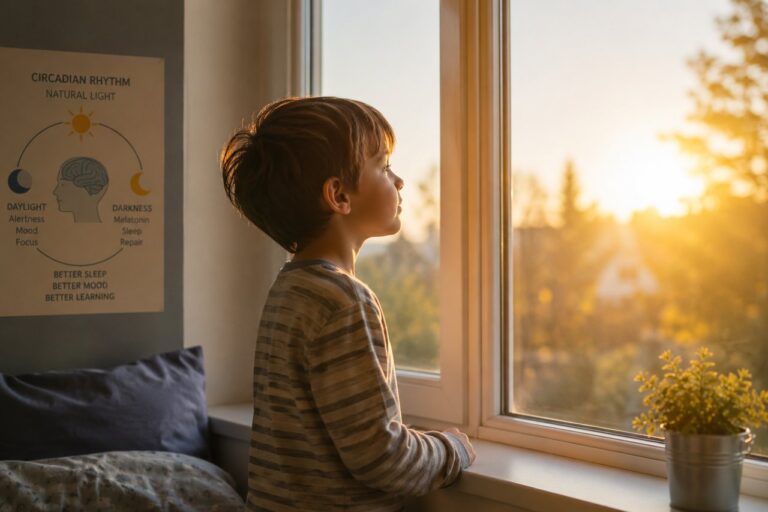
Modern chronobiology shows that light exposure — especially in the evening — is an important and often overlooked influence on children’s sleep and daily rhythm.